A Guide to Ensuring Good Indoor Air Quality

Homeowners Can Help Ensure Good Indoor Air Quality

Most people think of air pollution as an outdoor problem, but indoor air quality has a major impact on health and well-being since the average American spends about 90 percent of their time indoors. Some of the benefits of good indoor air quality include:

good-indoor-air-benefits-header

Proper ventilation is one of the most important considerations for maintaining good indoor air quality. Check out the infographic below for the top 10 tips for homeowners to improve ventilation and indoor air quality, or download the PDF version here.

iaq-blog-infographic

Making Home Performance Businesses Successful

Article summarized by Becky Hoelscher and original article written by Andrew Oser – Indoor Environment & Energy Efficiency

Are you prepared to generate business and revenue without being able to dangle rebates in front of your customer? Maybe you already are in a market without rebates and are having problems generating enough revenue to keep your business running. Regardless of your situation, it’s always a good time to supercharge your home performance business.

To boost your business, don’t rely on selling ROI (return on investment), instead, focus on “PAIN.” Homeowners will more readily spend money to eliminate their pain points, than to potentially save a few dollars on utility bills. This doesn’t mean customers won’t experience energy savings by implementing home performance work, only that you won’t have to “sell” people on “investing” in your work based on potential energy savings. Instead, you can show how home performance can make their home more comfortable, healthy and safe while saving money on utility bills.

How Can You Elevate Your Home Performance Business?

Focus on becoming a problem solver. You need to discover and reduce your customer’s PAIN. Finding out what causes your customer’s pain is simple, just ask what they don’t like about their home’s current comfort level. Are there unpleasant odors, mustiness, or drafts? Is their home too humid or dry? Does anyone living in the home have allergies? Are there any areas of the home that don’t maintain heat as easily the other areas? More often than not, the person you’re speaking with will have at least two of these issues.

Take Action:

Once the homeowner mentions their initial complication, ask them relevant follow-up questions so you can better diagnose the issue at hand. For example, if the homeowner says that their top floor is hard to cool in the summer, ask questions like, “is it the whole upper level, or just certain areas?” and “how long has this problem been going on?”

Tips on Closing a Home Performance Deal:

  1. If you are in contact with a homeowner that doesn’t want to admit that they are having HVAC-related issues, start with an icebreaker. Ask them something like, “If you could wave a magic wand and make one thing better in your home, what would it be?”
  2. Don’t waste money advertising home performance, market home performance through your technicians and internal staff. Teach your staff, empower them to become problem solvers, and reward them for scheduling tests.
  3. Lastly, test every employees home. Once your employees see the testing process for themselves, they can be advocates for your work, speaking honestly and with excitement about the benefits of home performance testing.

Understanding and Upselling Two-Stage Technologies to Homeowners

The Goodman 16-18 SEER systems featuring the Copeland Scroll two-stage compressor provide contractors with an ideal way to help homeowners get the comfort and efficiency they want at an accessible price.

In this podcast, check out an interview with Eric Strausbaugh of Emerson and Steve Miles of Jerry Kelly Heating and Air Conditioning to hear what Steve thinks about two-stage technology and how to talk about it with homeowners.

Hosts: Eric Strausbaugh and Lindsay Headings
Guest: Steve Miles, Jerry Kelly Heating & Air Conditioning

Timestamps:

  • 0:01 – Introduction
  • 1:21 – Benefits of modulation
  • 2:08 – Educating homeowners
  • 3:04 – Rebates
  • 4:05 – Wrap-Up

Gearing up for IE3 2017

The industry is getting ready for the upcoming cooling season, and this can be a very busy time of year for contractors.  In this episode of HVAC on Air, we’d like to take a moment and look at how attending shows like ACCA, can help the industry prepare and stay ahead of trends.  So as we gear up for IE3 ACCA 2017, take a moment and listen to all the great reasons for attending from the 2016 show and we hope to see you this year.

Hosts: Lindsay Headings, Pete Lee, Eric Strausbaugh

Guests:

  • Wade Mayfield – Thermal Services, Omaha, Nebraska
  • David Kyle – Trademasters Service Corp. (former ACCA Chairman), Lorton, Virginia
  • Ben Kelley – Cropp Metcalfe Services, Fairfax, Virginia
  • Andrew Oser – Cropp Metcalfe Services, Fairfax, Virginia

Timestamps:

  • 0:01 – Introduction
  • 2:00 – Benefits of being a member of ACCA
  • 9:32 – Wrap-Up

Is a Baseboard Heater Right for You?

Image credit: flickr.com

An electric baseboard heater is an electrical heating element inside a metal pipe. When the heater is turned on, an electric current flows through the heating element. This type of heater is really efficient to use for zonal heating (heating only occupied rooms in your home).

Using a Baseboard Heater

For unconditioned rooms or rooms that need supplemental heat, baseboard heaters are an ideal solution. Some homeowners use them for individual zone room heating. For example, a bedroom at night is conditioned by the baseboard heater and the rest of the house is put into a temperature setback to conserve on energy in unoccupied rooms. Baseboard heaters do not have a blower to circulate air so the heat generally stays in the same room as the baseboard heater. If you have a heater in a bedroom, do not expect the heater to also heat the hallway outside of the bedroom by simply keeping the bedroom door open.

To keep your baseboard heater working efficiently and circulating air properly, move thick carpet or rugs away from your baseboard heater. Ensure there are no obstructions that block the natural circulation of the heating air. Also, keep your heater free of dust and grime to guarantee it will work properly.
Source

Another thing homeowners must look out for is the location of the heater. The location of the unit often limits options of how a room can look. There are some recommended locations, such as under a window, but no matter where you place the heater there are some guidelines to follow. There must be at least 3/4 an inch above your floor and a few inches of clearance in front of the heater to allow the unit to properly function.

Deciding If It’s Right for You

Did you know?

  • In colder climates, heating your home costs more than any other system and typically takes up around 42% of your energy bill?
    Source: Energy.gov
  • Today’s heat pumps can reduce your electricity use for heating by approximately 50% compared to electric resistance heating such as furnaces and baseboard heaters.
    Source: Energy.gov
  • Baseboard heaters are relatively inexpensive and easy to install; however, they are one of the most inefficient ways to heat your home.

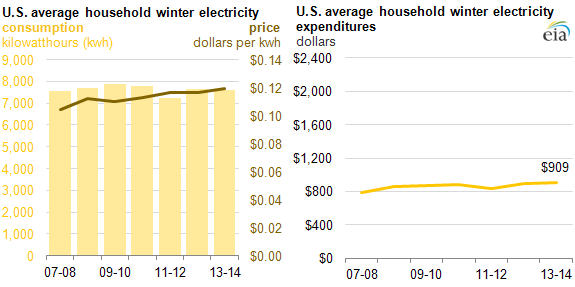
winter-electricitySource

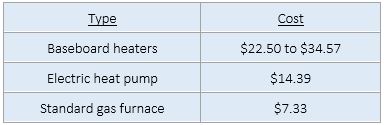
To generate 1,000,000 BTUs of heat (as of March 2013):

generate-heatSource
Additional Source

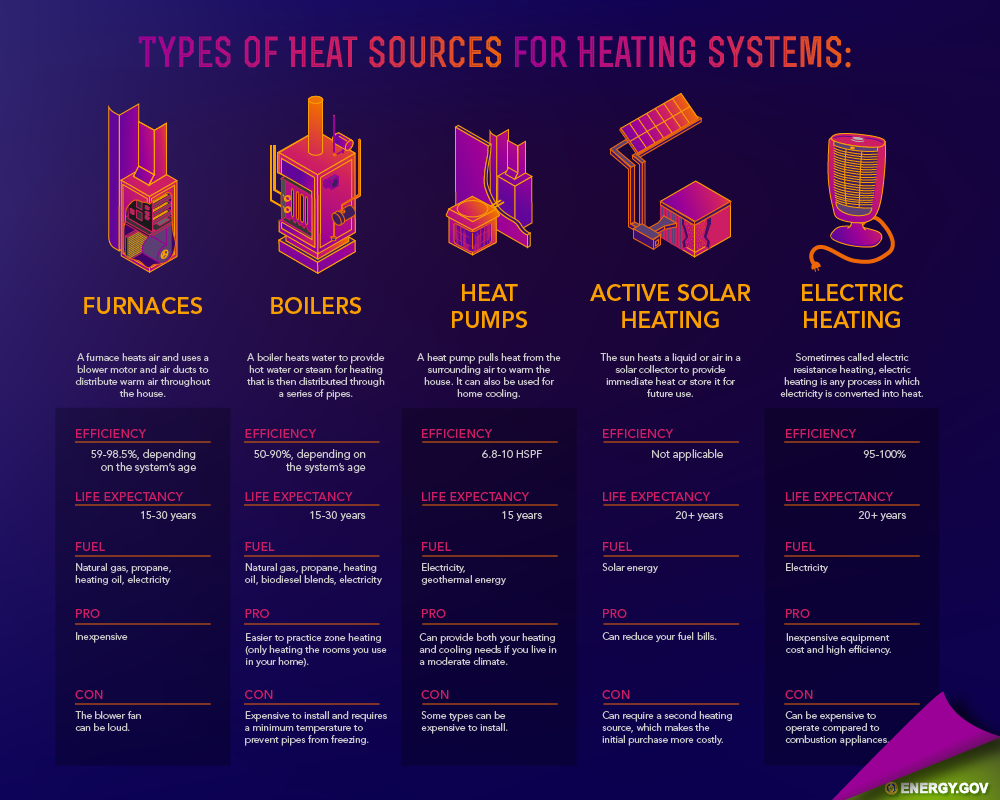
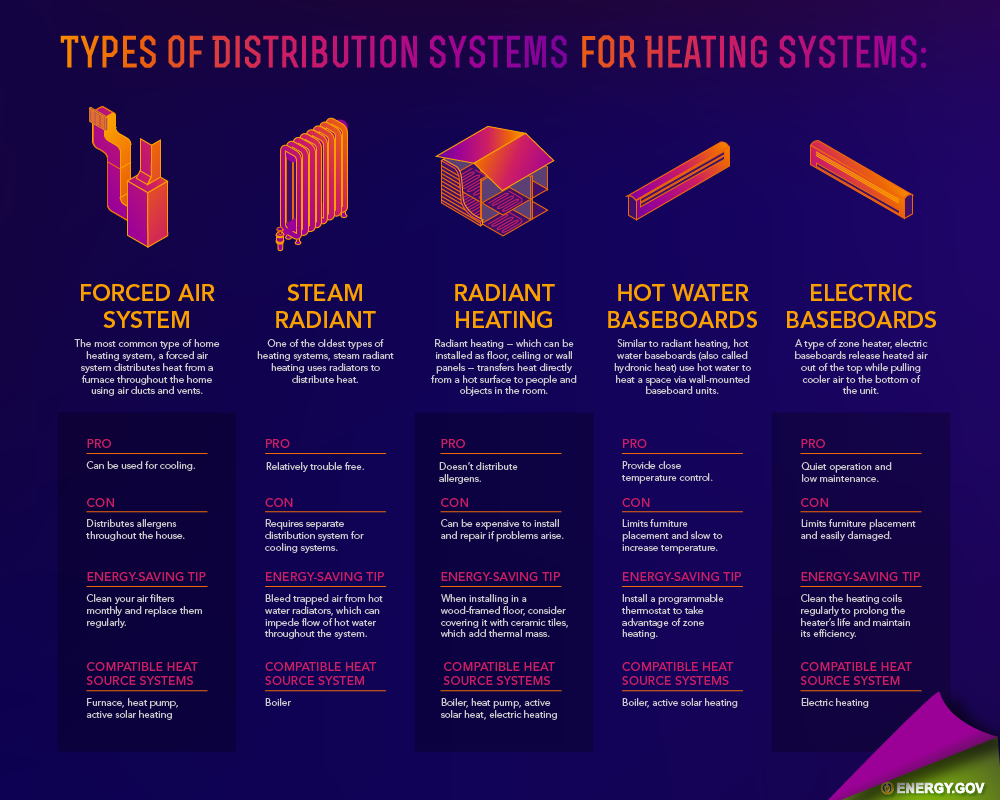
homeheating_heat-sourceshomeheating-heat-distributionInfographics Source

What Homeowners Need to Know: Residential Regional Standards Enforcement Rule in Progress

Residential Regional Standards Enforcement Rule in Progress

Reference: DOE NOPR

Most appliances we buy are governed by energy efficiency regulations. The Department of Energy (DOE) sets efficiency standards for various appliances from time to time, including those for central air conditioners and heat pumps. The changes in efficiency standards for air conditioners are usually transparent to homeowners as they typically rely on a contractor for guidance. While contractors are a great source of information, there are some unique changes to the latest round of efficiency standards that are important for any homeowner to be aware of.

New efficiency standards for central air conditioner and heat pumps went into effect January 2015 and they are very different from previous standards set. Historically, those criterions were the same across the entire country, but now it is divided into three regions; each of which now has their own set of standards to follow. Here they are:
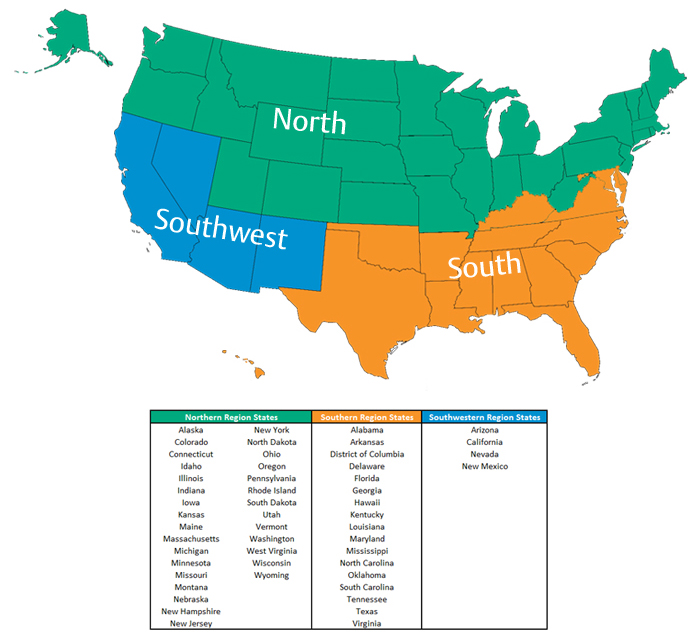
Regional Standards Map

Enforcement Challenges with Regional Standards

One variation that can be noted is that heat pumps have a national standard, while air conditioners have regional standards. This creates a unique challenge because manufacturers are allowed to still make 13 SEER units for the north, but these units are illegal to install in the south or southwest.

For example, imagine you live in Cincinnati, Ohio and your friend resides just across the bridge in Florence, Kentucky. Even though you are close in proximity, you each will have a different minimum SEER requirement. You personally are able to get a 13 SEER air conditioner, while your friend cannot. This is because of the region differentiations – Kentucky is classified as part of the southern region and Cincinnati, the northern.

Under this new enforcement regulation currently in progress, the DOE will not hold a homeowner liable for any incorrect installation, but it is certainly helpful to educate yourself on the regulations and sources of information.

Labeling

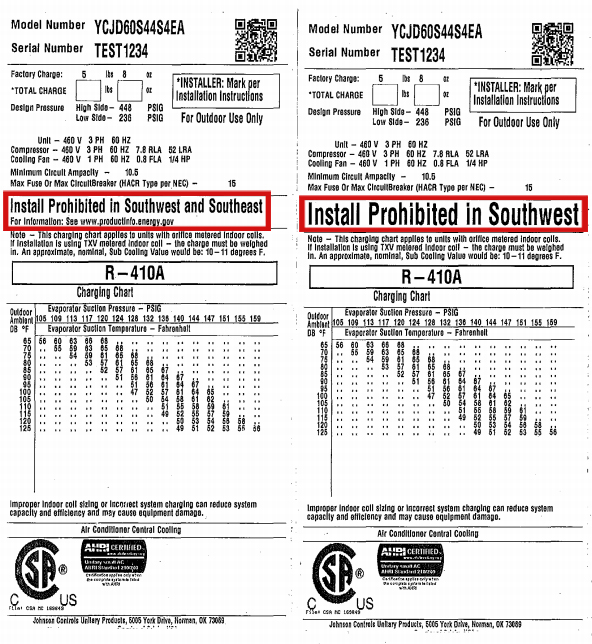
Manufacturers agreed to add a voluntary label to all outdoor air conditioning units that cannot be installed in certain regions. Here is an example of the proposed label:
Labeling

Reference: Regulations.gov

As you can see, the label clearly calls out the regions where the unit is prohibited. More information on the regions and the sates that belong to each region is provided by Energy.gov.

What to Lookout For

If the DOE finds that a contractor, distributor, or manufacturer knowingly sells equipment to someone that installs equipment wrongfully, they will be determined a “routine violator.” The DOE publishes a list of these routine violators, so when you hire a contractor it is a good idea to be sure he or she is not listed. You can do so here.

Record Keeping

There is no record-keeping requirement for homeowners, but it is highly recommended that you take note of and save:

  • Manufacturer’s documents
  • Contractor’s information
  • Date of installation

How to Talk to Your Contractor about Regional Standards

A contractor is likely to respect you even more if you show that you have done your homework and are familiar with the SEER levels for your region. This not only allows you to better understand the type of unit you are purchasing, but also discourages any bad-seed contractors from trying to illegally install an incorrect air conditioning unit.

Reference: CAC Enforcement NOPR – section F

Amended Standards Impact Based on Region

If you live in the North:

The amended standards that impact the northern region are based on the product’s date of manufacture.

  • Units manufactured before January 1, 2015, must meet the standards that were in effect before January 1, 2015.
  • Units manufactured after January 1, 2015, must meet the new standards.

Reference: Energy.gov

If you live in the Southeast or Southwest:

The amended standards that impact the Southern region are based on date of installation. Therefore, units installed on or after January 1, 2015, should meet the new standards. The DOE has issued an enforcement policy that they will not penalize the individual who installs units manufactured prior to January 1, 2015. In light of this, an installer may offer to sell you a noncompliant unit that was manufactured in 2014.  After July 1, 2016, however, DOE will strictly enforce the standards.

In Summary

When investing a large amount of money into a new air conditioning unit, it is very important to also invest time and research into the regulations standardized by the DOE.

Effective January 2015, air conditioners must meet the criteria recognized for the individual unit, based upon the region you live in and the SEER rating level of the appliance. This knowledge will not only make you feel more confident and at ease with your purchase, it will help ensure the right products are legally and accurately installed.

Traditionally, energy efficient standard regulations were solely the responsibility of the contractor and manufacturers for an air conditioning unit or heat pump. However, with these recently implemented changes established by the DOE, the time is right for homeowners to take an initiative to better understand their region and SEER level regulations.

**If you believe your air conditioner installer has installed an illegal air conditioner, you may report it to DOE at EnergyEfficiencyEnforcement@doe.gov or by phone at 202-287-6997.


What Contractors Need to Know About Residential Regional Standards Enforcement Rule in Progress

Reference: DOE NOPR

Efficiency standards for HVAC equipment are nothing new to contractors, but on January 1, 2015 a new residential efficiency standard went into effect. It is very different from those previously created, and it affects all contractors in new ways. It is important to be aware of your responsibilities as required by the rules.

As of January 1, 2015, minimum efficiency of central split air conditioning systems will change to 14 SEER in the Southeast and remain 13 SEER in the North. They must also be 14 SEER and have 12.2 SEER for systems smaller than 45KBtu/Hr, and 11.7 sEER for systems larger than 45KBtu/Hr in the Southwest.

This regionalism in standards created a unique problem for enforcing these regulations. In the past, enforcement was always by manufacturing date. With these updates, that’s no longer possible. The 13 SEER ACs are still legal in the north, meaning they still need to be manufactured for that region. Thus, the burden of enforcing the regulation shifts to installation. This shift to the industry has created new complications and challenges for everyone in the distribution channel.

DOE established a Working Group consisting of various members from industry stakeholders, in efforts to negotiate an enforcement mechanism. The group met several times in the fall of 2014 and made a recommendation to DOE. DOE issued a Notice of Proposed Rulemaking (NOPR) in November 2015, adopting most of the recommendations laid out by the Working Group. In this article, we will discuss aspects of NOPR that are most pertinent to contractors.

Record-Keeping Requirements

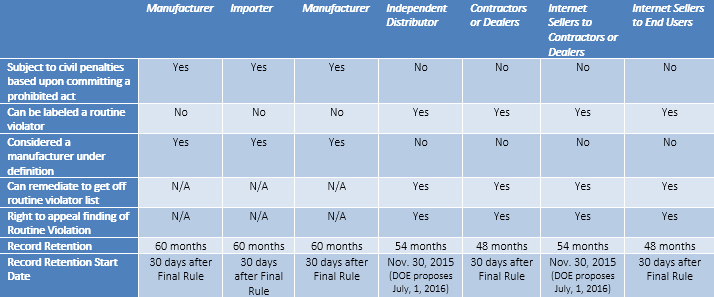
Contractors will be required to keep records for 48 months after the date of installation; distributors retail records for 54 months after the date of sale; and, manufacturers retain records for 60 months after the date of sale.

Ref: CAC Enforcement NOPR – section F

Manufacturer Responsibilities

Beginning 30 days after the final rule, a manufacturer must retain:

  • For split-system central air conditioner condensing units: the model number; serial number; date of manufacture; date of sale; and party to whom the unit was sold, including the person’s name, full address and phone number
  • For split-system central air conditioner indoor coils or air handlers (not including uncased coils sold as replacement parts): the model number; date of manufacture; date of sale; and party to whom the unit was sold, including the person’s name, full address and phone number
  • For single-package central air conditioners: the model number; serial number; date of manufacture; date of sale; and party to whom the unit was sold, including the person’s name, full address and phone number

Distributor Responsibilities

Beginning July 1, 2016, a distributor must retain:

  • For split-system central air conditioner condensing units: the manufacturer; model number; serial number; date the unit was purchased from the manufacturer; party from whom the unit was purchased, including person’s name, full address, and phone number; the date the unit was sold to a dealer or contractor; the party to whom the unit was sold, including person’s name, full address, and phone number; and, if delivered to the purchaser, the delivery address
  • For single-package central air conditioners: the manufacturer; model number; serial number; the date the unit was purchased from the manufacturer; the party from whom the unit was purchased, including the person’s name, full address, and phone number; the date the unit was sold to a dealer or contractor; the party to whom the unit was sold, including the person’s name, full address, and phone number; and, if delivered to the purchaser, the delivery address

Contractor Responsibilities

For all installations in the South and Southwest, beginning 30 days after issuance of a final rule in this rulemaking, contractors must retain:

  • For split-system central air conditioner condensing units: the manufacturer name; model number; serial number; location of installation, including the street address, city, state, and zip code; the installation date; and the party from whom the unit was purchased, including the person’s name, full address and phone number
  • For split-system central air conditioner indoor coils or air handlers, not including uncased coils sold as replacement parts: the manufacturer name; model number; location of installation, including street address, city, state, and zip code; date of installation; and the party from whom the unit was purchased, including the person’s name, full address and phone number
  • For single-package central air conditioners: the manufacturer name; model number; serial number; location of installation, including street address, city, state, and zip code; date of installation; and party from whom the unit was purchased, including the person’s name, full address and phone number

Public Awareness

Ref: CAC Enforcement NOPR – section C

The DOE provides great information on enforcement of regional standards:

The DOE has also setup an email and phone number for public input:

Labeling

Ref: CAC Enforcement NOPR – section I

The Working Group also recommended (and manufacturers agreed) to add a label to the central air conditioner condensing unit which indicates where the unit can legally be installed. For units that do not meet the EER standards applicable to the Southwest region, the label would state, “Install Prohibited in Southwest.” For units that cannot be sold in the Southeast or Southwest because their SEER value is below the minimum required in those regions, the label would state, “Install Prohibited in Southwest and Southeast”.

Manufacturer Liability

Manufacturers may be fined up to $200 (per unit) in violation for knowingly selling a product to a distributor, contractor, or dealer with knowledge that the entity routinely violates any regional standard applicable to the product.

Summary Table

Central Air Conditional Regional Enforcement Summary Table

Ref: CAC Enforcement NOPR – section L

Central Air Conditional Regional Enforcement Summary Table

In Summary

Enforcing regional standards is complicated so it is important that contractors should familiarize themselves with the enforcement rules. There is some work being done to change the enforcement from installation date to manufacturing date and we hope to see this change when the next residential standard change occurs in 2023.

Decoding Dehumidifying

Fresh outdoor air is required to maintain indoor air quality and a healthy building environment. However, it usually takes much more energy to treat outdoor air than recirculated air, and a large portion of this energy is spent removing humidity. Dehumidifying the air has several beneficial effects on indoor spaces:

  • Decreases the latent load on cooling system
  • Discourages mold and microbial growth
  • Prevents condensation
  • Reduces food spoilage
  • Protects electronics

There are several methods used to dehumidify indoor air and each has its benefits and drawbacks.

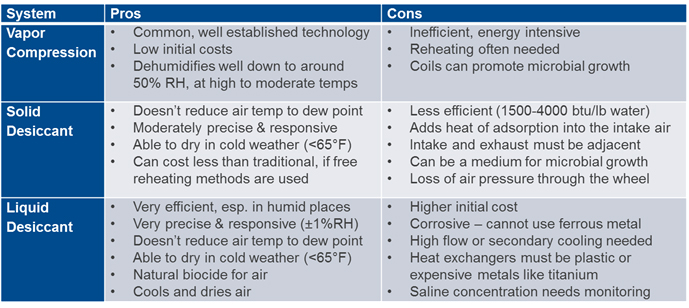
Vapor Compression

A vapor compression dehumidifier uses refrigerant compression and evaporation to reduce air temperature to the dew point. A flow of air passes over the evaporation coil, cooling the air and causing condensation. The condensation is collected and the drier air is often reheated to the desired temperature.

This system relies on proven, readily available technology. It is inexpensive and easy to integrate into existing systems. However, to remove large enough amounts moisture, the air must be cooled well below comfortable levels and then reheated. There are major inefficiencies inherent in both the overcooling and reheating of supply air. Generally, the process requires much more energy below 65°F and/or 50 percent relative humidity (RH).

Solid Desiccants

Solid desiccant systems dehumidify by utilizing the water adsorbing properties of certain substances, such as molecular sieves, silica gel and activated clay. Their porous surfaces and electrostatic properties combine to attract and store moisture. Solid desiccants generally rotate between an intake and exhaust system. The desiccant captures moisture from the intake, releasing the water vapor’s heat in the process. The desiccant then rotates into the exhaust, where heated exhaust air releases the captured moisture and regenerates the desiccant.

Possessing few moving parts, solid desiccant dehumidifiers are attractive due to their simplicity, responsiveness and potential lower energy cost. If free exhaust heat is available for regeneration, there can be significant energy savings. However, using additional energy to regenerate the solid desiccant is largely inefficient. Solid desiccant systems also require intake and exhaust airflows to be adjacent, which can cause design constraints or inefficiencies.

Liquid Desiccants

Liquid desiccant systems, like their solid counterparts, use the water absorbing properties of chemical substances to dehumidify. Liquid desiccant systems expose incoming air to a concentrated saline solution, which readily absorbs moisture from the air. The resulting less-concentrated and hotter liquid is pumped to the regenerator, where additional heat desorbs the water vapor into an exhaust airflow. The re-concentrated desiccant is cooled, and then is ready to repeat the process. In order to keep from adding significant heat to the intake air as moisture is absorbed, the desiccant must either have a high flow rate or be artificially cooled.

Liquid desiccant systems are excellent for specific humidity environments, since they can dehumidify within ±1 percent RH. They can be much more efficient than vapor compression or solid desiccant systems, especially when dehumidifying below 50 percent. However, many saline liquid desiccants are very corrosive. Exposing the liquid desiccant to airflows without contamination is a concern, and usually requires a complex and more expensive system.

Dehumidification Trends

ASHRAE Standard 62.1 specifies measures regarding outdoor air to combat adverse air quality health effects. Older ventilation standards resulted in approximately 10 percent outside air by volume, but ASHRAE 62.1 now prescribes much higher requirements, which average around 30 percent outside air. To ensure occupant health, building HVAC systems will have to treat larger amounts of outdoor air.

To better combat humidity from outdoor air sources, alternative technologies and methods are being developed. A promising area of development is gas-permeable membranes. The main issue with liquid desiccant systems is the direct exposure of the desiccant to airflow, causing desiccant contamination and potential HVAC system corrosion. If a membrane could effectively block contaminants but still allow humidity transfer, this issue would be nearly eliminated. Liquid desiccant dehumidifiers would be much more commercially viable, and could potentially save thousands in annual energy costs.

HVAC System Overview of Vapor Compression, Solid Desiccant, and Liquid Desiccant

Busting Myths on Ductless Mini-Splits: Part II

Revisit the Four Myths that I Proposed were “Busted” Three Years Ago

Revisiting the July, 2013 post, “Busting Four Myths About Ductless Mini-Splits”

When I wrote the “Busting Mini-Split Myths” article in 2013, I did not think it would become the most viewed article on our new website but it has over 365,000 page views and counting! I guess I would attribute the popularity of this topic to how new these systems are and how different they are from conventional, ducted, central HVAC systems, which are found in over 80% of the homes in the U.S. However, in addition to the volume of traffic the number and quality of the posted comments and questions has also been remarkable (over 270 to date).

Although we started out trying to provide a balanced view on this new technology for consideration, I found that I also learned some things as the user feedback continued to come in. This led our team to do some additional consumer research into the U.S. Mini-Split phenomena and this research will now appear in some new articles written by Eric Strausbaugh.  Without going into the details of the study, I thought I would use some of the findings from the study, along with the knowledge contained in the many posts on this site, to revisit the four myths that I proposed were “busted” three years ago.

busted-myth-or-magic

Myth #1 – The sales of ductless mini-spit systems continue to grow and will dominate the U.S. market.

Status: Still Busted. While mini-splits are growing a little faster than the sales of central systems on a unit basis, the dollars spent on these systems and the number of BTUs of capacity getting installed is still a fraction of that spent on traditional central systems. The reason for this is that the majority of the installed base of homes (over 80%) have pre-existing ductwork. It is simply less expensive to replace a ducted system with another ducted. The air quality and humidity control benefits from central AC are also contributing factors to the staying power of central systems.

Myth #2 – Ductless mini-splits are ideal whole-home HVAC solutions in the U.S.

Status: Still Busted. Our recent research suggests that only a small percentage of people are trying to use mini-splits as a whole-home heating and air conditioning solution; these are mostly in very small homes with no existing ductwork available. What appears to be more popular recently is the “hybrid” approach of keeping the central system for the bulk of the whole home comfort, air flow, air quality and humidity control but also use one or more mini-splits to address areas where consumers want more direct control or where the central, ducted system is not keeping up. Our research articles will go into more detail about this and theories about why this is happening.

Myth #3 – Ductless mini-splits are more energy efficient because there are no air leaks in the ductwork.

Status: Mixed. Based on our research and the comments on the original article, I would say that there are definitely instances where poor or failing ductwork has led to major problems with central systems. No one can argue that the most efficient way to run an air conditioner is to turn it off. If you intend to turn off an entire mini-split zone for long periods, these systems will use less energy than a home that does not have zones that can be shut off. I am giving this a “mixed” rating due to the comments about people also using zones in ducted systems, in addition to comments about energy losses in the long line sets for mini-splits.

However, it has been shown that mini-split installation can also have serious “leaks” as long line sets on the outside of the house can pick up heat in the summer and lose heat in the winter. The result can be significantly higher energy costs than would be expected based upon the rated efficiency of the system.

Myth #4 – Ductless mini-splits provide superior comfort and quality of life.

Status: Mixed. Based on user feedback, I would have to say that for certain situations mini-splits can do a great job and at reasonable costs. However, it would also appear that for whole-home solutions in larger, U.S.-style homes, the hybrid approach of using a base central HVAC system along with some mini-splits for certain areas provides the best overall approach to both comfort and energy efficiency. Combining this hybrid approach with an automated duct zoning system for the main central HVAC would also improve the performance of the overall hybrid approach.

The Bottom Line on Ductless Mini-Splits

If you want to learn more about this topic, check out our first article on the survey of over 350 people who have purchased mini-splits in the past 1-5 years. In the meantime, we would encourage anyone in the market to get a few different quotes for each of the various system types that are available today and consider mixing and matching them to meet your unique needs. It is important to get multiple quotes not only to get the best price, but also to find the right contractor who can recommend the best equipment solutions for your situation, then install and service them well.

To download the infographic in PDF, please click here.

3 Main Uses for Mini-Split Systems

Top Reasons to Use a Mini-Split System in the Home

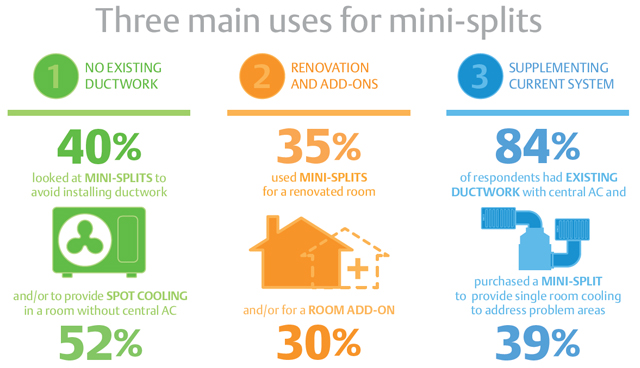
Recently, Emerson conducted a survey of homeowners who have purchased a mini-split system within the past 1-5 years. The respondents represented a large sample of people across the U.S. in different climate zones, which provided a good understanding of how mini-splits are being applied throughout the country. After reviewing the data, we found three main reasons that people opt for a mini-split.

three-main-uses-for-mini-splits

No Existing Ductwork:

Mini-splits have recently become an alternative to window AC units for homes where ductwork is not present. They are quieter and more efficient than most window units are. However, they come at an additional cost. As the graph below depicts, for those respondents without a central air conditioning system (~16%), they are primarily looking at mini-splits to avoid installing ductwork (40%) or to provide spot cooling to a room without central AC (52%).

Renovations/Add-ons:

Respondents with central AC and existing ductwork were using mini-splits for a renovated room (35%) and/or for a room add-on (30%). And 37% of those with ductwork and central AC stated they purchased a mini-split to avoid adding ductwork in the renovated space or room add-on. In the past, it was common for people to use through the wall packaged or window units. In any case, the “spot cooling” option allows the homeowner to avoid adding additional ductwork and potential central unit replacement to cover the increased load. When adding on additional rooms, mini-splits can provide a good alternative to package and window units or additions to an existing central air system.

Addressing Problems:

In the survey, 84% of people had existing ductwork with a working central AC unit, which was surprising. However, of those 84%, 39% purchased the mini-split to augment their existing central system by addressing a poorly heated or cooled room in the house. As with add-on rooms, these issues were addressed with package and window units in the past. Digging further, we also found that the top three rooms where mini-splits are applied are the master bedroom, living room/den, and a child’s room. This makes sense as many bedrooms tend to be at the end of a long run of ductwork that may not get enough airflow to properly heat or cool the room, or if a system has not been properly sized or zoned.

However, while mini-splits may address poor heating or cooling in specific areas, they are simply treating the symptoms of an underlying issue. To address the issue, homeowners may consider properly sizing a newly installed system down the road. In the meantime, some duct zoning solutions could potentially solve the problem when a system is replaced at the end of its useful life. We’ll have more on this topic in a future article.

As always, please review your specific needs with your contractor to understand your best options to address your particular heating and cooling needs.

To download the infographic in PDF, please click here.