Expert Answers to the Top 5 Homeowner FAQs About HVAC

The last thing you want to do with the spare hours you can find in your day is worry about your home’s HVAC system. That’s what the AC & Heating Connect experts are here for. We understand that informed purchases, regular maintenance and trusted contractors are key to keeping you and your family comfortable in your home.

You don’t need to know it all, but a foundational knowledge will make future HVAC decisions less daunting than they may seem. Save yourself some time and worry by checking out these top questions we see homeowners bring up about their home’s HVAC. These FAQs will get you thinking about the basics so that, next time you’re in need of expert HVAC advice, you’ll remember where to turn.

Q: Will my home warranty cover my HVAC system?

A: While the homeowner policy typically covers the actual structure of your home, there is often an additional home warranty available that will cover appliances such as those needed for your heating and cooling system. Some research into the specifics of the home warranty that your realtor is offering will be key in making the right decision. Read more: http://www.ac-heatingconnect.com/homeowners/busting-myths-home-warranty/

Q: Do I need to replace my HVAC system?

A: Most HVAC systems have a “life expectancy” of 14-16 years. Repairing a system is certainly an option, but it’s recommended that you spend less than 50 percent of the cost of a new system on repairing the old one. Considering the Seasonal Energy Efficiency Ratio (SEER), or energy efficiency, of your system will also help you make the right decision. Read more: http://www.ac-heatingconnect.com/homeowners/repair-replace/

Q: How often do I truly need to maintain my HVAC system?

A: Like most other things, your HVAC system will perform better and last longer with regular maintenance. We recommend making a habit of booking an annual maintenance appointments ahead of the heating and cooling seasons where your contractor can inspect your heating and air conditioning systems and address central air duct cleaning. Read more: http://www.ac-heatingconnect.com/homeowners/ac-tune-up/

Q: I’m noticing humidity or condensation issues in my home. What should I do?

A: The ideal relative humidity in a home should be between 30 to 50 percent. Humidity levels that are above or below that threaten to cause mold or other health issues. There are options, such as a modulating system or humidifier, to help monitor and regulate in-home humidity. Read more: http://www.ac-heatingconnect.com/homeowners/preventing-indoor-mold/

Q: I’m ready to upgrade my HVAC system. Where can I find the rebates available in my area?

A: As you consider your options, keep in mind that high-efficiency units typically have a higher upfront cost but lower operating costs, and may qualify for additional rebates. Read more here: http://www.ac-heatingconnect.com/homeowners/saving-money-on-your-system-a-guide-to-rebates-and-incentives/

Have another home HVAC question? Let us know in the comments, and we may include it in this list!

Don’t Sweat It: Comfort at School and in the Office

Do you dress for the temperature in your office or classroom rather than the temperature outside? Do you find that you’re often wearing or shedding an extra layer for indoor conditions? Your comfort in the office or at school may be affecting more than your fashion choices. Copeland recently conducted a survey of consumers and found that discomfort can cause a decrease in productivity, learning ability and knowledge retention.

Comfort clash at work and school

To learn more, download a PDF of the infographic.

Uncomfortable Consumers Make for Risky Business

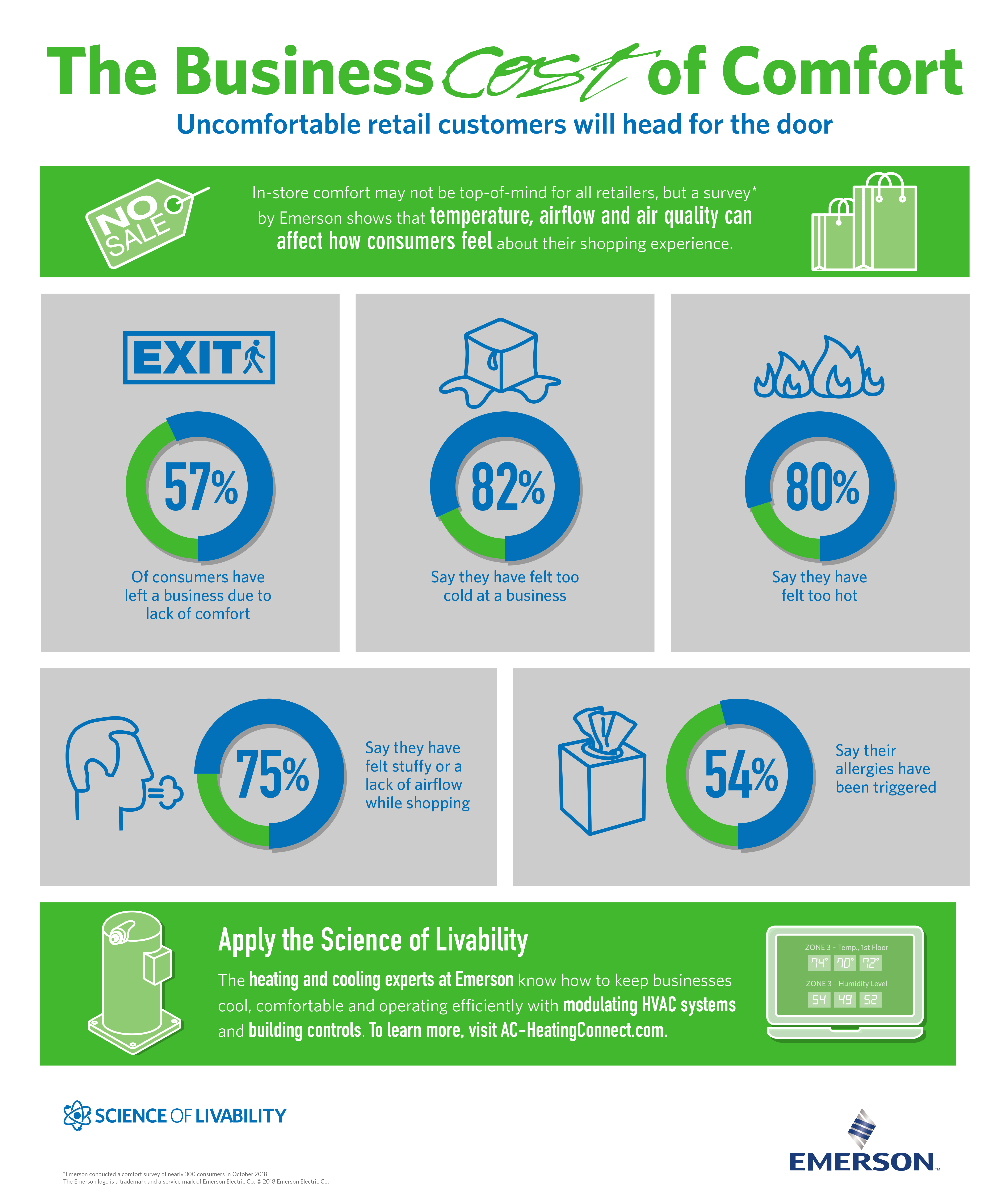
In-store comfort may not be top-of mind for all retailers, but temperature, airflow and air quality can affect how consumers feel about their shopping experience and that can in turn affect sales. Copeland recently conducted a consumer survey and found that customer comfort is a problem more often than you might expect.

customer comfort

To download a PDF of the infographic, please click here.

Holding Your Facility to ENERGY STAR Certification Standards

Improving energy efficiency should be a top goal of facility managers. Beyond environmental concerns, there’s a direct dollars-and-cents component. In 2016, the ENERGY STAR® program for commercial buildings and industrial plants translated to savings of nearly $10 billion and $1.4 billion (respectively) in energy costs.

Buildings and plants that have earned ENERGY STAR certification perform among the top 25 percent of similar buildings nationwide, and on average, use 35 percent less energy and generate 35 percent fewer greenhouse gas emissions than their peers.

Interestingly, the economic advantages of having ENERGY STAR certification go beyond cost savings. According to the Department of Energy’s 2011 Buildings Energy Data Book, studies have shown that commercial buildings with the ENERGY STAR label fetched quantifiable rental rate, sale price and occupancy premiums relative to comparable non-labeled buildings. When you’re certified as an ENERGY STAR building, the door opens for you to lease space to the federal government.

Facility managers who want to earn the ENERGY STAR label or those that have already earned ENERGY STAR certification but want to ensure re-certification can use either the ENERGY STAR Portfolio Manager® for buildings or the ENERGY STAR Energy Performance Indicators (EPIs) for industrial plants to measure performance.

Buildings: Using the ENERGY STAR Portfolio Manager

The Portfolio Manager is an online tool that measures and tracks energy, water consumption and greenhouse gas emissions with data drawn from past energy bills and some basic building information. The Portfolio Manager can also be used during the design stage for new buildings, allowing facility managers to set the energy use target and compare it to similar, existing buildings nationwide.

Additionally, the Portfolio Manager offers automated benchmarking to transfer data from energy service providers into Portfolio Manager via the internet. With this, energy performance scores can be updated monthly, thereby keeping important benchmarking data up-to-date.

Industrial Plants: Using the ENERGY STAR Energy Performance Indicators

Energy Performance Indicators (EPIs) are external, industry-specific benchmarking tools that score a plant’s energy performance and compare it to that of similar plants in its industry within the U.S. on a scale of 1 to 100. Plants that attain a score of 75 or higher are eligible to earn ENERGY STAR certification, once the final verification by a licensed professional engineer or registered architect is completed. This ensures that the building’s energy data and operating characteristics are correct and that the building meets indoor air quality standards. At that point, the facility is ENERGY STAR certified for a period of 12 months.

While there is no fee for applying for or earning ENERGY STAR certification, there is a cost associated with the verification by a professional engineer or registered architect—typically in the $1,000 – $1,500 range, according to ENERGY STAR. However, free or discounted verifications may also be available for K-12 schools, congregations or those in need of financial assistance.

What New ENERGY STAR® Applicants Should Know

The process of earning ENERGY STAR certification starts with measuring energy performance, using either the ENERGY STAR Portfolio Manager or ENERGY STAR Energy Performance Indicators (EPIs) detailed above. A score in the lowest quartile, or an ENERGY STAR score between 1 – 25, indicates a need for investment and potential improvement, while a score of 50 indicates that the building is performing at the industry average.

For facilities that need to improve their energy efficiency, the EPA recommends the following five-stage technical approach as described in the ENERGY STAR Building Upgrade Manual:

  1. Retrocommission—Identify underperforming equipment, determine which equipment should be replaced and review operational tips to improve building performance.
  2. Lighting—Upgrade lighting systems to reduce lighting-related energy use, improve the visual environment and affect the sizing of HVAC and electrical systems.
  3. Supplemental Load Reductions—Improve heating, cooling and electric loads in the building to reduce the size and cost of equipment upgrades.
  4. Air Distribution Systems—Upgrade or adjust the fan systems to maximize energy efficiency.
  5. Heating and Cooling Systems—If needed, upgrade to a new, properly-sized system or retrofit the existing system to optimize operation, reduce noise and reduce the amount of required maintenance.

ENERGY STAR-Certified Facilities

Given that certification needs to be renewed every year, ENERGY STAR-certified facilities should monitor their performance on an ongoing basis, via the Portfolio Manager or the Energy Performance Indicators (EPIs). Using the applicable ENERGY STAR tool allows facility managers to establish priorities and goals, identify under-performing buildings, correct issues and verify energy improvements—all with an eye on achieving and maintaining that coveted certification status.

Battling Home Discomfort

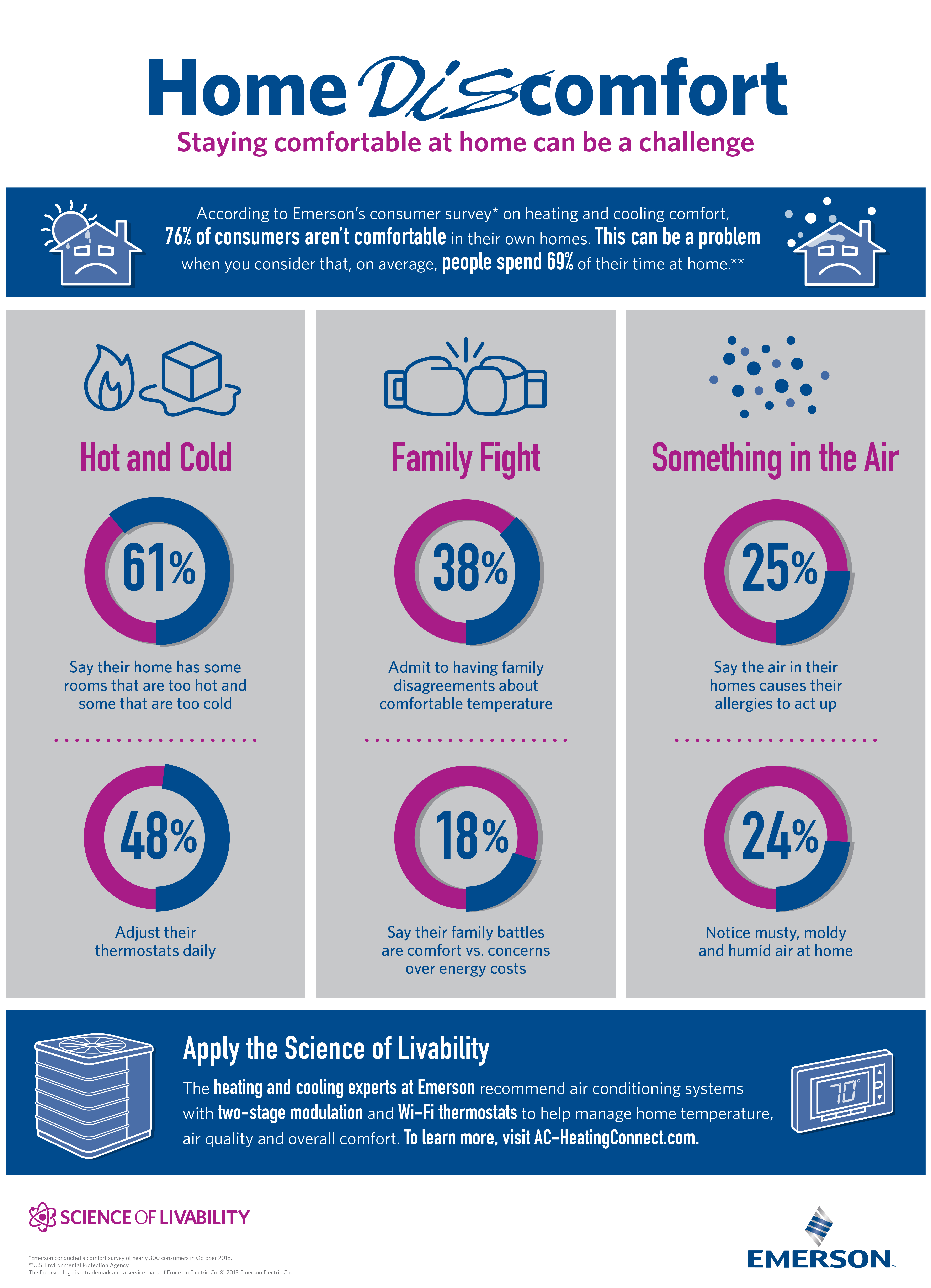
On average, you spend over two-thirds of your time at home and you deserve to be comfortable. But finding that perfect temperature or humidity level can be difficult and can disrupt the comfort level in your home. Emerson recently conducted a survey of consumers and found that issues of air quality, humidity and temperature can have a significant impact on making homeowners uncomfortable.

To combat these issues, the heating and cooling experts at Emerson can help you better understand how HVAC equipment and technology can improve the livability of your home, turning home discomfort into home sweet home.

home sweet home

To download a PDF of the infographic, please click here.

To learn more about how this survey and what you can do, download our e-book.

Don’t Let Customers Duct Out on Spring HVAC Cleaning

Spring cleaning of the HVAC system can sound simpler than it truly is, so it’s important to educate your customers about the entire process. Do your customers understand what goes into an HVAC cleaning?

General guidelines suggest homeowners clean their air ducts every three-to-five years, but several factors may increase that frequency, such as indications of mold, recently completed remodeling projects and the presence of pets. Start the conversation by letting your customers know your recommended time frame for their unique needs.

It’s also helpful to explain how the process works. According to the National Air Duct Cleaners Association (NADCA), there are two elements of cleaning the HVAC system: breaking the contaminants loose and then cleaning them out of the different components. Cleaning the vents? An easy item for your customers’ annual spring cleaning list. But others aren’t so straightforward.

HVAC components that need regular cleaning include:

  • Air ducts
  • Coils
  • Drain pans
  • Registers and grills
  • Air plenum
  • Blower motor and assembly
  • Heat exchanger
  • Air filters and cleaners

Where does the central air duct come in?

While it’s likely your customers will ask about or request a central air duct cleaning, the list above shows much more is needed, and that the entire system requires regular upkeep. The impression that one component of the system needs cleaning is simply a way to introduce the full service to new customers.

The equipment required for a thorough cleaning is largely what differentiates a DIY attempt from a contractor-completed, thorough HVAC system cleaning. And “thorough” means more than simply “clean.” A thoroughly cleaned system impacts overall efficiency, the comfort of the home, overall air quality and equipment longevity. Trying to DIY this process without the proper equipment would be like trying to change a tire without a wrench or car jack.

Let’s talk spring cleaning.

What does HVAC cleaning have to do with the seasons? In colder climates, your customers will likely be wrapping up several months of closed windows, indoor activities and home improvement just before spring arrives. Be careful not to lose sight of seasonal opportunities for customer education. While spring cleaning will be on their minds, they are unlikely to think about the impact this closed-up environment has on overall air quality.

Luckily for your customers, a thorough HVAC cleaning will require little effort on their part. Simply ask them to clear any furniture blocking the registers before the appointment, and offer the great news that a cleaner system will lead to less dust in the home.

How else do you educate your customers about HVAC maintenance? Tell us in the comments.

How Contractors Can Prepare for Smart Thermostat Installations

smart thermostat

It’s forecasted that 25.5 million North American homes will have smart thermostats by the end of 2019. As this technology moves from a novelty to commonplace, it’s likely that more of your customers will seek your expertise when it’s time to install the new unit. How can you prepare to assist your customers in the smart thermostat installation process?

Whether you’re completing the installation yourself or simply advising on the process, the first step is to recommend a smart unit that will best suit a particular home’s needs. You can ensure that remote temperature control is both precise and energy efficient by encouraging customers to choose a thermostat that is Energy Aware Qualified ®.

To offer more guidance on selecting the right product, you can refer your customers to our checklist for choosing a smart thermostat.

When your customer is seeking assistance through the installation process, there are several steps you can take ahead of the appointment to help it go smoothly. When you help your customer prepare, it leads to a better experience for both of you, especially when elements of their internet connectivity are beyond your control.

Step 1: Gather relevant information before your installation appointment

Use this interaction with your customer to get an understanding of:

  • where the router is located,
  • what is their network’s bandwidth,
  • whether they’re looking to relocate the smart thermostat and
  • what their Wi-Fi network is named.

Step 2: Take network privacy into account

Remind your customers that they should set up a temporary Wi-Fi password ahead of time if they do not want to share the primary credentials with you.

Step 3: Arrive prepared to install a smart thermostat

Come prepared with the installation manual for the smart thermostat model you’ve selected for their needs. Download the smart thermostat app on your mobile to help walk you through the installation process and help you test their internet connectivity in the event that you need to troubleshoot.

Step 4: Help your customer get comfortable with their new smart thermostat

To get the smart thermostat up and running, your customer will need to program its settings to their liking. Make sure you set proper expectations by clarifying whether or not they’re seeking your assistance in this process. If so, ask them to download the relevant mobile app ahead of the appointment to save time in this final step of the process.

These are our four easy steps to a smooth, professional installation of the newest smart thermostat models.

After you take these into account, don’t forget to promote your new business offering! Sites such as Angie’s List and Thumbtack already see many requests for professional installation of smart thermostats. You can find opportunities by scanning the requests on these networks, and then help your customers leverage local utility rebates of up to $100. Find smart thermostat rebates in your area to get started.

So, tell us in the comments, are you planning to offer smart thermostat installation services this year? If so, what else are you doing to prepare for this shift?

Busting Myths on Home Warranty

home warranty

What is a Home Warranty?

A home warranty is an insurance policy that covers specific areas of your home that your typical homeowner policy does not.  A homeowner policy typically covers the structure of the home, roof, walls, and flooring, while a home warranty focuses on covering appliances, heating and cooling units, sump pumps and other mechanical systems.  Home warranties can be very beneficial to the homeowner, but some caution needs to be given to the following myths!

Myth #1.  Purchasing the highest level of coverage will cover all my mechanical systems.

Busted!

When purchasing a home warranty, special attention needs to be given to the fine print of the contract.  The following pieces are examples that are not usually part of the coverage:

  1. Mini-split systems – not covered by most warranties.
  2. Second refrigerator – most warranties only cover one refrigerator in the primary kitchen. The second refrigerator in a basement or garage is not covered.
  3. Window AC Units – not covered by most warranty plans.

Myth #2. If my system cannot be repaired and needs replaced, I will receive the exact model replacement.

Busted!

Home warranty contracts may state that they will replace the unit with the same features.  This can leave the door open to variances of brand and color.  An air conditioner in a distinct color may not be an issue, but a stove or refrigerator in a different color may be upsetting.

Myth #3.  If my current AC unit is outdated, a new high efficient system will be installed.

Busted!

Home warranty contracts may state that if an AC unit is found to need replacing, a unit that meets current federal regulations will be installed.  Clarification is needed on what all will be replaced.  Regulations are changing with refrigerants, efficiency ratings, and sizing of equipment.  If the outdoor section of the AC unit is replaced, the indoor section may also need to be replaced or it should be verified that the sizing and refrigerant type is suitable for the upgrade to the outdoor unit (Link to what needs replaced article).

Myth #4.  When my system needs repairing, I will receive Original Equipment Manufacturer (OEM) Parts.

Busted!

Home Warranty companies may buy out surplus sales, or remanufactured pieces to get a better price on replacement parts.  Remanufactured pieces and parts are not always re-certified under UL requirements (link to UL article).  Equipment manufacturers do not always use remanufactured parts and may stick to UL certified parts.

Myth #5.  You can choose or use your contractor of choice to perform diagnostics and repairs.

Busted!

Home Warranty companies generally have contractors that are pre-screened to meet their requirements of certifications, insurance, and customer feedback/reputation.  However, when a policy owner submits a claim, the home warranty company may dispatch their contractor of choice to diagnose and repair your equipment. There are some small home warranty companies that allow you to use your contractor of choice, but these warranty companies are few and far between.

Conclusion

Home Warranties are often sold by realty companies at the time of home purchase or sale.  The home warranty gives the buyer peace of mind that they will not have any unexpected expenses shortly after purchasing a new home.  Home warranty plans can, in fact, be very beneficial to homeowners, but some research and caution need to be given so the policy holder’s expectations are clear.

Specializing Your Service for Customers with Spring Allergies

Your aim is to keep your customers comfortable in their homes. While a well-tuned HVAC system will successfully monitor and adjust the home’s temperature as needed, there’s more to take into consideration when it comes to indoor air quality (IAQ.) With spring approaching, how can you specialize your service for customers with seasonal allergies?

Customers with a severe allergy or asthma concerns may broach the subject on their own, but the majority are likely unaware of the impact that the upkeep of their HVAC systems takes on their seasonal symptoms. Whether or not there’s already an air purifier, dehumidifier or high-quality filters in place, annual maintenance appointments set at the beginning of spring represent a great opportunity to talk IAQ with your customers.

Here’s our three-part checklist for servicing a home where allergy and asthma concerns are key:

  1. High-efficiency air filters

    Electronic air cleaners can certainly help improve air quality, but the best thing you can recommend is using HEPA filters throughout the home. Customers may find it difficult to justify a higher price point for a higher quality filter, so show them the relative thickness of a filter with a 17+ MERV rating to help demonstrate the benefits.

  2. Cleaning the HVAC System

    Seasonal duct cleaning is recommended for every customer, but it’s essential for customers with seasonal sensitivities. Annual maintenance appointments tie in naturally with the spring cleaning trend, an opportunity your business can capitalize on.

  3. Monitor humidity

    The further north your business operates, the more important this reminder will be. As warmer temperatures and rainier forecasts approach, monitoring in-home humidity becomes more important. Any customers who moved into a new home or facility over the winter are subject to surprises in their new space’s humidity levels. Leaving these unmanaged introduces a breeding ground for germs and allergens. Remind your customers that monitoring and adjusting humidity now will be much more cost-effective than eliminating resulting black mold in the long run.

Tips for businesses in colder climates

When the snow melts and warmer temperatures return, spring cleaning will begin. If your customers are booking their annual HVAC maintenance appointments within this timeframe, they’ll like appreciate the reminder that they can dust their registers and return vents before the appointment to get a head start on eliminating allergens. Otherwise, recommending HEPA filters will be key. Customers aren’t likely to understand why their investment in a filter with a higher MERV rating is worth it, so your counsel here will be appreciated. Ask customers about allergy or asthma concerns before the appointment, and bring samples of each filter option to help them understand your recommended approach.

Tips for businesses in warmer climates

Without the major shifts in temperature, it’s easier for your clients’ allergy or asthma symptoms to sneak up on them. You can always consider a seasonal or annual check-in that reminds loyal customers that regular maintenance and cleaning of the HVAC system will prevent the onset of any issues. But the true culprit in these climates is humidity. In warm weather climates, it’s a great idea to recommend a whole-home dehumidifier.

Thinking through your customers’ ultimate indoor experience will simply lead to better reviews and more business, so considering seasonal sensitivities and air quality preferences like these will keep you a step ahead.

How to Detect the Silent Danger in Your Home

Protect Your Family From Carbon Monoxide Poisoning Video Overlay


Silent and invisible, accidental carbon monoxide (CO) poisoning claims the lives of more than 400 Americans every year. The Centers for Disease Control and Prevention says the common gas is also responsible for 4,000 hospitalizations and 20,000 emergency room visits.

Carbon monoxide is created when fuel from household items such as space heaters, fireplaces, stoves, and furnaces is not burned completely. Often overlooked as signs of the flu, symptoms of CO poisoning include fatigue, nausea, headaches, and dizziness. Even small concentrations of CO exposure can lead to devastating outcomes.

To protect your family from CO poisoning, make sure you have a CO detector installed in your home.

What does a CO detector do?

Similar to a smoke detector, a CO detector alerts you when CO is present in your home. In fact, some smoke detectors have a CO sensor already built in. Most CO detectors use an audible voice alert or intermittent beeping that won’t shut off until CO leaves the area.

If you’re looking to purchase a CO detector, there are plenty of affordable options available. Most models vary from $15 to $150 per unit, depending on the specific features, including detection sensitivity, Wi-Fi compatibility, and dual smoke detection.

Where should they be located?

First, place a CO detector near all sleeping areas. After these areas are covered, place several devices within 5-20 feet of furnaces, water heaters and fireplaces to ensure optimum detection. Avoid locations near windows and exterior doors, as they may dilute the CO, preventing the detector from activating.

How you can prevent exposure:

  1. Be knowledgeable: If your CO alarm goes off, evacuate the area, check for signs of poisoning and call 911.
  2. Be diligent: Inspect your CO detector regularly to ensure it’s working properly. Choose a battery-operated or battery-backed detector in case of power failures.
  3. Be proactive: Make sure your furnace, chimney, and fireplace are all inspected annually. Do not run stoves, grills, generators or cars in confined or closed spaces. This includes running your car even with the garage door open, as the CO can still build up to harmful levels.

For additional information on carbon monoxide and how to prevent exposure, please contact your local fire department or building code enforcement department.