Three benefits of the smart thermostat

Upgrade to a smart thermostat and ditch the outdated model that is costing you money

Struggling to maintain a comfortable and consistent home temperature? System cycling too fast or too slow? Home thermostat reading doesn’t seem to match the actual room temperature?

An outdated model can not only make you uncomfortable; it can cause HVAC inefficiencies that can cost you money.

3 Perks of the Modern Wi-Fi Thermostat

1. Comfort

Off-brand digital or older mechanical home thermostats are less precise than modern units. These outdated models can cause your HVAC system to cycle too fast or too slow. Not only can this make your home uncomfortable, but it can also strain your system and your utility bill.

2. Features

If you find yourself struggling to read the controls on your old home thermostat, look for a newer smart thermostat model that has more features. A large, easy to read display and keypad lockout are two of many features found in modern smart thermostats.

3. Convenience

Ever wake up to a freezing house and wish you didn’t have to trek down a long hall to turn up the thermostat? Turned the thermostat setting up while on vacation to save money and had to return home after a day of traveling to a sweltering house? Dreamed of being able to control a home appliance with only your voice? The correct smart thermostat can help with all of these things.

Most smart thermostats have free mobile apps that serve as an intuitive remote control, allowing you to set, change and schedule your home thermostat temperature from your bed, your couch, across the room or the country.

When you do replace your home thermostat, remember to dispose of your previous unit properly, especially if is a mercury thermostat. Each state has specific laws and collection programs. You can find more information at thermostat-recycle.org.

Find the best smart thermostat for your home here.

Four Signs of a Refrigerant Leak

Learn the red flags to let you know whether you have a refrigerant leak

We get it ‒ your AC unit isn’t something you think about every day. But it’s still important to regularly check its performance. By catching red flags early, you can maintain a cool temperature within your home and avoid shelling out thousands on repairs. A refrigerant leak is a common problem for air conditioners during the summer months. The following signs may indicate there’s a leak in your AC unit.

Is your electric bill higher than usual?

A refrigerant leak can cause your AC unit to work harder than normal. If your utility bill has unexpectedly skyrocketed, your air conditioner may be leaking.

Is your air conditioner inefficient?

When AC units experience a refrigerant leak, they lose the ability to reach the set temperature on your thermostat. A faulty unit may also run longer than usual.

Are you experiencing increased humidity inside your home?

It should only take a functional air conditioning system about 15 minutes to properly dehumidify your home.

Are ice crystals forming on your evaporator coil?

Ice crystals are a tell-tale sign of a refrigerant leak. It’s important to check your evaporator coil (indoor coil) periodically for new formations.

If you answered yes to any of the questions above, it might be time to give your local HVAC contractor a call.

Most AC leaks are easy to repair if caught early on. And with record-breaking temperatures this summer, there’s no better time to check that your air conditioner is in tip-top shape.

Livable Buildings: Designing for Comfort

Air Conditioning Webinars Video Overlay


Your customers may understand the importance of efficiency, as well as the industry standards that their systems are based on, but are they having the “designing for comfort” conversation?

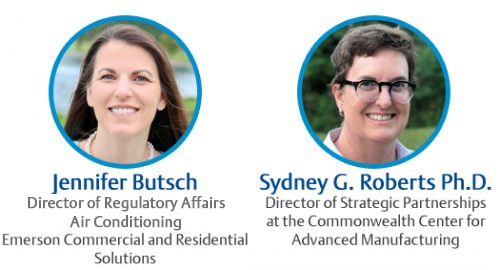
In this webinar, Jennifer Butsch of Emerson and Dr. Sydney Roberts of the Commonwealth Center for Advanced Manufacturing discuss the importance of designing buildings for comfort. They share their thoughts on the future of building comfort, including advanced controls and self-commissioning systems.

The webinar covers the challenges of designing comfort for spaces like commercial kitchens, groceries, and office buildings, using examples from Emerson’s working environments at the Helix Innovation Center.

Presenters:

PDF Presentation | Q & A | Webinar on YouTube

Timing Uncertain for HFC Refrigerant Regulations

Hydrofluorocarbon (HFC) refrigerants are the current choice for most of the U.S. air conditioning industry and for a good reason. Many of the HFC refrigerants used today are non-ozone depleting, nonflammable, recyclable and energy efficient.

While HFCs have good environmental properties and promote energy efficiency, many are now also considered to be global warming gases due to their relatively high Global Warming Potential (GWP).

The Environmental Protection Agency (EPA) began regulating HFC refrigerants in 2015 with the introduction of the Significant New Alternatives Policy (SNAP).

Since then, the industry has made significant progress in identifying the next generation of low-GWP refrigerants. However, the events of the past year leave the timing of the transition uncertain.

U.S. Court Vacates SNAP Rule 20

In August 2017, the U.S. Court of Appeals for the D.C. Circuit ruled to vacate EPA SNAP Rule 20. Responding to a challenge submitted by two refrigerant manufacturers, the court ruled that the EPA had exceeded its authority to require the replacement of HFCs under Section 612 of the Clean Air Act.

The decision was based on the reasoning that Section 612 was created to curb substances containing higher ozone depletion potential, not to address the matter of greenhouse gases and their associated GWPs.

In January 2018, the D.C. Circuit Court of Appeals appealed this decision, but it was denied. The ruling to vacate Rule 20 as initially enacted calls into question the future of EPA SNAP. In June, Honeywell and Chemours filed a joint appeal with the Supreme Court. The EPA is actively working on new regulation. However, there is currently no mechanism in place for the EPA to regulate refrigerants based upon GWP.

Kigali Amendment

The U.S. has not yet ratified the 2016 Kigali Amendment to the Montreal Protocol, a global treaty created to phase out harmful greenhouse gases and ozone-depleting substances. More than 21 countries ratified the treaty, including Canada and most of Europe. Although the U.S. has yet to ratify, in November 2017, the U.S. State Department announced that it initiated the process to consider ratification.

There is industry support for the ratification of Kigali. In fact, the AHRI and the Alliance for Responsible Atmospheric Policy released an economic impact study report concluding ratification is good for American jobs and will allow US manufacturers to remain global leaders.

A group of bipartisan senators also introduced a bill earlier this year named the American Innovation and Manufacturing Act. If passed, this bill would allow the EPA to phase down HFCs used in refrigeration and air conditioning in consultation with the industry.

California Air Resources Board (CARB) HFC phase down

With federal efforts to regulate HFCs stalled, the California Senate directed the California Air Resources Board (CARB) to preserve the original framework outlined in EPA Rules 20 and 21. CARBs proposal also calls for more aggressive phase-down measures in line with the EU’s fluorinated greenhouse gases (F-gases) efforts.

The first CARB proposal looked to preserve the federal framework in new retail food refrigeration, food dispensing equipment, refrigerated vending machines, and foams.

The second proposal calls for future rules on refrigerant use according to their GWP and refrigerant charge in specific applications. Under these guidelines:

  • Refrigerants with a GWP of 150 or more would be prohibited in chillers.
  • Refrigerants with a GWP of 750 or more would be prohibited in new stationary air-conditioning systems containing 2 or more pounds of refrigerant beginning in 2021.

Approved by the board, CARBs Rulemaking 1 proposals will take effect as early as 2019. Draft regulation regarding CARB’s Rulemaking 2 proposals will be released in October.

California is only the first of several states to introduce HFC regulations. New York recently announced that they too would begin to phase out HFC’s.

Standards and Codes

Many low-GWP refrigerants are classified as A2L, or mildly flammable. ASHRAE standards, UL standards, and building codes are in the process of being modified to allow the use of A2Ls in residential and commercial HVAC applications. Building codes vary from state to state and in some cases town to town. Local code adoption to allow the use of flammable refrigerants in comfort cooling may take years to accomplish.

Factoring Energy into the Regulatory Equation

HFC Refrigerants are only one factor in the regulatory equation. The HVACR industry is also dealing with energy mandates from the Department of Energy (DOE). Both residential and commercial air conditioning and heat pump sectors will see new energy efficiency regulations effective January 1, 2023.

The most recent regulatory developments create an opportunity for regulators to align refrigerant regulations with the DOE’s energy efficiency mandates, allowing equipment manufacturers to design systems that are low-GWP and highly efficient. It’s in the best interest of all parties to push for coordination and cooperation between the two efforts.

All of these factors combined leave the industry begging for certainty as they continue to invest in new technologies to enable product redesigns.

Find the Best Smart Thermostat for Your Home

Use this smart thermostat checklist to find your perfect match

You’ve read all the news stories about smart home products. And you’ve heard many of your friends brag about their connected gadgets. You know the benefits of home automation. So you’ve finally decided to take the plunge and update your traditional thermostat to a smart thermostat.

One of the easiest smart home entry-level devices is a smart thermostat. But how do you know which one is right for you? Use this simple thermostat checklist to help narrow down the smart thermostat selection to find your perfect match.

Budget

One of the first things people look at is the price. Some smart thermostats can run as high as $250, and that’s just for the device. Others charge monthly monitoring fees and not all have a free mobile app. Before you purchase, you can also check online to see if you qualify for a rebate from your utility provider.

Quality

After you’ve narrowed down the field with price, you’ll want assurance that you are purchasing a quality device. Look for thermostats that are Energy Aware Qualified®.

System Compatibility

Next, you’ll want to make sure that the thermostat you purchase is compatible with your thermostat wiring and the type of heating and cooling equipment in your home. One of the most important factors in determining compatibility is whether or not your system has or will require the common, or c-wire.

If you aren’t an engineer, or familiar with HVAC systems and how they work, wiring can be intimidating. Before making your selection, read more about the c-wire here to help you better understand what it is and how it works with your thermostat.

Ease of Install

Most homeowners prefer to install the thermostats themselves. Why waste an hour thumbing through a user manual when you can install and connect by using your phone?

You’ll also want to consider the thermostat design. Look for a thermostat that is designed to cover the existing thermostat footprint, which means no messy wall patches, repairs or painting.

Features and Functions

A 2010 study by Lawrence Berkeley National Laboratory revealed that most people who have programmable thermostats don’t actually program them and use the manual settings instead. Why aren’t people programming their thermostats? Simple. Because they can’t figure it out.

Look for a thermostat with easy to understand navigation. Using the mobile app, you should be able to create custom temperature schedules for each day of the week.

Remote Access

It’s not a connected device if you can’t stay connected. Most smart thermostats have mobile apps, so you can change your settings and adjust your thermostat schedule from across the room or the country. It’s the perfect tool for the moms and dads too busy herding the family for the annual vacation to think about the thermostat settings. Or for the harried business traveler who is more worried about the big client presentation than home energy efficiency. There’s nothing worse than realizing that you forgot to adjust your thermostat when you arrive at the airport or have already driven halfway across the state.

As you can see, there are a lot of things to consider before you purchase your first smart thermostat. By following this thermostat checklist, you’re well on your way to choosing the perfect match.

Three Common Misconceptions About Smart Thermostats

Learn about the benefits of smart thermostats and home temperature control.

Smart thermostats and smart devices are in more homes than ever as consumers become more familiar with home automation technology. Despite the increase in adoption, there are still some common misconceptions about smart thermostats. Are you missing out on the convenience and cost-savings connected home products offer? Let’s take a moment to quell these myths about Wi-Fi thermostats.

I’ll never use it.

When was the last time you changed the TV channel without a remote? You’ll feel the same way after using smart thermostats. Once you start using home automation technology, you’ll never know how you lived without your thermostat remote control. Set, change and schedule your home temperature from across the room or across the country.

It will be too hard to install.

So you’re a little apprehensive about thermostat installation? We understand that some options on the market can be a tad intimidating. For most Wi-Fi thermostats, you don’t need to be a handyman to install. Just download the mobile app. The clearly illustrated in-app instructions will easily guide you through each step of the thermostat installation and connection process with confidence.

They’re too expensive.

If you’ve already started researching smart thermostats, you probably know that many popular smart devices can cost as much as $250. Some even charge monthly fees. Installing and programming an energy-efficient thermostat can help you to reduce wasteful heating and cooling without sacrificing your home comfort. Being connected makes it easy to reduce your energy costs by simply turning the dial down a few degrees when you aren’t home or when you’re sleeping.

And you’re not the only one interested in thermostat savings. Your utility company is too. Since your home energy efficiency generates energy reduction results for them, many utilities offer consumer thermostat rebates and incentives for your purchase.

Before you buy one of the new internet thermostats –

  • Make sure you have a good Wi-Fi connection.
  • Know your HVAC system and check for compatibility.
  • Make sure your new device works with your existing smart home automation hub.

Tips on How to Talk Comfort with Your Customers

Knowing how to talk comfort with your customers early on is one of the keys to winning the comfort conversation. Since homeowners have a strong desire to be comfortable, they make comfort and livability in their homes a top priority. Although customers want to be comfortable, they don’t always know what that means or how to achieve that. Being a comfort expert is one of the first steps to winning the comfort conversation with your customers. You want to have this conversation early and often.

In our recent webinar, we talked about the 8 tips on how to start the comfort conversation. Becky Hoelscher of Emerson and Nick Lamb of Butler Heating and Air Conditioning provided great tips and insight on the concept of comfort. They also answered some common questions about the topic, with their knowledge and experience in the industry.

Is comfort more important than efficiency? Don’t homeowners care about efficiency?

Homeowners do care about efficiency, but a lot of customers know that base efficiency equipment available now is typically more efficient than what they are replacing. It’s not often that a customer’s primary purchase driver is efficiency; it’s typically comfort. Remember, we frame our conversations based on comfort and we point out that efficiency comes along for the ride – typically the more comfort features included, the higher the equipment SEER rating.

Are you concerned with setting the owners’ comfort expectations too high? Stressing that defining what comfort is from the beginning is a must. Would you agree?

Defining comfort from the beginning is critical, but make sure you’re letting the customer define comfort. When you try to define comfort for them it becomes a sales presentation and not a comfort conversation. Because your customer is defining comfort, I would not worry about the expectations being too high. You can typically make a way to solve their comfort issues. There are certain obstacles, like ductwork issues in finished areas, that are extremely difficult or impossible to remedy, but if you communicate that to the customer, they should understand.

How important is product knowledge compared to comfort and efficiency knowledge? What are some good steps to explain during the sales process?

Product knowledge is important. You must know what the equipment is capable of when offering your comfort solution. Don’t explain equipment like the OEM explains it to you. Customers don’t care about features; they care about how those features benefit them. Practice explaining benefits to someone in your family or a neighbor that knows nothing about HVAC. Again, make sure you know the customer’s comfort concerns before discussing specific benefits with them. Listening is key.

Does the comfort conversation apply to facility managers too?

Absolutely. Facility managers want their comfort issue solved quickly because the entire building is complaining to them about being too hot or too cold! You can be a hero to a facility manager if you can quickly solve their facility’s comfort issue.

When during the conversation do you bring up comfort?

Early and often. Discuss comfort early and hold your solutions until closer to the end, at least after you’ve had the chance to look at the projects to make sure your comfort solutions are physically feasible.

When you explain to the customer the difference between single-stage, two-stage and variable speed, does the order matter?

No, the order doesn’t necessarily matter; however, it is important to explain how the different technologies will address the comfort issues the homeowner may have. Modulating air conditioning systems lower energy consumption, improved humidity control, better air quality and a more comfortable environment throughout the whole home, during all seasons. However, all modulating systems are not the same. Two-stage systems can offer significant improvements in comfort and energy savings over fixed systems. Variable speed units take this a step further by providing the best overall level of comfort and bring significant energy savings for the owner.

When is the best time to talk about IAQ solutions?

Same. Early and often. IAQ is not an add-on product. It’s part of the comfort solution, just like the equipment.

What other options do you offer for IAQ besides air filters?

UV lights, air cleaners/purifiers, humidifiers. We like to offer a UVC on the evaporator coil to keep the coil clean and to prevent mold growth in addition to UVA on the return side to kill germs and bacteria. These lights paired up with a 5” high MERV filter is a great combination that offers a lot of benefit to the homeowner.

Noise only comes up if the outdoor unit is by the back porch or deck which only happens occasionally. Is noise really that important to discuss?

Definitely. A quieter outdoor unit provides a better outdoor experience. But, if you take the time to listen to your customer, you might find that the indoor unit is too loud. You might hear that they must turn the TV up when the furnace kicks on. Listening is the key to presenting a good solution, whether the solution is comfort or sound or a combination.

Will customers pay to have a service tech out to show them how to take advantage of their thermostat?

Maybe, but only if they understand the benefits of the programmable and/or WiFi thermostat. You should consider sending the salesperson back out after install or training your installer to show the customer how to take advantage of their thermostat features.

Do you find that customers often go with the middle or entry level option due to price?

From personal experience, about 10-15% of customers will always decide on a price. A lot of times it depends on the conversation. If comfort is the key to the conversation with your customer, your customers will typically buy based on comfort. If your conversation is based on price, they’ll buy on price. Perfect the comfort conversation and you’ll sell a lot of top-tier equipment and you’ll have a lot of happy customers that will refer you to their friends, family, and neighbors.

Do you recommend any training materials or sources for the sales process?

Some good industry resources to use and pull training materials from for the sales process are Business Development Resources (BDR) and Electric & Gas Industries Association (EGIA). There are also some great free industry resources like AC & Heating Connect and Energy Star.

To learn more about the 8 tips to start the comfort conversation, view the webinar here:

HVACR Careers: Choosing the Right State

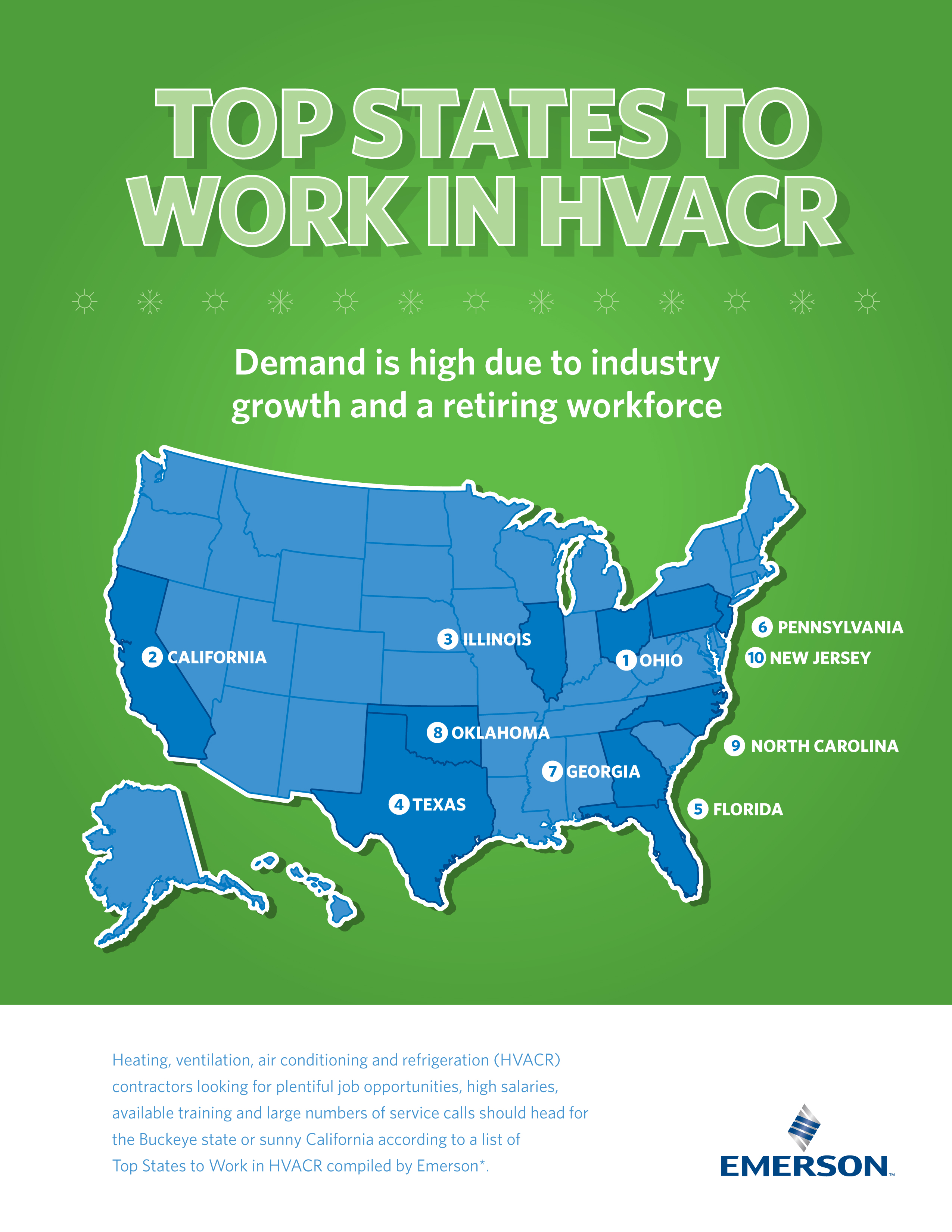
Heating, ventilation, air conditioning and refrigeration (HVACR) contractors looking for plentiful job opportunities, high salaries, available training and large numbers of service calls should head to Ohio or California, according to a list of top states to work in HVACR compiled by Copeland.

Ohio tops the list with more than 1,400 certified technicians, a competitive median salary, almost 9,000 openings, and eight accredited trade schools. California comes in second overall but tops the list when it comes to the number of open positions (22,000), certified technicians, and the highest hourly wages.

The ranking draws on HVACR salary and future employment data from the U.S. Department of Labor; trade school locations recognized by the Partnership for Air Conditioning, Heating, Refrigeration Accreditation; heating and cooling degree days calculated at DegreeDays.net; residential home values from Trulia, certified contractors by state from North American Technician Excellence (NATE) and current openings from HVACR Workforce Development Foundation.

hvacr careers024859-top_states_to_work_v4-0-1-thumb

To download the study in PDF, please click here.

Smart Home Upgrades That Help Sell Your Home

Smart home upgrades aren’t always top-of-mind for many sellers in today’s real estate market. Many look to invest in home improvement projects that pay off in the short-term with the best bang for their buck. A fresh coat of paint. New plants for curb appeal. Modern appliances. But the best home improvements to invest in might not be these typical choices. If you’re looking to sell your house, you might want to consider adding smart home products.

Smart Home Upgrades

As smart home technology has become more mainstream, buyers expect these types of gadgets. Eighty-one percent of people would be more likely to buy a home if smart technology was already installed.* And new smart home upgrades aren’t just appealing to younger buyers. Interest in home automation gadgets crosses generations and income levels.

One of the easiest smart home upgrades is to add a smart thermostat. Easy to install and managed through mobile apps, Wi-Fi thermostats are also compatible with Apple HomeKit, Amazon Alexa, and Wink home platforms.

Another easy project is to add smart lighting, which can be as simple as screwing in a new Wi-Fi-enabled bulb.  Advanced lock technology can give the buyer the impression of heightened safety and security. All of these products can also help you to monitor a vacant home and give your real estate agent more selling points.

In a recent study, nearly one-third of 2015 homebuyer respondents plan on adding home automation gadgets to their new homes. But only 1 in 5 of those planning on selling in 2016 intend to add any smart home upgrades.** Don’t miss out on an opportunity to differentiate your home in this competitive real estate market.

*Coldwell Banker and CNET Smart Home Survey (August 2015)

**2016 Houzz & Home Study

Should it Stay or Should it Go? When to Replace Your AC

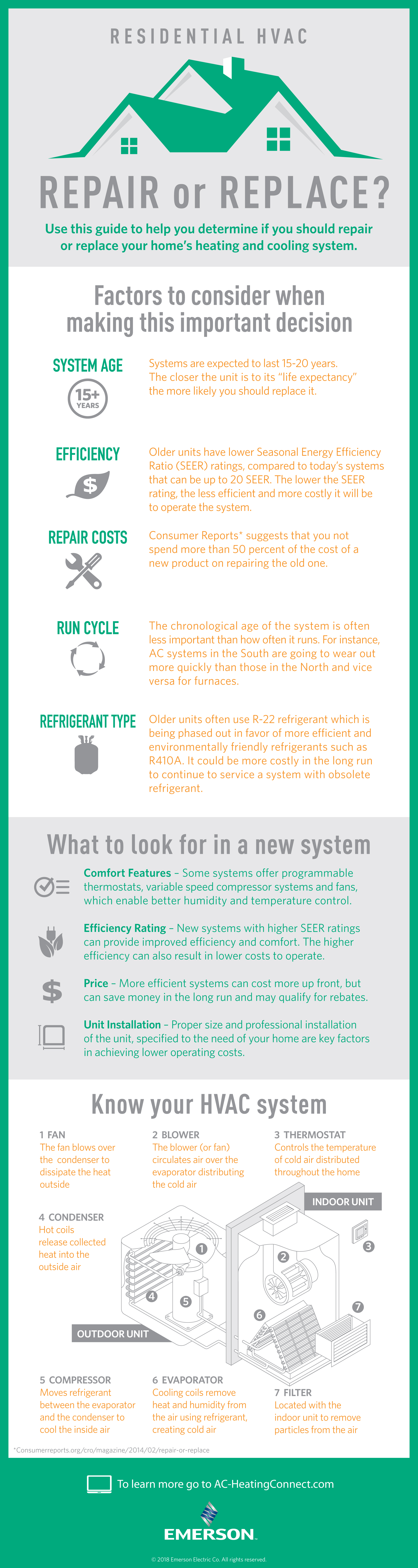
It’s not easy to know whether you should repair or replace your HVAC system, especially if you have an emergency situation. How do you know when you should consider a newer, more efficient system? While there are no hard and fast rules, we’ve created an infographic that will walk you through the factors to consider before making this important decision as well as what to look for when comparing new systems.

025079-repair-or-replace-residential_v6

To download the infographic in pdf, please click here.