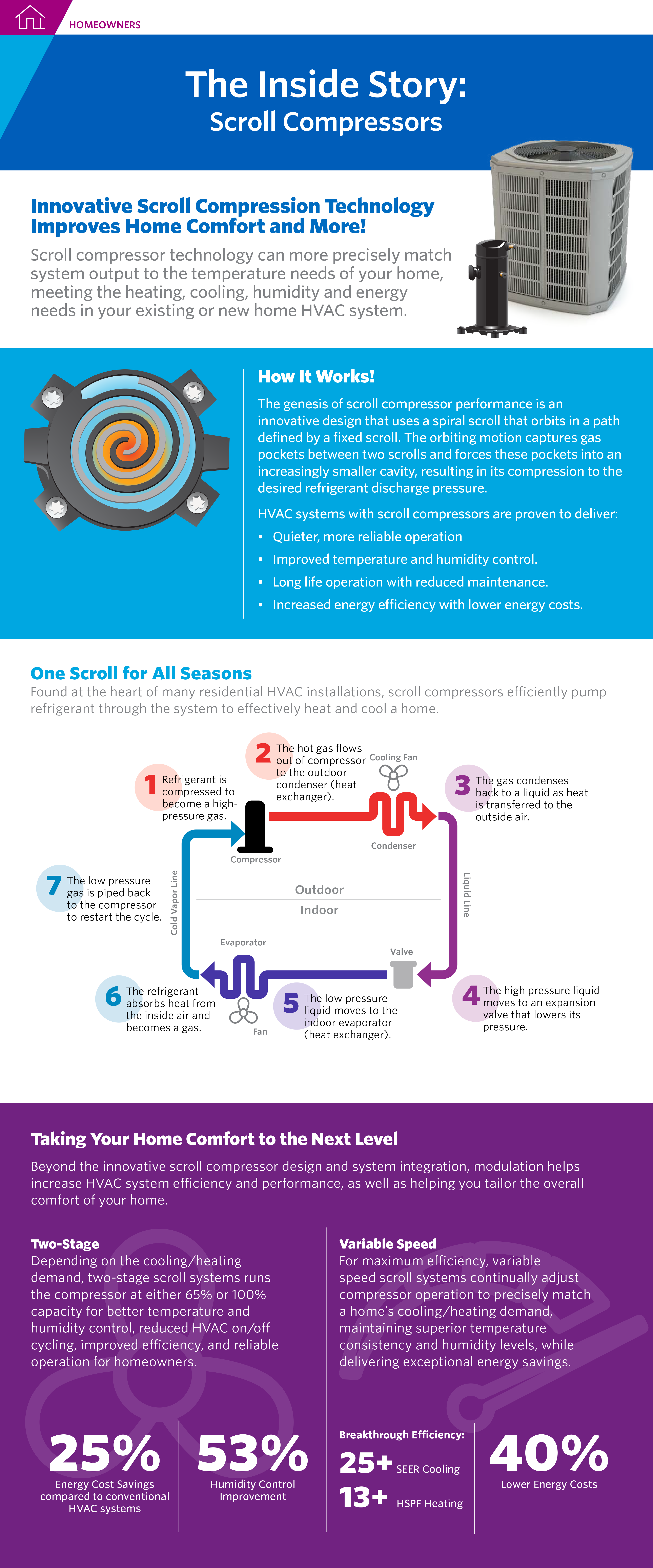
For heating and cooling your home, the compressor is one of the most important parts of your HVAC system. To maintain the optimal balance of temperature, humidity, and air quality levels, there is no better solution for your home’s comfort than an HVAC system powered by a scroll compressor. But how these units function can be a bit confusing with regards to their operation, so we’ll quickly explore these marvels of engineering in a little more detail.
What is a Scroll Compressor?
Typical reciprocating HVAC compressors operate by drawing in refrigerant and heating it by raising and lowering a piston, causing its volume to decrease and pressure and temperature to increase. This is typically an inefficient process, due to the number of moving parts required for operation. Scroll compressors, on the other hand, operate by compressing refrigerant through a moving scroll in a smooth, spiral motion. As the refrigerant passes toward the center of the scroll, increasingly smaller pockets of refrigerant are created that gradually rise in temperature and pressure. With only fewer moving parts, scroll compressors are much quieter and energy-efficient. Less parts also make for a more durable operation with fewer breakdowns.
Benefits of Residential Scroll Compressors
Residential HVAC system installations can vary from fixed to modulating platforms, offering a range of different capacities to meet the needs of your unique home. While the applications, platforms and capacities may differ, scroll compressors are proven to consistently deliver:
Quiet and reliable operation
Enhanced comfort and humidity control
Low-maintenance operation that requires less service
Improved energy efficiency and cost savings
To learn more about scroll compressors and modulation technology for your home HVAC system, check out the inside story on Scroll Compressors:
The summer months get hot but can also heat up your bill. Learn how to keep AC costs down.
Hot weather is here and with it comes the need to reduce the heat and humidity inside your home. When you crank up the AC as the temperature rises, the degrees may be dropping, but your electric bill is headed in the opposite direction.
Don’t sweat the summertime, check out these strategies for saving money and staying cool—all season long.
AC Hack #1: Maintain Your Machinery
Whether you have window AC units or a central air system, be sure to actively maintain your equipment so that it runs as efficiently as possible.
Start with the filter. By replacing a dirty or clogged filter with a clean one, you can lower your air conditioner’s energy consumption by 5-15%. Wondering how often an AC filter should be replaced? Keep an eye on monthly buildup and replace as needed. When you’re running the AC constantly, especially in an environment prone to dust or contaminants, your filter will require more frequent replacement.
For homes with a central air system, don’t forget to check the outdoor condenser coils and remove any dirt or debris that may have accumulated around the unit. Aim to establish a two-foot space between the unit and any surrounding foliage. Then, repair or replace any damaged pipe insulation on the larger refrigerant line (the suction line) that brings the cool refrigerant back to the compressor in the outdoor unit. (The smaller copper line doesn’t need insulation.)
AC Hack #2: Stop the Sun
Curtains, drapes, blinds, and film are your friend when it comes to escaping the sun. Among the most popular energy-efficient window options for blocking the heat, they’ll help you stay cool and comfortable and save money on AC costs. Choose the combination that works best for your home, especially if you live in an area that experiences both strong summer heat and winter cold. For example, tightly installed cellular shades can reduce unwanted solar heat through windows by up to 80%, while slat-type blinds can be adjusted to control glare, light, and solar heat gain.
Want to keep extra cool this year? Choose medium-colored draperies with white-plastic backings. These can reduce heat gains by about 33% if you close them on windows receiving direct sunlight.
If you live in a climate with longer cooling seasons, consider window film, since it helps block against solar heat gain while also protecting against glare and ultraviolet exposure. For maximum benefit, use film on east and west-facing windows because of their greater potential for heat gain.
AC Hack #3: Deter the Drafts
If you have a window AC unit, you’ll want to ensure a secure seal between the unit and the window frame to keep cool air inside. An improperly installed unit can leak as much air as a six-inch square hole. With the strong seal intact, make sure the unit is level so that the inside drainage system and other mechanisms operate at maximum efficiency.
In the market for a new window AC unit? Opt for one with the ENERGY STAR® label. It will use 10% less energy and costs only about $70 per year to run on average. (Not sure what size fits your home best? ENERGY STAR® has a window AC size guide.)
AC Hack #4: Tweak the Temperature
There’s no need to have your AC run at your preferred coolness setting if you’re not there to enjoy it. Using a Wi-Fi thermostat gives you the ability to set the temperature higher when you’re not around, and then adjust it once you’re heading back home.
If you haven’t installed a smart thermostat just yet, make manual adjustments that keep the temperature higher when the house is empty, and lower it to meet your comfort needs when you’re back home. This is especially necessary when taking a summer vacation!
AC Hack #5: Reverse the Rotation
Ceiling fans can help boost the cooling impact of your AC, saving energy and money. When you use a ceiling fan alongside your AC unit, you can raise your thermostat setting about four degrees with no reduction in comfort as the air movement creates an added feeling of coolness. Or, to put it in watt terms, while your central air conditioning unit burns through 3,500 watts of energy when running, the average ceiling fan uses only 60 watts. Be sure to save energy and turn off the fan when the room is unoccupied since its function is to make you feel cooler, not actually cool the room.
If you’re looking to buy a ceiling fan, start by choosing one with the ENERGY STAR® label. Fans with this label move air 20% more efficiently on average than standard models. Select the size that best fits the dimensions of your room. Your ceiling should be at least eight feet high, and the fan diameter should be appropriate to the square footage of the space: 36 or 44-inch diameter for a room up to 225 square feet and 52 inches or more for a larger room. For spaces longer than 18 feet, use multiple fans for better performance.
Maximize your ceiling fan’s effectiveness by ensuring the fan is directing air downward, which is counterclockwise on most models. Not feeling the breeze? Turn off the fan, find the switch or button on the base that controls the direction of the fan’s airflow and move it to the other end. Then test it again.
These summer hacks to keep cool will do more than just that—they’ll also help you save money and reduce your home’s environmental impact.
Have any other tips and tricks to share? Tell us in the comments.
In this episode, we are joined by two experts, Bill Wireman and Chris Cantrell, from Logan A/C & Heat Services in Dayton, Ohio. We kick off the conversation discussing the serviceability of two-stage systems, then move to installation differences between two-stage and fixed or variable speed systems. We also discuss a basic checklist homeowners should do before having a technician service a unit.
Host: Lindsay Headings, Digital Marketing and Content Manager, Copeland Co-Host: Brad Hess, Application Engineering Manager, Copeland
Guests:
Bill Wireman, Field Service Supervisor, Logan A/C & Heat Services
Chris Cantrell, Service Manager, Logan A/C & Heat Services
The simple answer? Rain is not harmful to your AC unit, whether it is a central system or window unit. A little bit of rain can actually have a positive impact, but there is more to the story.
Depending on your climate, there are certain weather patterns that you may want to prepare for when it comes to AC upkeep and maintenance. For example, Gulf-area homeowners have to be more concerned about flood conditions, while Northerners often wonder whether they should cover their AC units over winter months. Let’s break it down a bit further.
Your outdoor AC unit is built to withstand weather patterns.
Seasonal rain patterns will not have a negative impact on your AC unit. In fact, a little rain is helpful for removing any vegetation or debris that could otherwise remain lodged in the unit!
Your unit’s hardware is designed for durability, from the materials it is made from to the way the AC unit actually works. But the system is not at peak performance when it’s burdened with leaves, dirt or other buildups so if your area has been short on rain during spring through fall months, you may even want to spray the unit down with a hose. And don’t worry about getting the electrical components wet — any electrical wiring, such as those used in the condenser coil, will be insulated from wet or rainy conditions.
Are window AC units also safe in rainy weather?
Similar to central air units, window units are built to withstand the weather. However, there are some special considerations to keep in mind, especially since these smaller units are less likely to be maintained by a professional.
When using a window unit, you want to ensure that your home’s interior is properly protected from the potential of water seeping in around the edges and causing damage. For that reason, as well as to improve efficiency, it’s well worth it to take the time to ensure that your window AC unit is sealed properly (even if you plan to remove it during cooler seasons). Proper insulation will also help to prevent added humidity that window AC units can often lead to.
What to do to protect your AC unit during severe weather conditions.
Severe weather conditions, such as flash floods, are a different story. Any water that submerges the outdoor condensing unit could result in a short circuit, ultimately damaging the unit. This can also be a concern when lightning is present and poses a risk of striking the unit directly.
Storm Damage:
Even though heavy rains cannot damage your AC unit, the winds accompanied by the same rain can leave dirt, leaves, twigs, and other debris to damage the condenser fan grille. Even objects falling on your unit, such as tree branches, from the storm can cause damage. It is important to note that if there is damage on the exterior, the interior might be at risk too. Therefore, it is necessary to inspect both the exterior and interior of the unit once the storm subsides.
Flooding:
Central AC units are built to withstand different weather conditions. Although, if your area is experiencing heavy rains with floodwaters exceeding 15 inches, it is advisable to get your unit inspected by a professional contractor.
Corrosion:
Many homeowners prefer to cover their AC units for the winter if their internal parts are exposed. Avoid covering your unit with plastic wraps or garbage bags because the moisture from the condensation can stay trapped inside rusting and corroding metal parts. It is advised to use a covering that allows ventilation. Lack of ventilation or proper openings in the cover can increase the growth of mold and mildew causing further damage to the unit.
It’s good to know that you won’t have to worry about your AC unit withstanding normal weather conditions. But, when facing a more severe forecast, these simple precautions can go a long way.
In this episode, we are joined by three of Logan A/C & Heat Services in Dayton, Ohio’s own apprenticeship program graduates. We kick off the conversation by discussing how each of them unexpectedly took a leap of faith and made a career change to be a part of the HVAC industry. We also discuss how they receive a sense of accomplishment on the job and why awareness about the industry is important.
Host: Lindsay Headings, Digital Marketing and Content Manager, Copeland Co-Host: Vickie Blakey, Product Marketing Manager, Copeland Guests: Devin Johnson, Jared Cloyd, and Matt Andre
This podcast episode is all about the updates made on both the Copeland Online Product Information tool (OPI) and the Copeland Mobile app. This podcast will walk you through how to access OPI and Copeland Mobile along with the several features it has to offer. Lindsay, John, and James discuss the various feature upgrades including marketing bulletins, advanced search, cross reference tab, and more.Be sure to check out the question of the week at the end of the podcast for a chance to win a genuine Copeland t-shirt.
Host: Lindsay Headings – Digital Marketing and Content Manager, Copeland
Co-Hosts:
James Stevenson – Technical Service Engineer, Copeland
John Roberts – Technical Service Engineer, Copeland
Many contractors use the word rebuilt and remanufactured interchangeably. However, there is a significant difference between the two. A rebuilt compressor addresses the visible problem and is only replaced with parts that are either worn out or no longer usable. Even if there is a part that might potentially stop working in the near future, causing a problem to the compressor, it will not be replaced until it is completely unusable. On the other hand, a remanufactured compressor is remanufactured to the latest OEM Spec. It addresses not only the visible problems but also the underlying complications. All the parts including ones that are still functioning or outdated are replaced to meet the latest manufacturing specs of a brand-new compressor. Remanufactured compressors go through an extensive process of being disassembled, cleaned, gauged, and tested to verify all parts are up-to-date and meet UL certification.
Here are the top 3 reasons to choose a remanufactured compressor over a rebuilt/reworked compressor.
Peace of Mind
A rebuilt compressor may have a combination of new, used, and worn-out parts. If there are some parts that are worn out but still meet the rebuilder’s normal wear standard, it will not be replaced. Many rebuilders use a single gasket thickness regardless of the specification for optimal performance. On the other hand, with a remanufactured compressor, you are guaranteed to receive a compressor that meets the latest standard of a brand-new compressor. It has been torn down to identify any problems and fix issues that are not visible. All parts are thoroughly inspected and gauged for wear and tear and are replaced. In addition, parts such as valve plate gaskets are selected based on the deck height of the cylinder pistons, further providing reliability and improved performance. All Copeland certified remanufactured compressors are UL certified and backed by the same warranty as the new models. More than 500 parts are either replaced or upgraded!
Reputation
As a contractor, your personal and company reputation is the key to improving your image and building upon recurring business. Homeowners and customers look to you as the experts in the industry and want to be assured you will take care of all their HVAC needs with the right OEM certified parts. The ability to give your customers a peace of mind by insuring them that their problems would be fixed, will help your reputation significantly. To achieve this, as a contractor it is important to use a Copeland certified remanufactured compressor. Remanufactured compressors provide reliability, optimal performance, and safety. It also prevents future system failures, costly customer call backs and installations hassles.
Thorough Process
With a remanufactured compressor, all parts that are worn out or do not function are replaced down to the core, making it essentially a brand new compressor. As an example, here is the process that all Copeland Certified semi-hermetic compressors go through.
Teardown – When compressors are received in the Copeland facility from buy backs and salvage programs, they are completely disassembled in ordered to be replaced and upgraded with newer parts. This includes oil check valves, name plates, oil pickup tubes, piston rod assemblies, seals, and bearings.
Cleaning – After the disassembly, all parts are thoroughly cleaned to remove any chemical residue.
Qualification – In order to prevent any future problems, all worn out parts are inspected and requalified before reusing or replacing the part. Parts that do not meet the latest engineering requirements are replaced with new or requalified parts.
Assembly – All components are identified and verified before they are put into the remanufactured compressor. In each assembly station, the part that would go into a remanufactured compressor is highlighted so the technician can easily identify the required components, mitigating the risk of placing the wrong piece into the compressor. If an incorrect part is chosen, the assembly will come to a stop and prevent the technician from continuing the process.
Repainted – Compressors are then sent to an auto paint station to provide consistent color coverage and prevent them from rusting.
Inspection – By the end of the process, compressors are thoroughly inspected for electrical and mechanical performance verification. Both brand-new and remanufactured compressors are packaged in the same line and shipped to the OEMs!
How has your experience been with a rebuilt or a remanufactured compressor? Let us know your feedback below!
With a lot of focus on the transition to lower GWP refrigerants, as a facility manager or owner, you may wonder what this means for your existing systems and systems purchased ahead of the transition. Will it still be okay to service them? You will most likely be able to continue servicing your systems in the future, but it is important to understand the differences between HFC refrigerants. The most popular hydrofluorocarbon (HFC) refrigerants for new commercial air conditioning systems in the US today include R-410A, R-407C, and R-134a, but there are still plenty of R22 systems out there. The next generation fluids will have lower global warming potentials (GWP) but many are classified as mildly flammable. Outlined below are a few of the main differences between refrigerants along with some additional guidance on why selecting the correct refrigerant for the desired application matters.
R-22 Refrigerant
Often referred to by a brand name, such as Freon®
R-22 is a hydro-chlorofluorocarbon (HCFC) that contributes to ozone depletion
As of 2010, R-22 was discontinued for use in new air conditioning systems
As of 2020, the use of R-22 is limited to recycled or stockpiled quantities.
R-410A Refrigerant
Often referred to by a brand name such as Puron®, Suva® 9100, or Genetron® AZ-20®
It is a hydro-fluorocarbon (HFC) that does not directly contribute to ozone depletion with a GWP of 2088[1]
R-410A operating pressures can be more than 50% higher than R-22, thus R-410A systems require components capable of working at these higher pressures
R-410A is the most common refrigerant for new light commercial unitary air conditioning systems
R-407C Refrigerant
Often referred to by a brand name such as Suva® 407C or Genetron® 407C
R-407C is a hydro-fluorocarbon (HFC) that does not directly contribute to ozone depletion with a GWP of 1774
Of the higher temperature HFC options, R-407C most closely matches the operating characteristics of R-22
It is a high-glide refrigerant with lower efficiency, but provides the simplest conversion from R-22 due to its similar pressures
R-134a Refrigerant
Widely used in many air conditioning and refrigeration systems globally
It is a hydro-fluorocarbon (HFC) that does not directly contribute to ozone depletion with a GWP of 1430
It is a single-component refrigerant with no glide, featured in many large commercial screw chillers
R-32 Refrigerant
Widely used in many air conditioning and refrigeration systems globally
It is a pure (single component fluid) HFC that does not directly contribute to ozone depletion with a GWP of 675
Classified as A2L or mildly flammable
R-454B Refrigerant
Widely used in many air conditioning and refrigeration systems globally
It is a hydrofluorocarbon blend (HFO+HFC) that does not directly contribute to ozone depletion, with a GWP of 466
Classified as A2L or mildly flammable
System manufacturers have had great success with R-410A because of its energy efficient properties and ease of use in their systems. In addition, components are widely available for designing efficient R-410A systems.
Many air conditioning models are designed to be used with R-410A for a reliable and more efficient operation. Because R-410A can absorb and release more heat than R-22, an air conditioning compressor can run at a cooler temperature, reducing the risk of compressor burnout due to overheating.
R-410A also functions at a higher pressure than R-22, so new compressors are built to withstand greater stresses. If someone were to put R-410A refrigerant into a system designed for R-22, the pressure could potentially be too high, causing the unit to potentially fail.
Most air conditioners use oil to keep the compressor lubricated during operation. R-22 air conditioners use mineral oil (MO) and R-410A systems use Polyol Ester Oil (POE). For cases when you are retrofitting a system to an HFC refrigerant, it is recommended to remove at least 95% of the MO before replacing it with POE oil. (NOTE: Under no circumstances should R410a be used to ‘top-off’ an R22 system, find out why here). POE oil is generally more soluble with R-410A than mineral oil is with R-22. This means the R-410A system operates more efficiently, reducing wear and tear on the compressor. What if I have a HCFC refrigerant, can I use alkyl benzene oils? The answer is probably, but only if it is approved by the compressor manufacturer. If you are unsure, always consult with the compressor manufacturer. For example, a list of refrigerants and lubrications approved for various CopelandTM compressors can be found here: 93-11 – Refrigerants and lubricants approved for use in Copeland™ compressors.
In addition, temperature glide is a property of some HFC refrigerant blends or mixtures and is generally undesirable. Because the composition alters during a phase change, there is a slight change in evaporating and condensing temperature at constant pressure. Commercial air conditioning systems that use higher glide refrigerants are usually designed to work around the problems associated with glide, with little or no effect on system performance.
As lower GWP refrigerants become available, it’s important to note it may not be possible to use all of them as a retrofit in existing systems because some have mildly flammable properties. Refrigerants should always only be used in systems specifically designed for them, as selected by manufacturers and system designers.
In this episode, we are celebrating Women’s History month with four of our special guests, Ashley Pleiman, Sandy Heckman, Lynn Williams, and Mindy Ondera from Logan A/C & Heat Services in Dayton, Ohio. First, we dive into learning about the history of women at Logan’s and how they discovered their own careers in the HVAC industry. We also dive into the role of women in the HVAC industry along with the plethora of career opportunities it has to offer. Our special guests further discuss how flexible the industry is and give advice to our next generation of females.
Host: Lindsay Headings, Digital Marketing and Content Manager, Emerson Co-Host: Becky Hoelscher, Director Aftermarket Sales, Emerson
Guests:
Ashley Pleiman, VP of Human Resources and Finance, Logan A/C & Heat Services
Sandy Heckman, VP of Administration, Logan A/C & Heat Services
Lynn Williams, Customer Service Supervisor, Logan A/C & Heat Services
Mindy Ondera, Director of Install Coordination and Remote Offices, Logan A/C & Heat Services
If your air conditioner or furnace just died, you’re facing some quick and tough decisions. Now is the time to take a deep breath and not rush to an uninformed decision. The top mistakes people make when purchasing a new air conditioner or heat pump are:
Ignoring SEER – The higher the SEER (seasonal energy efficiency ratio) rating the more efficient the unit, which translates to less money spent each month heating or cooling your home. A 13 SEER (North AC)/ 14 SEER (South AC and Heat Pump) rating is the minimum; 16 SEER is good; above 18 is high efficiency. A higher efficiency system can significantly reduce your energy bills in half when compared to an old 8 SEER unit and also provides many comfort benefits.
Missing rebate opportunities – Many states and manufacturers offer rebates to help offset the costs of some systems, particularly those that are higher efficiency. In fact, some states offer as much as $1500 in rebates. Talk to your contractor or visit www.dsireusa.org to learn more.
Only getting one estimate – Prices and options will vary, as will service contracts, installation costs, and permits. Shop around and compare apples to apples.
Going for the lowest price – A low price does not always equal the best value. A higher efficiency system might cost an extra $800 up front, but could save you $300 per year in energy costs. Over the life of the system, typically 12-15 years, you would be saving significant dollars by paying a little more for the higher efficiency system.
Not considering maintenance contracts – Maintenance is necessary to keep your system functioning in optimal conditions over the life of the unit. Over time dirt, debris, and other foreign substances can cause build up in your system, erode electrical connections and cause other damage that is expensive to replace. In addition, the buildup can cause a 14 SEER unit to perform like a 10 SEER one, making your system work harder and your utility bills higher. Ensuring your system is clean and maintained annually can extend the life of your system and help you avoid expensive and preventable repairs in the future.
Buying a new air conditioner or heat pump furnace is a big decision. Take the time to make it a good one. Have you recently replaced your system? Tell us what you learned before your purchase! Looking for heat pump rebates in your area?