HVAC in the Midwest: What’s the Best System for My Home?

Replacing or upgrading your HVAC system is an important decision to make. Efficiency is always a top priority, especially since HVAC usage accounts for about 48% (on average) of a home’s energy consumption. The decision often leans heavily on location since climate frequently dictates what is practical for a home. Central furnaces remain the most prevalent heating option across all regions in the U.S. residential market, with gas and electricity used as the primary types of fuel. Heat pumps have grown in popularity in southern areas due to the milder climates but are typically not suitable further north.

AC & Furnace Split System

This type of split system utilizes a central air conditioner and an electric, propane, natural gas, or fuel oil furnace. The furnace produces heat in the winter, distributing it throughout the entire home, while the air conditioner draws out heat during the summer and transfers it outdoors.

An AC and furnace split system is a popular solution that combines the heating capabilities of a furnace with the cooling capacity of an air conditioner. This HVAC combination allows the homeowner to control their heating and cooling from a single thermostat, saving both energy and money.

Dual-Fuel HVAC System

A dual-fuel system uses a furnace alongside an air source heat pump. A heat pump is able to both heat and cool down your home, providing comfort in all seasons. It keeps your home heated in the winter with heat transfer technology and removes hot air from inside the home during the summer to maintain a cool interior.

Heat pumps can heat your home most efficiently when the outdoor temperature ranges between 25 °F – 60 °F. Due to the nature of the Midwest, there are times during the winter when freezing temperatures reach well below 25 °F, and a heat pump on its own will not provide the necessary heat. This is when a backup furnace will come into play and take over to provide the heat needed to keep your home comfortable and warm.

Mini-Split Heat Pump System

These systems are ideal for homes that do not have ductwork and may be using older, more expensive heating solutions like fuel oil. They are also a good option for garages, bonus rooms, etc. Upfront installation costs are frequently higher than other systems but may be assisted with reduced energy costs and potential utility rebates.

Geothermal HP System

Geothermal systems work differently from a traditional furnace. The systems use pipes below the ground where circulating water is warmed in the winter and cooled during the summer. Since it is easier to gather heat below ground than it is to capture heat in freezing air or to release heat into summer air, geothermal systems are very energy efficient and environmentally friendly. However, these systems usually have a higher installation cost than other HVAC solutions.

Consider some of the following factors when choosing the right HVAC system for your home in the Midwest:

  • Upfront costs to replace your system or to install in a new home
  • Climate for both summer and winter
  • Energy efficiency/long-term costs the cost payback
  • How environmentally conscious you’d like to be

Put Money Back in Your Pocket

Did you know? The federal government offers a variety of tax credits to reduce the capital costs associated with implementing renewable energy and energy efficiency home projects.

If you live in the Midwest, keep track of rebates and incentives available in your area here.

Thermostats: Keeping Your Home Cool During Summer

The heat of summer is in full swing, and you’re likely cranking up your air conditioner to compensate. However, once the electricity bill comes in, you may start looking for ways to save on energy so your costs don’t continue to skyrocket during the summer months.

The lower your thermostat setting, the higher your energy bills, which means it’s a delicate balancing act when it comes to finding the best temperature for both your comfort and wallet. Adjusting your thermostat properly and exploring additional cooling methods to help supplement can have a major impact on your overall savings and home comfort.

Best Temperature Settings While at Home

The U.S. Department of Energy recommends setting your thermostat at 78°F while you are at home during the summer, rather than keeping it low and cold like most of us are tempted to do. In most settings, this temperature level keeps your home reasonably cool and prevents a high energy bill. Did you know? A higher temperature indoors during the summer actually slows down heat entering your house, resulting in lower energy expenditure. The closer the temperature is between the indoors and outdoors, the lower your costs will be.

According to the U.S. Department of Energy, homes can save as much as 10% a year on average by turning their thermostats back 7-10°F from the normal setting for 8 hours a day. During the summer, this means turning it up 7-10°F higher than the set 78°F. These savings can depend on the climate of the area you live in. A milder climate will result in greater overall savings, but a hotter, more extreme climate may not benefit as much.

Best Temperature Settings When Away from Home

When you are not at home and you don’t have pets, there is no reason for your air conditioner to keep pumping out cold air. Turning up a higher temperature while you are gone for a few hours can save you a lot of money on cooling costs.

For instance, if you normally set your thermostat at 78°F while at home in the summer, set it to 88°F when you are at work or out for part of the day. Since the higher temperature slows heat flow into the house, it will take less energy to cool it back down to comfortable levels when you are coming home. This way, your air conditioner doesn’t needlessly run when nobody is at home.

Best Thermostat for a Set Schedule

If you don’t have a programmable thermostat, the investment can pay for itself, especially if you know when you’ll be away from home.  Programmable thermostats can be configured to raise or lower the temperature automatically according to specific times of the day or night.  There are also WiFi thermostats that can be adjusted when you aren’t even in the house.

Humidity Levels

We have all experienced high humidity and know how it can turn an average summer day into nearly unbearable conditions. This happens because the moisture from humidity makes it difficult for sweat to evaporate and leave the body, which results in discomfort and higher heat levels.

Most air conditioners perform well on their own when it comes to reducing humidity in the home. Some newer highly efficient air conditioners have settings on them for dehumidification; check with your HVAC contractor to make sure that your system is optimized for humidity removal. If you don’t want your air conditioner doing all the work, a dehumidifier can help reduce some of the humidity. The EPA recommends keeping humidity levels between 30-50% during the summer.

How to Maximize Cooling & Save Energy

You may be concerned that 78°F is still too high for comfort, but there are other methods to help maximize your house’s cooling. Many of these cooling strategies are easy and inexpensive to implement for greater energy savings.

  • System tune-up: Have your HVAC contractor come out and make sure that your AC system is running at its optimum for efficiency and effectiveness.
  • System fan: Newer indoor furnaces or air handlers have a setting that enables the blower in the equipment to operate 24/7 to circulate the air around the house and reduce hot spots.
  • Window treatments and coverings: Installing window coverings or interior window treatments can reduce energy loss. Roughly 30% of heating energy is lost through a home’s windows, making them a major factor in keeping a house cool during the hotter months.
  • Use ceiling fans: Ceiling fans efficiently cool down the spaces that they are in. Just make sure to turn them off when you leave the room so that they don’t run unnecessarily. Most ceiling fans have a switch that reverses airflow; you want air directed downward in the summer (makes you feel cooler by evaporating any sweat on your skin) and upward in the winter (takes the warmer air off of the ceiling and directs it downward to mix with cooler air).
  • Limit appliance and artificial lighting use: When possible, limit the use of appliances that create heat, such as ovens, washing machines, dishwashers, etc. Also, try to use natural lighting as much as is convenient so that your artificial lights generate less heat.
  • Update caulk or weatherstripping: Install new caulking or weatherstripping around your doors and windows to seal in air leaks.
  • Eves/Roof vents: If you have an attic, make sure your eves/roof vents are free of debris and are moving the hot air across and out of the attic to lessen the heat load on your home’s ceilings.

Maintaining comfortable temperature levels in your home while also keeping costs down can be a delicate balancing act. However, following these recommendations will go a long way toward setting your home up for success this summer.


Read Next: HVAC in the News: Should I really set my thermostat to 78 degrees?

Should I really set my thermostat to 78 degrees?

Understanding Indoor Air Quality: Today and in the Future

Now more than ever, there is an increased focus on preserving people’s health and quality of life. Due to COVID-19, facility managers are beginning to shift their attention from prioritizing energy efficiency to achieving better indoor air quality (IAQ) for their occupants. Evidence shows that COVID-19 may spread through particles in indoor spaces. A building’s layout and design, type of HVAC systems, and occupancy all contribute to the potential spread of the virus through indoor air.

Many buildings use energy-efficient HVAC products in their construction, but these products pose a risk by sometimes sacrificing indoor air quality. As a result, while energy conservation is important to help lower costs and greenhouse emissions, emphasis is now being placed on retaining healthy indoor air quality. Indoor air quality can be defined through factors such as:

  • Temperature
  • Humidity
  • Particulate matter (i.e., PM2.5 and PM10)
  • Volatile Organic Compounds (VOCs)
    • Sometimes the focus is placed on the metric Total Volatile Organic Compounds (TVOCs)
  • Carbon Monoxide and Carbon Dioxide
  • Formaldehyde or Radon
  • Other organic material/life (e.g., mold, microbes, pests, etc.)

Once these factors have been pushed outside of an acceptable threshold, the IAQ may be compromised and require measures to keep those levels in check.

Poor IAQ has historically been shown to contribute to issues such as headaches, fatigue, and respiratory irritation. At times, inadequate air quality has led to asthma and other respiratory diseases. The EPA suggests increasing air filtration and ventilation rates to combat these issues.

Reasons for Facility Managers to Reprioritize Indoor Air Quality

  1. Concentrations of concerning pollutants (carbon monoxide, radon, mold, lead, ozone, etc.) are up to 5 times higher indoors than outdoors. Americans tend to spend the vast majority of their time indoors, and those who are the most susceptible to ill effects from pollution are even more likely to stay indoors (the elderly, people with diseases, etc.).
  2. Better air quality improves comfort inside a building. Low humidity can irritate skin, eyes, and throat, whereas high humidity can cause uncomfortable muggy conditions. Excessive VOC exposure can also cause physical irritation. If you are using an indoor air quality monitor, you will be able to measure additional variables such as humidity, carbon dioxide, and VOC levels to name a few.
  3. Air quality inside schools in particular is very important. Children are more vulnerable to pollution than grown adults. Poor air quality affects the ability to learn, and students tend to cognitively perform better when the school building offers good ventilation.
  4. Using proper ventilation, air filtration, and maintaining adequate air flows allows for better control over odors and contaminants. A steady flow through the ventilation system helps dilute odors and contaminants with air from the outdoors. A good ventilation system will distribute the outdoor air and remove internal polluted air.

Proper – ASHRAE Standard 55-2017

In order for IAQ parameter standards to be met and indoor environments to reach a correct thermal comfort level, temperatures ought to range between 67- and 82-degrees Fahrenheit according to ASHRAE Standard 55-2017. HVAC systems are supposed to maintain a humidity ratio of 0.012 or below, dependent on factors such as temperature, season, activity levels, etc.

Air Pollutant Thresholds:

  • Particulate Matter (PM2.5): 0-12 ug/m3
  • Particulate Matter (PM10): 0-54 ug/m3
  • Volatile Organic Compounds (VOCs): 0-15ppm
  • Carbon Dioxide (CO2): 400-650 ppm
  • Formaldehyde: 0-0.2ppm

Carbon dioxide (CO2) levels are typically good indicators for whether an indoor space is meeting the required levels for fresh air. Using a monitoring system allows you to keep an eye on air pollutant levels and whether the filtration needs to be changed. During the COVID-19 pandemic especially, try to either upgrade your central filtration or use a combination of air filters and air cleaners to maintain acceptable levels of air pollutants indoors.

Implementation of a Dedicated Outdoor Air System (DOAS) can simplify ventilation design and control, improving overall IAQ.

Maintaining Indoor Air Quality Standards

Moving forward for future evaluations, make sure to have a good indoor air quality plan in place. Consider using an air quality sensor to track carbon dioxide, particulate matter, humidity, and more. Implement a well-designed ventilation system with proper filtration to limit any air pollutants.

Maintaining healthy indoor air quality is more important than ever. Facility managers can create a balance between operational efficiency and improvements to air quality so that occupants can enjoy the best health and comfort possible.


Read Next: Comfort, Efficiency Key to Success for Facility Managers

Comfort and Efficiency Case Study

How the AIM Act Will Impact Your Facilities

Over the past few years, the U.S. Environmental Protection Agency (EPA) has faced challenges in implementing regulations relative to HFC refrigerants. These regulatory issues have caused uncertainty throughout the HVAC (Heating, Ventilation, and Air Conditioning) industry as shifts have been made toward more environmentally friendly refrigerant options. The landscape continues to change as the EPA pushes toward a phase-down of HFC production and usage.

Given the uncertainty at the federal level, states like California took the lead.  In 2018, the California Cooling Act went into effect, implementing SNAP 20/21 which prohibited HFC refrigerants containing higher global warming potentials (GWP). Other states followed California, adopting SNAP 20/21 into their own state regulations. Relative to HVAC end uses, SNAP 21 prohibits the use of R-410A and R-134a in chillers as of January 1, 2024.

In December 2020 the federal AIM Act was signed into law, giving the EPA the authority to regulate HFCs, hopefully pulling refrigerant regulation back to the federal level and avoiding the complexity of a state-by-state approach. The AIM Act provides enough time for industries to prepare for the transition from high- to low-GWP equipment without adverse effects.

AIM Act – What is it?

The AIM Act grants the EPA the ability to regulate HFCs, which are commonly used as refrigerants, among other applications.  HFCs have been widely used as substitutes for legacy refrigerants such as R-22 that harmed the ozone layer. Under the Clean Air Act, these chemical substances were successfully phased out of new equipment a decade ago. Now the focus is moving away from high GWP refrigerants, which are recognized as a contributor to climate change. Globally, the HFC phase-down has been under consideration for some time and in 2016 the Kigali Amendment phasing down HFC production and consumption was finalized.

The AIM Act aligns with the phase-down limits contained in the Kigali Amendment and restores the EPA’s authority to regulate the consumption and production of HFCs and establish sector-based GWP limits.

AIM Act – How It Will Affect Facilities

Facility managers need to be aware that new equipment purchased after 2024 Chillers/2025 AC will likely contain new lower GWP refrigerants. Many of these are classified as A2L mildly flammable refrigerants, requiring facility managers to be educated on the new safety features built into the system to mitigate flammability concerns.

The question that arises is whether the new refrigerant can be used in older equipment already in use. The answer is that A2L refrigerant is not designed to be utilized in low-GWP equipment that previously used R-410A or other legacy materials. Safety is a primary focus as changes are implemented, making the new regulations and standards vitally important to understand and follow.

There are several options for HFC replacements considered by North American companies, including R-32, R-454B, and others. They are evaluated for efficiency, capacity, and cost among other factors in order to provide the best performance possible.

Older equipment should not be stranded as the phase down is designed to preserve enough refrigerant to service existing systems. R-410A will continue to remain available for those with older systems. However, the benefits of switching to a low-GWP alternative (positive environmental impact, efficient energy solution, etc.) may be strong influencers in the decision to make the transition sooner than later.


Read Next: HFC Refrigerants Used in Commercial Air Conditioning

HFC Refrigerants

5 Tips to Troubleshoot AC Issues

When you rely on your AC to help keep your home cool and comfortable during the summer months, nothing can be as upsetting as when it stops working. Even seemingly small issues such as water leaks can be a cause for concern when you consider how important your AC is to your daily life.

While you should ideally be getting your unit serviced each year before the summer heat sets in, sometimes issues can seemingly pop up overnight. If your AC isn’t acting the way it should, try these 5 tips to help troubleshoot the issue and help get it back up and working as soon as possible.

Start with the Thermostat

Sometimes what seems like an issue with the air conditioner is actually an issue with your thermostat. This is especially true for those that have smart or programmable thermostats that automatically turn themselves on and off at preset times. If you wake up or come home and discover that your AC isn’t on, it might be because the thermostat failed, rather than the AC unit itself.

Double-check that your thermostat is on and functioning properly. Many take batteries, particularly those that are digital, so make sure those are new first to see if that fixes the issue.

Check the Circuit Breakers

If the thermostat is working as it should be, but your AC still isn’t turning on, take a trip to your circuit breaker next. Sometimes a power surge or an unexpected load can trip a circuit, which will shut off your unit. Since this is independent of your thermostat, you won’t necessarily see the issue from there.

Check and see if the breaker for your AC has tripped, and if so, try setting it to see if that fixes the problem. If your breaker continues to trip, however, it’s time to call an electrician to see what else might be going on.

Check Your Air Filter

If your AC unit is struggling to cool the house, you notice water leaking around the unit, your unit has frozen or stopped working, or if you suddenly notice higher than average energy bills, your air filter may be to blame. A dirty or clogged air filter will make your unit work harder to pull air through. This can result in higher-than-average temperatures, a frozen unit that leaks upon cooling, or a higher-than-average energy bill.

Remove your air filter and hold it up to the light. A clean air filter should allow light to pass through. If yours is opaque, change it for a clean one to see if this fixes your issue.

Check Your Outdoor Unit

Your AC is likely made up of two components, with an outdoor component. If your AC is blowing warm air, seems like it’s struggling, or your energy bills are rising, it could be dirt on the outdoor unit. Go outside and take a look at the unit. If you see a thin layer of dirt covering its entirety, you can try to gently wash this off with a hose. If you notice a thick layer of dirt, it may be time to call in a professional to have the unit cleaned. Dirt build-up can cause your AC to work harder than it should or even fail eventually, which is why cleaning it regularly is a good idea.

Check All Your Air Vents

If your AC is struggling, freezing, leaking, or shutting down, take a quick walk through your home to make sure all the air vents are open and not blocked. This means checking even the rooms where you don’t necessarily want to cool.

Your air vents can do one of two things. They can let cool air out, or they can take air back in and return it to your unit. If your returns or air vents are blocked by a curtain, pet bed, clothing, or other items it could be causing your unit to work too hard. This in turn can cause several issues that can impact your AC.

When to Call the Pros

If you’ve run down this checklist and your unit is still not working, it may be time to call in a professional. Your AC may need a repair, or it may be time to purchase a new one. Remember to start troubleshooting the second you suspect a problem, to avoid a potentially more serious issue, and enjoy beating the heat this summer.


Read Next: Stay Cool and Save Money With Our Top 5 AC Hacks

ac tips

Top 5 Things a Homeowner Expects in Their HVAC System

As an HVAC contractor, it’s important to know what your customers are looking for when shopping for a new system. Emerson recently conducted a survey of about 1,500 homeowners on what factors they find most important when purchasing an air conditioning and heating system.

The results help contractors gain insight as to what homeowners are looking for in their HVAC systems and what they are looking for when it comes to HVAC customer service. As a contractor, understanding these trends can help you better communicate with your customers, leaving them highly satisfied with their service and eager to remain loyal to your business.

Below are the top 5 benefits that homeowners tend to expect from their HVAC systems, and ways you can help them in the decision-making process.

  1. Reliability Over the Long-TermReliability was a top factor among all the homeowners surveyed and ranked high for being one of the most important concerns. Customers want to ensure their new system will stick around through the years and feel at ease that it will continue to operate without needing to be repaired or replaced any time soon. The knowledge that their HVAC system will provide them with years of trouble-free performance will grant instant relief and peace of mind. Reassure the customer that they are purchasing a quality system and that it will be professionally installed in their home. Many times, quality assurance takes precedence over cost with equipment that’s critical to a home.
  2. Reasonable Monthly Operating CostsThe monthly costs accrued with a new HVAC system is always a concern at the forefront of a homeowner’s mind. Typically, homeowners will take a significant amount of time to research and compare different HVAC systems. As a contractor, you will want to help them make a choice that leaves them satisfied. Oftentimes, this means helping them understand that when it comes to choosing a new system, you shouldn’t always go down the cheapest, “best deal” route.It’s important to help the customer consider whether the system delivers the best efficiency and service for what they are paying, and make sure that they feel comfortable with the price range. Be prepared to show them that while they may pay a higher upfront (or monthly) cost, any savings on energy costs may help balance out finances.
  3. Systems Provide Desired Air TemperatureA top priority of homeowners is ensuring that their purchased system provides comfort and produces an even temperature without any hot or cold spots in the home. Contractors should be prepared to help customers consider other less-commonly known factors as well, such as humidity control, air quality, and sound. Some of these factors may not have been initially considered but are important alongside the actual air temperature when it comes to matching personal comfort preferences.
  4. Purchase PriceThe cost for replacing an entire system can be expensive and homeowners may be hesitant before making a purchase. Some may choose to continue to pay for repairs, believing they are avoiding a large price tag of a new system. Contractors ought to be prepared to talk through some of these financial concerns with their customers and offer up information regarding energy savings, rebates, or financing options that may be available to them.
  5. HVAC Maintains Desired Temperature Throughout the HomeNot only are homeowners concerned about the quality of the air temperature, but they also want to make sure the same temperature consistently reaches the entire home year-round, no matter the season. Uneven temperatures leave homeowners living in discomfort in winter and summer, constantly adjusting their thermostat.

Improve your home comfort with insightful HVAC articles. Learn tips, techniques, and expert advice to optimize your heating, cooling, and ventilation systems. Elevate your comfort level and create a cozy environment in your home.


Read Next: Providing High-Efficiency Systems That Customers Will Want to Buy

indoor air quality

HVAC Basics for New Homeowners

What is HVAC?

As a new homeowner, you may know that it’s important to keep your HVAC system updated – but what exactly is an HVAC system, and how does it work?

HVAC stands for heating, ventilation, and air conditioning. HVAC systems heat and cool the entire home and involve a range of different equipment such as furnaces, air conditioners, ductwork, and thermostats, to name a few. You can also enhance your HVAC knowledge by reading up on the latest articles for homeowners.

These systems work by moving air between the indoors and outdoors to keep you warm or cool depending on the current season and personal comfort preferences. Additional benefits produced by your HVAC system that can sometimes be overlooked include:

  • Filtering and cleaning indoor air
  • Maintaining humidity levels
  • Energy conservation

The 4 Most Common HVAC Systems

    1. Standard Split SystemsThese systems have two components: one outside the house and the other inside. Split systems offer a variety of options to choose from and are typically the most affordable. The systems can be split in a combination of different ways:Furnace and air conditioner: The furnace portion is typically installed inside of your home while the air conditioner unit is installed outside. A furnace burns fuel and distributes it throughout the house while the air conditioner draws heat energy out of the house and transfers it to the outside air.

      Heat pump split system: Common in milder climates without freezing temperatures, this system includes a condenser or compressor component installed on the outside and an air handler in the interior of the home. During the heating season, heat pumps move heat from outdoors inside your home and during the cooling season, heat pumps remove heat from your house.

      Furnace and heat pump: This hybrid heat system contains a split system with two heat sources. Often used in colder climates, the heat pump operates during moderate weather and switches to the furnace portion when the temperature becomes too cold for the heat pump.

    2. Ductless Split SystemsUnlike standard split systems which require ductwork, ductless split systems can be used in buildings that do not have ductwork. In its most basic form, ductless split systems include one outdoor unit and one indoor unit that are connected through refrigerant tubing and electrical wiring.
    3. Packaged SystemsPackaged systems are installed entirely outdoors, with all components contained in one unit and connected to the ductwork through a hole in the outside wall. Different types of packaged systems include:
      • Gas/Electric
      • Heat pump
      • Hybrid


  1. Geothermal HVAC SystemsGeothermal heating and cooling systems operate much differently from a traditional furnace. A furnace burns fuel to create heat, whereas a geothermal heat pump exchanges heat between the ground or water source and the air to heat the home. The geothermal cooling process is very similar to the way an air conditioner or air-source heat pump works, however rather than releasing heat into the air, it uses the ground as its heat sink. These systems offer excellent energy efficiency but are usually more costly than other systems.

How to Maintain Your HVAC System

When it comes to HVAC basics, it’s important to take care of your HVAC system on a regular basis. Ignoring HVAC maintenance can cause serious complications and costs down the road.

Below are 5 things all homeowners should do to maintain their HVAC systems:

  1. Change Your Air Filter
    Ideally, you should change your air filter every three months or so. This keeps your system running smoothly and improves the air quality inside your home.
  2. Clean Your Outdoor Condensing Unit
    At the start of every season, remove debris from your condensing unit and spray down the outside with water to clean off dirt and grime buildup.
  3. Clear Around Your Outdoor Unit
    Clear out any plant life around your outdoor unit to eliminate interference. Make sure bushes and trees provide a distance of at least two feet on all sides.
  4. Check Your Air Conditioner’s Drain Line
    Clear out any blockage that can build up on your unit’s drain line. A drain line that is clogged can cause a breakdown and interior leaks.
  5. Get Regular Maintenance
    Bring out a trusted HVAC technician at least once a year to check on your system. They will be able to perform inspections and address any problem areas. Regularly maintaining your HVAC system will extend its lifespan and potentially save you money in the long run.

Read Next: The Four HVAC Terms You Need to Know Now

mold

Recruiting the Next Generation of HVACR Professionals

Originally published on May 17, 2018

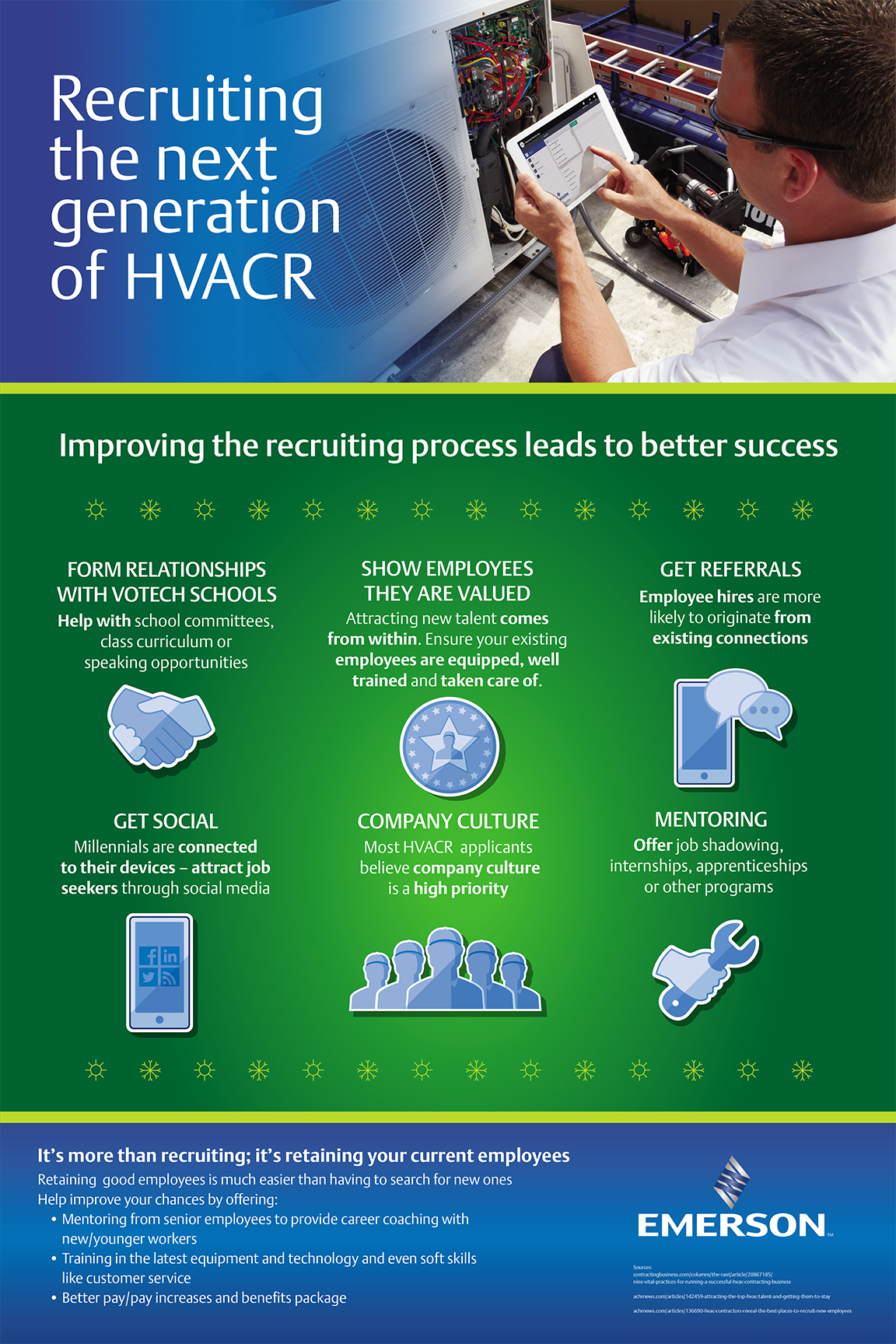
According to data from the Partnership for Air-Conditioning, Heating, Refrigeration Accreditation, by 2022 the HVACR industry will be facing a staffing shortfall of 115,000 contractors, making recruiting new professionals even more challenging.

Recruiting the Next Generation

Our latest infographic offers ideas on how your business can attract and recruit the next generation of professionals.

hvacr recruiting To download the infographic in PDF, click here.

Customer Service Experts

customer service experts

In this episode, Lindsay Headings and our co-host, Vickie Blakey, are joined by three HVAC customer service experts: Ty Gates, Zane Pockrandt, Scott Frymann from Logan A/C & Heat Services in Dayton, Ohio. These industry experts provide insight on the benefits of talking through two-stage technology with the homeowner. We also discuss comfortability at home during the pandemic and other topics.

Host: Lindsay Headings, Digital Marketing and Content Manager, Emerson
Co-host: Vickie Blakey, Product Marketing Manager, Emerson
Guests:

  • Ty Gates, Comfort Consultant, Logan A/C & Heat Services
  • Zane Pockrandt, Comfort Consultant, Logan A/C & Heat Services
  • Scott Frymann, Comfort Consultant, Logan A/C & Heat Services

Timestamps:

  • 0:09 – Welcome
  • 0:21 – Two-stage system recommendations to customers
  • 3:22 – Advantages of two-stage vs single-stage system
  • 4:18 – Explaining two-stage systems to customers
  • 5:36 – Discussing HVAC terms with customers
  • 6:27 – Helping with buying or upgrading decision
  • 9:53 – Finding the value of buying and upgrading new HVAC systems
  • 13:10 – Training technicians on how to effectively talk to customers
  • 18:42 – Final thoughts and personal stories

Learn more about Logan A/C & Heat Services:

Website: https://www.logan-inc.com/
Social Media:

Preparing to Meet the Challenge of Low GWP Refrigerants

The regulation of refrigerants continues to be a source of great uncertainty in the HVAC industry. Carbon emissions from hydrofluorocarbon (HFC) refrigerants and their potential contribution to climate change continue to be critical considerations. The industry has seen a shift toward alternative refrigerants with lower global warming potential (GWP), resulting from global, national and state regulations targeting the phase-down of HFCs.

Even as recently as December 2020, the path forward has evolved, with the passage of the American Innovation & Manufacturing (AIM) Act. This legislation grants the federal government the authority to phase down the production and consumption of HFCs in a manner consistent with the Kigali Amendment and Montreal Protocol.

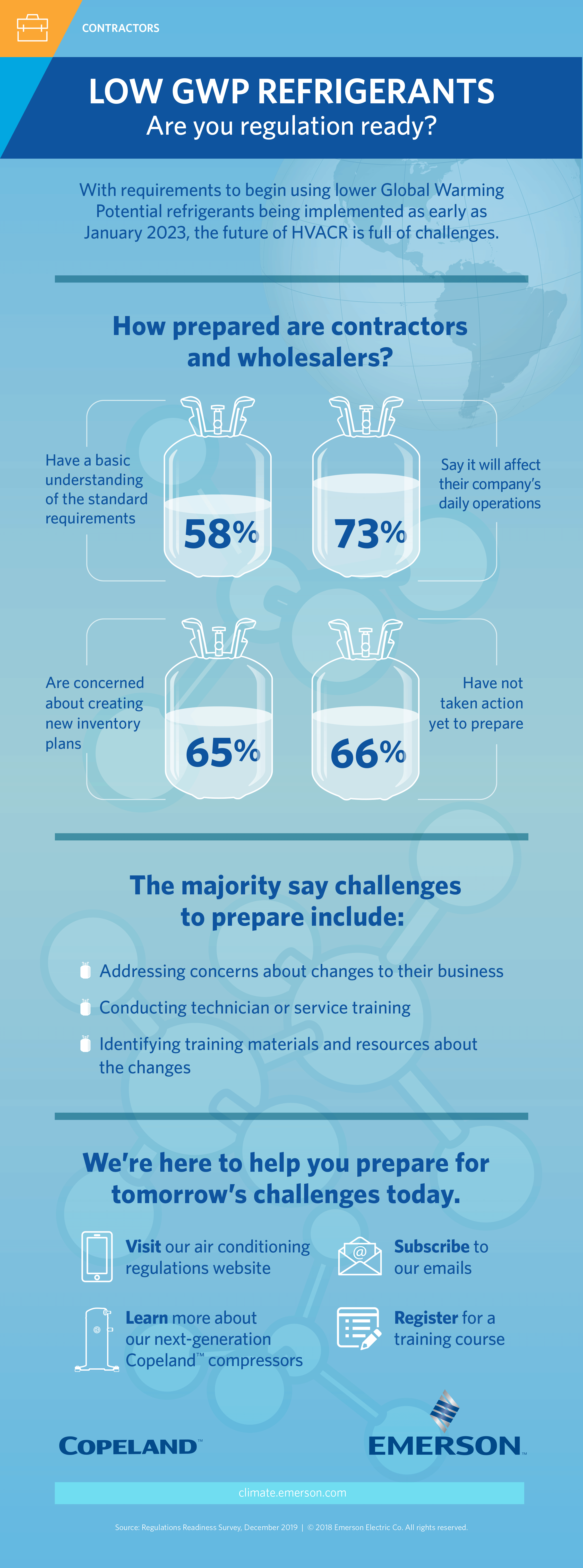
The industry faces the ongoing challenge of preparing for these changing regulations. See how experts responded to a regulation readiness survey and how Copeland is prepared to offer resources in support:

Low GWP Refrigerants

To download a PDF of this infographic, click here.

For more information specific to these regulations, visit Copeland’s regulatory site.