
Can my AC System Help with Indoor Air Quality (IAQ)?

Understanding the Relationship Between Air Conditioning Units and IAQ

Your air conditioning unit does much more than just push out cool air. Air conditioning systems today, especially high-efficiency systems, help control what’s known as IAQ or “Indoor Air Quality.”  IAQ is a combination of cleanliness of the air (no dust or pollen), humidity, temperature control and odor.

Why is this important?

Indoor air quality can affect your health, comfort and wallet. The following tips can help keep your air clean, fresh and healthy.

Change your air filters at the beginning of every heating or cooling season or every three months – even better.

  • Filters keep out dust, pollen, spores and other airborne problems that can lead to health issues.
  • Changing the filter is important because a dirty filter causes less airflow, which makes your system work harder and costs you more money in energy bills.
  •  A dirty filter can also cause your system to overheat or lead to other permanent damage.
  • Check with the original equipment manufacturer’s recommendation for exact timing.

Get a High SEER (more efficient) system.

  • To maintain good air quality you need to have longer periods of air circulation allowing the air to constantly pass through the filter.
  • The higher efficiency systems can run at low power for longer periods and keep the air moving in your home. This is simultaneously better for your air quality and is more energy efficient.
  • High efficiency systems (>16 SEER) feature stepped or variable speed modes that change the amount of cooling and air flow that is delivered.

Avoid using room air conditioners and ductless systems that don’t have proper air filtration.

  • These systems are ideal for small spaces that require cooling, but if you try to use them for more than just an “add-on” zone to your main system you will likely not be pleased with the overall air circulation and filtration that will result.
  • The key to keeping your air healthy and dust free is to keep it moving through your ducted central air conditioning system

Keep humidity low.

  • Humidity causes the air to feel hotter than it really is which usually prompts people to crank up their AC system.
  • Without humidity you would actually be more comfortable at higher temperatures and save money on your energy bill.
  • Similar to an air filter, your central air conditioning system can act like a big sponge to remove the moist, humid air from your home, making it important to run efficiently for longer periods.
  • In addition to comfort issues, high humidity can cause mold to grow which can lead to health problems.

The Bottom Line:

Your central air conditioning system can provide good indoor air quality for many years if you and your contractor select the right equipment, have it installed properly and keep up with filter changes and other basic maintenance.

Did you know your central air conditioner could play such a big role in your health and comfort?
What Factors Affect My Comfort?

When purchasing a new air conditioning or heating system, for your home or business it’s important to consider how it will affect your overall comfort in addition to its ability to heat or cool.

Here are three things you can look for that will help you stay comfortable:

1.       Temperature Management

When it’s cold outside you need to keep it warm inside – but how warm?  And how cool do you keep it when it is hot outside?  One mistake people often make is by picking the least expensive, lowest efficiency system that often has long swings of hotter or colder temperatures in the space. Usually this occurs during the time after the system has run, hit the desired temperature and then shuts off until the cycle repeats.  Even by setting a thermostat at 72 degrees the temperature can swing up and down by as much as ten degrees through the run cycle depending on the unit.  But by using a higher efficiency system (16 SEER or higher) you can avoid this problem as the temperature and air flow are managed much more precisely – usually within one degree – saving you on energy costs and keeping you much more comfortable.

2.       Temperature Variability

Evenly cooling or heating every room in a home or business is one of the greatest challenges for low efficiency systems.  Since the conditioned air coming out of your system has to travel to all the rooms in your home or business, the ones farthest away from the system often get “shorted” out of the coolest air in the summer and the warmest air in the winter.  The key to addressing the end- of- the-line room problems is having your system running longer periods at lower energy levels to keep the air moving into those spaces. This problem can be solved by a higher efficiency system with variable speed capacity. These systems can vary the amount of heating or cooling into a space as well as the air flow during the cycle.

3.       Humidity Control

Humidity can cause you to run your air conditioner more than necessary in the hottest months. Your air conditioner acts as a sponge taking humidity out of the home, but it only works when the system is running. By using a high efficiency system running longer on lower power you can more effectively pull the humidity from the air. By running the system longer at lower speeds, you’ll also be filtering out more dust, pollen and other airborne particles.

Tip:

We always recommend that people evaluate more than just the price of cold air.  By investing just a little more in higher efficiency systems you can not only save energy and money, but can improve your comfort and health.

Did you know that higher efficiency air conditioners can actually make your home or workplace healthier?

Humidity Control for your Home in the Summer

The Basics and Benefits of Removing Humidity from your Home

When it comes to cooling your home in some regions of the country, humidity control is as big of a problem as high temperatures. Unlike the arid Southwest, the Southeast and parts of the Midwest have very high humidity in the summer months and this can result in higher than necessary energy bills if you aren’t careful.

Humidity is behind the “heat index” you hear on the weather report and drives the “feels like” temperatures that are usually several degrees hotter than the actual temperature. Selecting and properly sizing your air conditioning equipment to deal with humidity is a little more difficult than just getting something that keeps you cool on the hottest days.

The Basics of Removing Humidity

Most central air conditioning systems are capable of removing humidity from the air in your home. Window units or ductless systems do not generally move enough air through the system to remove the humidity evenly from your entire home. While most central AC systems will work, effectively controlling your humidity so you’re comfortable day and night is best achieved with a high efficiency system.

Why?

  • To remove humidity, an air conditioner has to be running. Basic, minimum 13 SEER systems typically run in either “on” or “off” mode. High efficiency systems (16 SEER and up) usually provide variable speed capacity which can run longer on lower power, giving the system more time to remove humidity.
  • High efficiency systems are able to control the temperature more precisely, eliminating noticeable cold or hot swings and not allowing humidity to build up in the air.
  • Because the air is constantly being conditioned with a high efficiency system, there is much less chance of stagnant humid air causing mold in the walls or attic.

Additional Benefits

In addition to the added comfort you’ll feel with a high efficiency system capable of removing humidity, they also run much more quietly, which can be a benefit at night when you’re trying to sleep. Because they run on variable speed, high efficiency systems are also much more energy efficient, which translates to money saved every month on the energy bill.

The Bottom Line

If you live in an area of the country that is naturally humid, talk to your contractor about humidity control and higher efficiency systems that can provide you with a comfortable environment, not just cold air.

Watch this video to learn more about the comfort and health benefits of high efficiency AC systems.

After reading this are you more or less likely to explore a high efficiency system? How important is humidity control in your home?

Five Home Energy Efficiency Resolutions Easier to Keep Than Losing Weight

Unlike vowing to eat better or lose weight, resolving to make your home more energy efficient is an easy commitment. You’ll not only save money, but also feel more comfortable at home throughout the year.

1)    Resolve to invest in an HVAC home energy audit – A home audit will assess how much energy your home consumes and provide suggestions for making it more energy efficient. Certified contractors can help recommend areas for improvement from insulation and ductwork to heating and cooling systems and lighting. Visit our homeowner’s HVAC resources page for locating a HVAC contractor

2)    Resolve to control humidity in your home – Humidity in the hot summer months can make your home feel extra warm causing you to spend more to cool it. In the winter months it can save you money by allowing you to keep your thermostat set lower.  High efficiency air conditioners remove humidity during the summer, and whole-home humidifiers can help you feel warmer in the winter.

3)    Resolve to install a programmable thermostat – Using a programmable thermostat in your home can save approximately $175 per year in energy bills by only heating or cooling your home when you’re there.

4)    Resolve to install energy efficient light bulbs – Energy-saving light bulbs can reduce your bill by approximately 80% because they require less energy to provide the same amount of light.  They also last five to six times longer than traditional incandescent bulbs. Read more about saving energy  from Energy Star.

5)    Resolve to commit to high efficiency AC and Furnace replacements – If you’re not in a position to proactively replace inefficient equipment then commit to making it a priority to upgrade when a replacement is needed.  For example, replacing your AC system with a high efficiency air conditioner can reduce energy bills by 40% over a minimum efficiency unit.

Saving energy is a worthwhile resolution at any time of the year for your home and wallet. Consult a HVAC contractor to explore options for making your home more efficient and more comfortable year-round.

Five and a Half Ways to Explain and Sell Comfort to Your Customers

The most common objection you hear when talking to customers about various levels of air conditioning systems probably has to do with price.  While this is a challenging hurdle to overcome, many times customers fail to assign costs to aspects of their life that are often overlooked, but greatly valued.  One such aspect is comfort.  When talking to a customer about their options it is often helpful to talk less about product functionality and more about comfort.  The following 5.5 tips can help guide you.

1. Define comfort – Sometimes the easiest way to define something is by describing what it isn’t.  Ask your customer if they had temperature swings on humid days between cycles, had hot and cold spots in the home, or trouble sleeping in the summer.  By getting them to talk about issues they have it’s easier to define what life is like without them – comfort.

2. Introduce the concept of air quality – A properly sized system will enable the air flow within the home to remain fresh and well ventilated.  This reduces the chances of stagnant air leading to poor odor or mold development.

3. Discuss efficiency standards – Let them know not only about minimum SEER standards, but what higher efficiency means.  Temperature consistency, energy efficiency and humidity control are all aspects of systems that deliver higher comfort.  In addition, discussing refrigerant standards such as the shift away from R-22 can open the door for more comfort-focused conversations.

4. Connect the dots between efficiency and comfort – Explain that the systems with over 16 SEER ratings provide superior comfort, humidity control and better indoor air quality, which are not only good for the way customers feel, but for their wallets as well.

5. Define different tiers of systems in terms of comfort – When explaining the differences between a 13 SEER and an 18 SEER system, for example, focus on the comfort factors – humidity control, consistent cooling, better air circulation – rather than just cost or machine performance differences. A customer might not care about what ‘variable speed’ means, but they will want to hear they won’t sweat or freeze at night.

5.5 Direct them to third party information – There are several good online sources of unbiased information to which you can direct your customers.  This site, AC & Heating Connect, as well as others such as OEM sites or associations such as ACCA and AHRI all offer good information for homeowners.

Comfort, when properly defined and explained, can be a valuable selling tool and is often appreciated and overlooked by homeowners.  Have you had success discussing the value of comfort?

Related Articles
Repair or Replace? What Should I Do with My Old Air Conditioner?
Be Cool and Avoid Disaster: Six Pitfalls to Avoid When Buying a New AC or Furnace

How much time do I really have to replace my AC System?

Find out how long you have to ensure a new AC fits your budget

At the end of the day, this is a decision you make based on your preferences, immediate needs and purchase ability.  If health and safety are an immediate concern you might consider purchasing one or more window air conditioning units to buy some time until you get your central AC replaced.  We discuss the long-term disadvantages with these units  such as energy costs and noise, in other articles throughout the site.  It is best if you have a few weeks to investigate the right equipment for your situation and find a good HVAC contractor who can install it for you.  Because the average person will only have to replace an entire system once or twice in their lifetime they aren’t always as knowledgeable about what to expect in terms of cost and maintenance.  Systems today can cost $3,000 to more than $10,000, so taking the time to make the right decision should pay off in the long run.

Related Articles
Simple Ways to Extend the Life of Your AC and Heating System

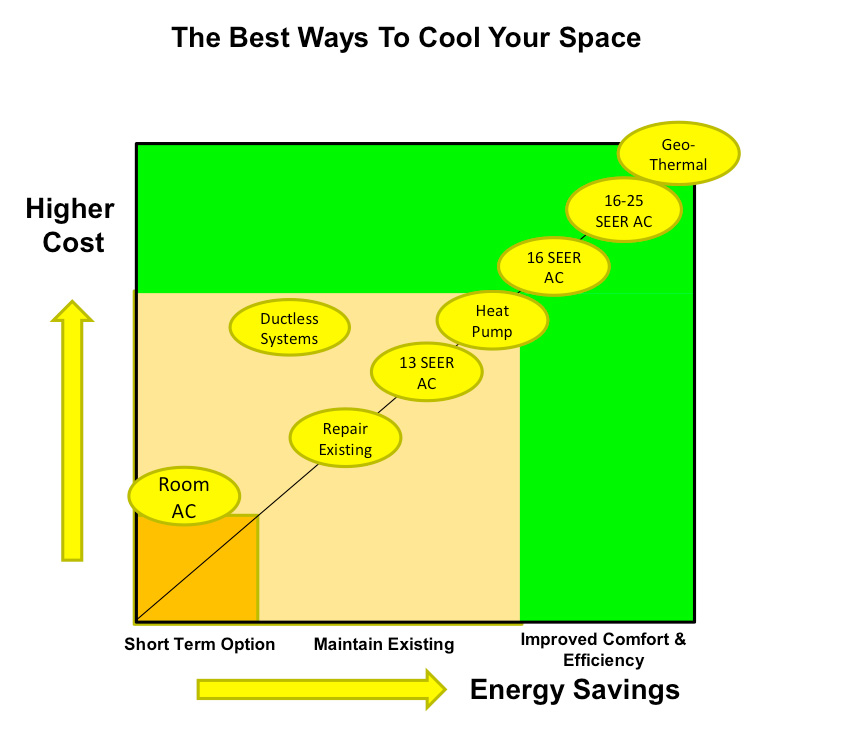
Comparing Options for Cooling Your Home

The major driver behind the price you pay for an air conditioning and heating system is based on efficiency Energy efficiency is measured by SEER ratings (Seasonal Energy Efficiency Ratio).  The higher the SEER, the more efficient the system, with SEER ratings higher than 16 being considered high efficiency.

What are your available options today?

1.  Room air conditioners or window units – These give you cool air and are relatively inexpensive to purchase; however, they tend to have higher total costs of ownership over the life of the system because they are the least efficient choice resulting in higher energy bills. Similarly, they are not subject to the minimum energy standards that central air conditioning units must abide. This means they end up being less environmentally friendly.

2. Repairing existing <16 SEER system – Depending on the age and condition of your existing system it might be most economical to simply invest in minor repairs rather than replace the whole thing.  Repairing will give you the same basic cooling you were experiencing before at the same energy cost.

3.  Ductless mini-splits –These are good, energy efficient options for add-on rooms or small spaces that do not have duct work.  If you have existing ductwork, going to a ductless system will mean you have to abandon all your old ductwork and install new refrigerant lines to some new in-room systems.  This can add considerable cost and when attempting to use ductless systems throughout an entire home can create other potential issues.

4.  High efficiency (>16 SEER) system – High efficiency systems will feature variable capacity cooling options which will not only save you money on energy costs, but can make your home more comfortable as well.  They have a higher upfront cost, but can have a lower total cost of ownership over the life of the system.  Talk to a contractor for a detailed recommendation.

5.  Geothermal Systems – Geothermal systems provide the best energy efficiency and savings on the market today. These systems use the earth’s constant temperature to heat and cool your home instead of having to transfer hot or cold air using the variable outdoor temperatures.  Because the ground under your space is at a constant temperature year-round it can be more quickly and easily transferred to your home regardless of the season. The initial cost involved is higher because you have to install a heat exchanger deep in the ground around your home.  This added investment can really pay off if you plan to stay in the home for more than five years and want consistent energy costs. Because it uses so little energy it is also the most environmentally friendly solution.

The Best Ways to Cool Your Space

The Best Ways to Cool Your Space

Related Articles
Behind the Scenes: How Your Air Conditioner Works