Changes to AC and Heat Pump Condensing Unit Energy Guide Labels

What is an Energy Guide Label?

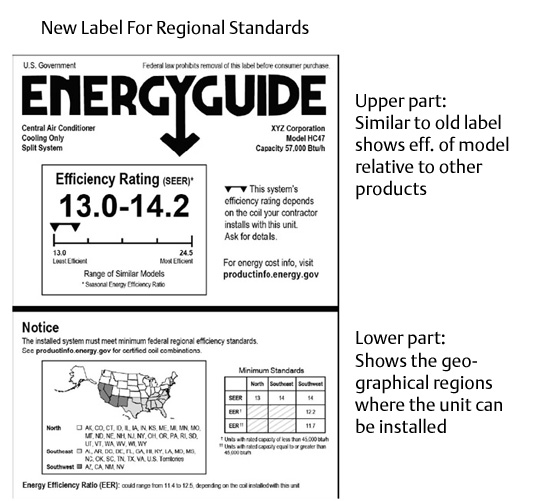
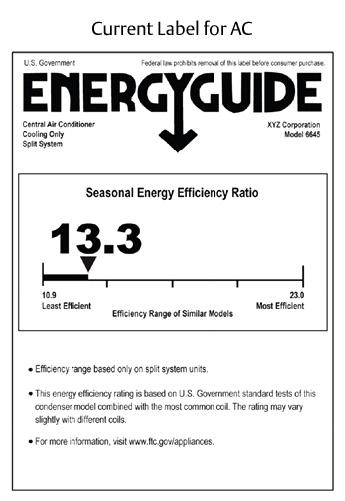
This is the yellow energy guide label prominently displayed on a new appliance. It shows the energy consumed by the device, as well as a comparison of the equipment’s efficiency to similar equipment in the market. The label is designed to help consumers make more informed buying decisions. The label will soon have a new look on air conditioners and heat pump condensing units. FTC published the ruling for the new label guidelines, which will go into effect along with the new minimum energy efficiency standards in January of 2015.

Why the change?

You may be aware of the change in Minimum Efficiency Standards for air conditioners and heat pump condensing units, to be effective in  January 2015.  If not, you might want to read, our recent article, “Answers to Common Questions About 2015 Regional HVAC Efficiency Standards” by clicking on the following link.

https://www.ac-heatingconnect.com/answers-to-common-questions-about-2015-regional-hvac-efficiency-standards/

Heat pumps will now have one national standard, while air conditioners will have different standards for each of  three regions:  North, South and Southwest. Since the efficiency of a system is dependent on the combination of the outdoor and indoor units, it is possible that an outdoor unit may have certain indoor unit combinations that will make it compliant in one region, but not in another. In the past, this did not matter, but the new regional nature of the regulations might cause issues for manufacturers, distributors and contractors.

If there were no changes made to the current AC labels, manufacturers would have to obsolete 13 SEER models in the South and Southwest regions. And if manufacturers wanted to sell the unit as 14 SEER in the South, they would have to re-certify the same models to accommodate the different SEER requirements of each region. For example, the unit would have to be certified to meet 14 SEER regulations for the South and then recertified again to meet the 14 SEER and 12.2 EER regulations for the Southwest (which would require new model numbers).  The new FTC label will be changed to avoid confusion and unnecessary work in cases like this. It will make installation of the same outdoor unit in different regions possible since the new labels will have energy calculations based on different indoor combinations and system efficiencies.

What exactly is changing?

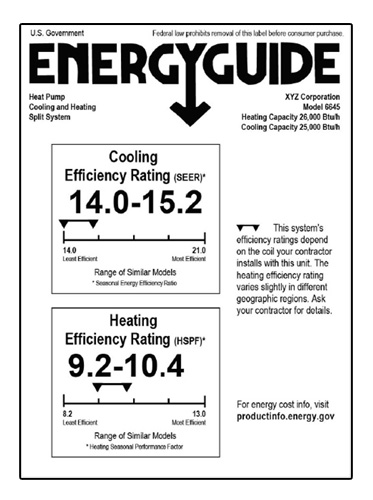
The updated upper portion will now include  a ‘range’ of the product’s efficiency rating, rather than a single number. There will also be text added to the label stating that installed efficiency depends on the installed coil. Further, the new label will include the efficiency range of similar products sold in the market. This feature will be similar to the comparisons displayed on the current label.

The lower portion of the label will contain information to help installers and consumers ensure that installed equipment complies with the Department of Energy’s (DOE) regional standards. It will provide additional content on regional standards, including a list of states where the model can legally be installed. A U.S. map illustrating regional standards information will appear on labels for products that do not meet standards in one or more regions. There will also be a link to the DOE’s database of certified equipment to allow installers and consumers to determine the ratings of specific condenser-coil combinations (https://www.productinfo.energy.gov).

What are the implications to the contractor?

Even though there will be a grace period for selling equipment manufactured before January 1, 2015, all of the equipment manufactured after that date will feature the new label.  All equipment installed after June 30, 2016, must be in compliance with the new regulations, and it is important that all contractors and HVAC technicians become familiar with the new labels and methods of determining compliance.  Since the system efficiency is dependent on the components installed, the contractor is going to play a crucial role in the implementation of the new standards. Be sure to take a proactive stance on understanding the 2015 regulations and continue to reference AC & Heating Connect to stay up-to-date on the details of the regulations and how they might affect you and your business.

Understanding Residential Energy Efficiency Regulations

The U.S. Department of Energy (DOE) recently announced changes to regulations regarding residential, central air conditioners.  Historically, residential air conditioning regulation changes have mostly affected equipment manufacturers and contractors who build and install your equipment.  However, you may be interested to know how these regulations can affect the cost the equipment you buy and your utility bill.

Energy efficiency standards for air conditioning were established to reduce the portion of our overall energy consumption that goes into cooling our homes and to make sure that we are using high efficiency air conditioning equipment to do it.  The Energy Policy and Conservation Act of 1975 specifies efficiency standards for several common appliances used in homes, including air conditioners.  The DOE can determine, from time to time, whether more stringent standards for these products would be technologically feasible and economically justified, and would save a significant amount of energy.

The energy efficiency of a central air conditioner is measured by its SEER rating. SEER indicates the amount of energy your AC unit consumes. The higher the number, the more efficient the equipment.  In 2006, the national energy efficiency standard for air conditioning changed from 10 SEER to 13 SEER (a 30 percent increase). The next round of efficiency standard changes will happen on January 1, 2015.

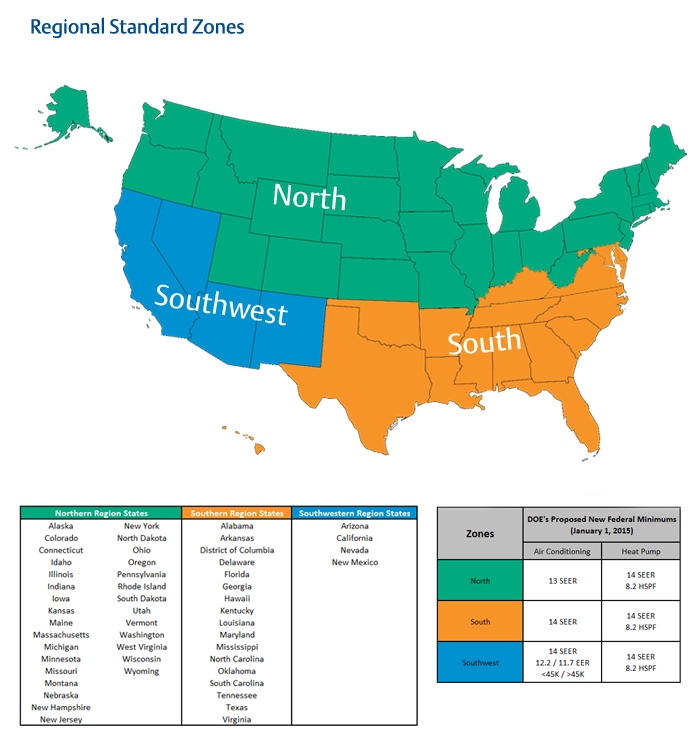
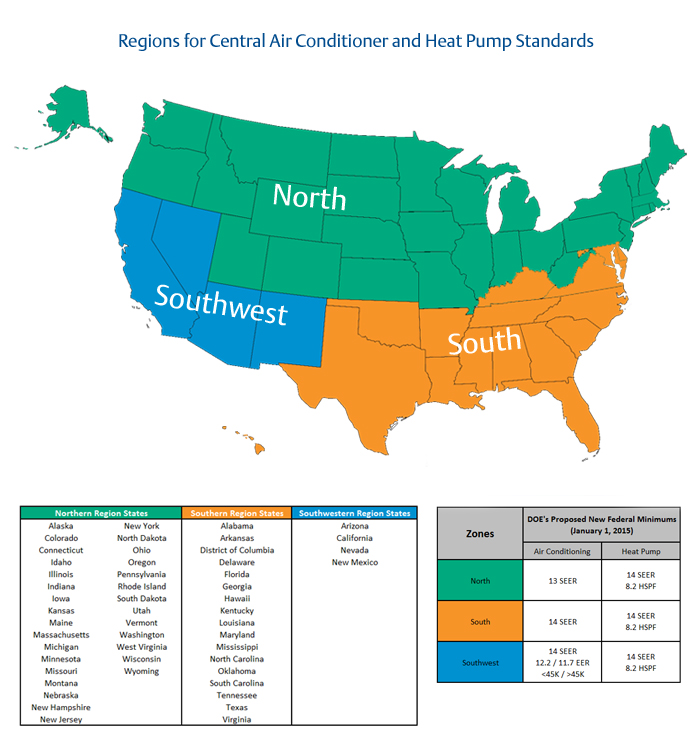
In 2015, the national standard is changing to a model that will specify separate regional standards for air conditioners based on various environmental factors, such as the length of the cooling season. The country will be divided into three regions, each with a different minimum efficiency requirement. The regions are North, South and Southwest. The map below shows the three regions and the table shows the new efficiency requirements for each area. The standards for heat pumps will continue to be national, but will change from 13 SEER to 14 SEER.

We expect consumers will see minimal effects from these changes during 2015 because there is an 18 month “sell through” period allowing the dealers in the South and Southwest regions to deplete their inventory of 13 SEER systems.  This also allows dealers in the North can deplete their inventory of 13 SEER heat pumps.  After January, there will probably be a gradual transition from 13 SEER to 14  SEER in the effected regions, with all sales moving to the new standard by July 1, 2016.

As you might have guessed, the price of a 14 SEER unit is going to be slightly higher than the price of a 13 SEER. This is because 14 SEER equipment requires more copper, aluminum and steel to achieve that rating.  The actual price you pay will depend on the brand you chose to buy and your geographic location, but in general, the prices for air conditioners and heat pumps will likely increase sometime during 2015 and early 2016, as the outdated equipment is sold off.

Regional Standard Zones

A Spring Weather Checklist for your Air Conditioner

8 Important Things to Check Before Switching the Wall Thermostat to Cooling

Updated post: Summer is Coming, is Your AC Unit Ready?

It is generally a good idea to consider doing some basic maintenance on your air conditioning and heating system at the beginning of every heating and cooling season.   This past winter’s “polar vortex” has been especially tough on outdoor equipment. These ultra-low negative temperature spikes, along with the extended times below freezing, can affect your home air conditioning system’s Spring start up. But with a few checks and a little effort, you can help to insure a trouble-free summer cooling season.

Spring HVAC Startup Checklist: Here are eight important things to check BEFORE switching the wall thermostat to cooling.

First, start with the outdoor unit:

1. Inspect the outdoor unit panels: These panels are designed to enclose the electrical connections and must be in place to help protect both you and the system. If you are missing a panel (possibly due to wind) or if the panel is misaligned, this could cause potential risks for both you and the operation of the equipment. If the panel covering the electrical connections is missing or out of place you should call a qualified technician for an assessment before starting your system.

2. Remove any condenser covers, coil blankets or lids: If you covered the outdoor coil in order to protect it during the winter months, be sure to remove the cover before starting the system. These covers protect and insulate the coil, but also limit any heat transfer. Starting the system with any of these covers in place, even for a short time, could severely damage your system.  Many people forget to remove their covers every year, often resulting in major repairs or even replacement of the whole system.

3. Repair or replace any damaged pipe insulation: The suction line (the larger copper pipe on the outdoor unit) helps to supply cool refrigerant back to the compressor in the outdoor unit. If the system’s suction pipe has damaged insulation, this could cause a loss of required cooling for the outdoor unit which could damage your system and may also cause you to lose energy as well. Damage to the foam insulation can be caused by sun rot, freezing water trapped in the foam or winter animals looking for shelter or food. The insulation should be intact to maintain system cooling. If the insulation needs replacing, do so before starting the unit. Look on the copper pipe for a size (5/8, 3/4, 7/8, etc.) to determine the coordinate size of insulation. It might be possible to find the insulation at a local hardware store.  NOTE: ONLY the larger line needs insulation. Do NOT insulate the smaller copper line.

4. Remove any debris from the outdoor coil: Depending on where you live or what side of the house your system is located on, you might find trash or vegetation blown into or against the coil. The system coils are designed to transfer heat, and any debris limits this effect. To get the best possible performance from your system, remove this debris from the coil and surrounding area. Also, while mulching in the spring, take care to not pack mulch around the base of the unit. This is especially true for heat pumps as there’s likely a space under the unit and this should always be kept open to allow good air flow to the outdoor unit.

Next, inspect the indoor unit:

5. Change the air filters: The change in seasons is usually a good time to replace your indoor air filters. The Polar Vortex this winter has probably caused your furnace to run a lot more than previous winters.  It’s likely that your indoor air filter will have gathered a lot more debris and dust than normal, so be sure to change the filter before the 2014 cooling season.  The link below provides a step-by-step guide to this process. (Be sure to pay attention to the airflow directions arrow on both the system and the filter – they both need to be pointing in the same direction).

How to Change Your Indoor Air Filter

6. Check the coil drainage hose: This hose (usually plastic) can also be called the “condensate line”. Since the coil’s temperature is lower than the ambient air, water will condense on the coil and drip into the tray below. This condensate needs to flow to a drain or the tray will fill up and flood the unit or potentially spill water into your basement. With the amount of time spent indoors this past winter due to the Polar Vortex affecting most of North America, it is possible that any impromptu soccer games or dodgeball matches in the basement might have moved this line. Check to make sure the line is in the proper place, attached, and will drain to the appropriate location.

7. Clean the supply vents and return grills:  Make sure the both the supply and return air grills and vents are open and free of debris.  It would also be good to use the vacuum to remove any pet hair or dust that might have accumulated during the previous season. Some houses have separate winter and summer supply grills, or house zoning and some even have separate systems – one for heating and one for cooling.  If you have a system like this you might have put extra plastic material over the AC vents to prevent drafts during the cold Polar Vortex months.  If so, it is important to remove these before you turn on the AC or you will not have proper air flow back through the system and this could cause severe damage.  In general, cleaning all grills at the beginning of every season is a good idea.

8. Turn it on and make sure it works:  After going through the check list, wait for a nice, hot day when you have some time to check the air coming out of the indoor vents for the first few minutes after starting it, and then every few hours throughout the day.  After the first few minutes, you should feel cool air coming out of the registers.  If no air is coming out, or if the air coming out does not feel cool, then something is wrong and you should immediately turn the system off at the thermostat.  You can go through the check list one more time and then try it again.  If the problem persists, turn the system off and call a good HVAC contractor who can diagnose the problem.  Leaving the system turned on when it’s not running properly can do a lot of damage.  It never hurts to ask a HVAC Professional to help diagnose the problems if your system is not working properly.

In summary, a brief inspection of your system now could help keep your system running worry free through the heat of the summer and fall and is especially important for older systems.  While performing this general inspection, take note of the overall system health in order to assess the likelihood of a problem. If your system is old and has endured an unusually harsh season, it might be time to call for help.  A qualified technician can help you do a more thorough spring technical inspection to avoid a system failure in the hottest months of the year. The technician can also help address any concerns you have so let the contractor know what you found during your own spring inspection. Summer is just around the corner and no one knows your house better than you.  If air conditioning is a necessity due to your lifestyle or geographical location, then be sure to get a professional’s opinion before time runs out.

Attached Checklist:

Outdoor Inspection:

1. Inspect outdoor unit panels – make sure they are all in place
2. Remove any unit covers or coil blankets from the outdoor unit
3. Repair or replace damaged or missing pipe insulation
4. Remove any leaves or debris from the outdoor unit coils

Indoor Inspection:

5. Change the indoor air filters
6. Check the indoor drainage hose
7. Clean the supply vents and air return grills
8. Make sure your system is working properly on start up and throughout the first day (and turn it off immediately if it is not working!)

Answers to Common Questions About 2015 Regional HVAC Efficiency Standards

There appears to be some concern about what is really going to happen when the new, residential unitary air conditioning efficiency regulations go into effect later this year so we put together a list of questions and answers to help HVAC contractors keep current on what they need to know about these new standards.

I heard the new regulations were being challenged in court.  Will they get thrown out entirely?

Although there are some legal challenges to the exact implementation date, the next round of efficiency standards for residential air conditioning is still expected to apply to air conditioners and heat pumps installed on or after January 1, 2015.  And, even if the challenges are successful in delaying the enforcement date by a few months, contractors should still try to become familiar with the structure of the new regulations because that is not likely to change.  For example, there will actually be three, new minimum efficiency levels with the new regulations because the standards for air conditioning are different for the three specified geographic regions.  For more information about the actual regulation you can click on the following link:

http://www.ac-heatingconnect.com/how-to-prepare-for-new-regional-efficiency-standards/

In 2005 there was a large build ahead of old, low efficiency systems.  Will there be a build ahead like this in 2014?

In 2005, there was a build ahead of 10 SEER systems just prior to the 2006 implementation date.  It is unlikely that there will be a build ahead of that magnitude since the move from 13 SEER to 14 SEER in 2015 will be less challenging than the 2006 move from 10 SEER to 13 SEER and the cost increases driven by the 2015 change will be much smaller.  Also, since 13 SEER AC systems can still be sold into the northern region, there is less stress about having unsalable, low efficiency inventory around after the new regulations go into effect.    

What product changes can we expect from these new regulations?

The most significant product change in 2015 will involve moving all split-system heat pumps in all regions to the new national heat pump efficiency minimum of 14 SEER and 8.2 HSPF.  Since most, if not all U.S. manufacturers already have 14 SEER heat pump systems today, many are probably just refreshing their 14 SEER designs to optimize their product offerings for high volume.  Depending on the outcome of the legal debate mentioned above, contractors can probably expect to see the planned elimination of 13 SEER heat pumps from OEM lines and an increased offering of new, low cost, 14 SEER heat pumps which should be available on time for 2015 stocking programs.

Will the yellow “hang-tag” efficiency labels be changing with the new regulations?

Yes.  One consequence of the regional nature of AC standards is the change to the FTC energy guide label. This is the yellow label that is attached to the unit with SEER and HSPF rating of the unit shown in relation to the range of similar models. One change to this label is that it will not show just one rating point for split-system air conditioners and head pumps (i.e. systems that consist of an outdoor condenser and an indoor coil).  Split-system air conditioners and heat pumps will now be shown as a range representing the lowest and highest SEER ratings for all of the condenser’s certified coil combinations Consider a unit with rated efficiency that can range from 13-14.5 SEER depending on the selection of the indoor system, blower and coil combinations.   It is possible that this outdoor unit might have a suitable Indoor match which would allow it to be installed in all three regions.  In this case, it would become important to track both the outdoor and indoor model numbers and check the rated system performance for each installation to ensure it is compliant with the new regulations.

Are there any tools we can use to determine if the indoor and outdoor equipment is qualified?

One useful tool to determine the matched system performance is the AHRI directory which contains the database of all system performance certifications (http://www.ahridirectory.org/ahridirectory/pages/home.aspx).   By entering a few parameters like the outdoor and indoor model numbers you can determine the expected performance of the combination.  The ruling on enforcement method is still pending, but it would be prudent for contractors to prepare for the eventual regulation changes by becoming familiar with this directory since it is likely that contractors are going to be involved with the process of insuring that the equipment they are installing meets the minimum regulations.

Do we know how the DOE is planning to enforce the new regulations?

Although the specific roles and responsibilities of the contractor, distributor and manufacturer are not defined yet, it is likely that all parties will be involved with some aspect of enforcement.  In any case, contractors should be able to verify that the equipment being installed meets the minimum standards provided by the new regulations and also meets the expectations of the consumer.

Glossary of HVAC Regulation Terminology

Industry regulations can be complicated, but we’ve developed a list of terms from A to Z that will help contractors and facility managers better familiarize themselves.

AFUE
Annual Fuel Utilization Efficiency rating. A rating system for furnaces that compares energy input and energy output.

AHRI
Air Conditioning, Heating, and Refrigeration Institute.  A North American trade association of air conditioning, heating, and commercial refrigeration equipment manufacturers.

Air conditioner
A system or an assembly comprised of certain system components that are designed for the control of air temperature, relative humidity and air flow in a living or working space.

ANSI
American National Standards Institute.  An organization that develops standards for a variety of industry sectors including HVAC.

ANSI/AHRI Standard 340/360
This is the standard for performance rating of unitary air conditioning and heat pump systems from 65,000 to 250,000 Btu/hr.

AHRI Standard 540-91
A method of rating compressor performance, published by AHRI and used widely by the industry.

ASHRAE
American Society of Heating, Refrigeration and Air Conditioning Engineers. An organization focused on building systems, energy efficiency and indoor air quality in the heating, ventilation, air conditioning and refrigeration industry.

ASHRAE Standard 55
Provides Thermal Environmental Conditions which help define a Human Occupancy Standard. ASHRAE 55 is intended to provide a design standard which considers both the comfort needs of a majority of the occupants and the overall environmental sustainability of the building.

ASHRAE Standard 62.1
Ventilation for Acceptable Indoor Air Quality Standard. Compliance with ASHRAE 62.1 indicates that the building meets the minimum ventilation requirements set forth by ASHRAE Standard 62.1.

ASHRAE Standard 90.1
Energy standard for buildings, except low-rise residential buildings. ASHRAE 90.1 has been a benchmark of U.S. Commercial building energy codes.

ASTM
American Society for Testing and Materials.  An international standards organization that develops and publishes voluntary consensus technical standards.

BTU
British Thermal Unit.  The quantity of heat required to raise the temperature of one pound of water by one Fahrenheit degree.

CAE ratio
Combined Annual Efficiency ratio. A rating system used for combined heating systems, which heat both air and water.

CFC
Chlorofluorocarbon refrigerants are composed of chlorine, fluorine, and carbon. CFCs have been shown to deplete the ozone layer. Common examples include R-11, R-12, and R-13.

COP
Coefficient Of Performance.  The ratio of the work performed to the energy used by an air conditioning or refrigeration system.

Defrost
A part of the refrigeration cycle in which evaporator frost and ice accumulation is melted.

DOE
U.S. Department of Energy.  A federal agency that, among other objectives, is responsible for setting HVAC minimum equipment efficiency standards.

Economizer
Used to reduce the mechanical cooling load, an economizer allows the use of outside ventilation air for supply air when the enthalpy or temperature of the outdoor air is lower than required supply air during the cooling cycle.

EER
Energy Efficiency Ratio. A ratio of cooling capacity (in Btu/hr) to energy consumed (in Watts) used to determine the energy efficiency of an air conditioner the higher the EER rating, the more efficient the unit.  EER ratings are generally lower than Seasonal Energy Efficiency Ratio (SEER) ratings because SEER ratings are seasonally adjusted while EER ratings are calculated against a fixed ambient temperature.

Efficiency
A measure of how much energy is used to accomplish a cycle, measured by ratios such as SEER, EER, IEER, IPLV, or HSPF.  The higher the rating, the more efficient a system is and the lower your energy consumption will be.

Energy Audit
The process of accurately determining the current energy consumption for a given area of a refrigeration or air conditioning system.

Energy Star® Applied to unitary equipment 20 tons or less, Energy Star® labeled equipment exceeds Environmental Protection Agency (EPA) guidelines for energy efficiency.

Enthalpy
Total amount of heat in one pound of refrigerant calculated from an accepted temperature base.

EPA
Environmental Protection Agency.   A governmental agency empowered to protect the environment.

EUI
Energy Utilization Index. A number used to compare energy usage for different areas. It is calculated by dividing the energy consumption by the square footage of the conditioned space.

F-Gas
Generally refers to Fluorinated gases (e.g. hydrofluorocarbons) which are often used as refrigerants.  Studies have shown that these chemicals can contribute to a global greenhouse effect, global warming, global climate change, etc.

F-Gas Regulations
Generally refers to a series of European Union refrigerant regulations dealing with Flourinated gases.  The F-Gas regulatory approach is based on containment and recovery of Flourinated gases as well as restrictions on the use of Flourinated gases in HVAC equipment and other applications.

Flooded system
A type of air conditioning or refrigeration system in which the liquid refrigerant fills most of the evaporator at all times.

Geothermal
An underground or underwater temperature source used for the operation of a heating and cooling system.

Glide
The temperature difference in a refrigerant that occurs between the vapor state and liquid state during evaporation or condensation at constant pressure.

GWP
Global Warming Potential. A relative measure of how much heat a greenhouse gas traps in the atmosphere.  CO2 is given a GWP of 1, and all other gases are measured relative to this.

HCFC
Hydrochlorofluorocarbon refrigerants are composed of hydrogen, chlorine, fluorine, and carbon.  Damaging to the ozone layer, but to a lesser degree than CFCs. R-22 and R-123 are examples of hydrochlorofuorocarbon refrigerants.

Heat pump
Compression cycle system used to supply heat to a temperature-controlled space. A reversible heat pump system can also remove heat from the same space i.e. air conditioning cooling in the summer and heating in the winter.

Heat transfer coefficient
A measure of the amount of heat that a material or combination of materials will allow through; also known as the U-value.

HFC
Hydrofluorocarbon refrigerants are composed of hydrogen, fluorine, and carbon. HFC refrigerants do not contain any ozone depleting chlorine. Common examples include R-134A, R-404A, R-407C, R-410A, R-422A/B/D, and R-507.

HVAC
Heating, Ventilation, and Air Condition. The term HVAC is used to describe the industry and technology of indoor environmental comfort. Refrigeration is sometimes added to the field’s abbreviation as HVACR.

HFO
Hydrofluoroolefins.  A new class of low GWP refrigerants with lower global warming potential than HFCs. Examples of HFO refrigerants include HFO-1234yf and HFO-1234ze.

Hot gas bypass
Piping system used to reduce system capacity by moving hot refrigerant gas from the condenser into the low pressure side.

HSPF
Heating Seasonal Performance Factor.  It is a measure of efficiency for air source heat pumps. A higher number represents higher efficiency.

IAQ
Indoor Air Quality.  The status of indoor air as measured by numerous factors.

IECC
International Energy Conservation Code. IECC is a code that establishes minimum design and construction requirements for energy efficiency.

IEER
Integrated Energy Efficiency Ratio. This ratio expresses cooling and weighted part load EER for commercial unitary air conditioning and heat pump equipment at different loads.

IPLV
Integrated Part Load Value.  This value defines the efficiency performance factor at part load cooling, and is commonly used on chiller systems. It is weighted toward operating hours at part load.

Latent load
Load due to moisture introduced into a building. Latent loads may come from ventilation air, people, equipment and infiltration. Latent loads are a concern for cooling and humidifying applications.

LCCP
Life-Cycle Climate Performance.  A method of calculating the global warming impact of any product which includes both the direct impact (from refrigerant leaks) and the indirect impact (from the energy consumption), which comprise TEWI and the energy associated with refrigerant production and the impact of end-of-like decommissioning of the equipment.

LEED
Leadership in Energy and Environmental Design. Sponsored by the U.S. Green Building Council (USGBC), LEED is a certification program that guides the design, construction, operation and maintenance of buildings and homes.

MERV
Developed by ASHRAE as a rating system for filters, Minimum Efficiency Reporting Value rates filter performance on a scale of 1 to 16. The higher the MERV value, the more efficient the filter is at trapping airborne particles.

Natural refrigerant
These occur in nature’s biological and chemical cycles without human intervention.  Examples include ammonia, carbon dioxide, natural hydrocarbons, water and air.

ODP
Ozone Depletion Potential.  A relative amount value indicating the potential of a substance to destroy ozone gas as compared to CFC-11.

PSC motor
Permanent-Split Capacitor motor (also known as a capacitor start and run motor).  Frequently used in air handlers, blowers, and fans and other cases where variable speeds are desired.

Rating point
A specific operating condition in which the performance of a system is evaluated and published.

R-value
A measure of the resistance of an insulating or building material to heat flow. The higher the number, the greater the resistance to heat flow.

SEER
Seasonal Energy Efficiency Ratio. The SEER rating is the cooling output divided by the total electric energy input during a typical cooling season. The higher the rating, the more energy efficient a system is.

Shaded-pole motor
A small AC motor designed to start under light loads.

Split-phase motor
A motor with two stator windings. Both windings are in use while starting. One is disconnected by centrifugal switch after the motor attains speed. The motor then operates on the other winding only.

Squirrel cage
A fan that has blades parallel to the fan axis and moves air at right angles, or perpendicular to the fan axis.

Subcooling
The amount of heat removed from of liquid refrigerant below its condensing temperature at a given pressure.

Superheat
The amount of heat added to vapor refrigerant above its boiling temperature at a given pressure.

Swamp cooler
An evaporative-type cooler in which air is drawn through porous mats soaked with water.

TEWI
Total Equivalent Warming Impact. The sum of the direct global warming impact (from refrigerant leakage) and indirect global warming impact (from energy consumption and the indirect emissions from the energy used to operate the system) measured over the service life of a system.

Thermal Resistance
A measure of a material’s resistance to heat flow. Measured as the R-value.

Total Energy Management
A conservation concept where a building is analyzed in terms of its total energy usage, rather than its individual systems.

U-value
A measure of the flow of heat through an insulating or building material. The lower the U-value, the better the insulating ability.

VAV
Variable Air Volume.  A type of HVAC system where variable air flow rates are used to distribute conditioned air to meet the changing load conditions of the space or spaces being served.

Wet bulb temperature
A measure of the degree of moisture in the air. It is the temperature of evaporation for an air sample.

Zeotropic
A refrigerant blend, comprised of various refrigerants, that changes in volumetric composition and saturation temperature when used.

Chiller Efficiency Improvements Coming in 2015

Chiller efficiencies for air and water cooled chillers will be significantly increased in 2015.  An addendum to ANSI/ASHRAE/IES Standard 90.1-2010, Energy Standard for Buildings Except Low-Rise Residential Buildings, continues the energy efficiency improvements that were implemented in 2010.  The efficiency requirements increase overall annual energy savings by 8.3 percent compared to 2010.

The 2015 chiller standard addresses both full-load and part-load efficiencies:

  • Air-cooled chillers must be 26 percent more efficient than the current ASHRAE 90.1 standard
  • Water-cooled chillers must be three to five percent more efficient at full-load and 16-19 percent more efficient at part-load

According to the Department of Energy, chillers consume more than 50 percent of electrical energy during seasonal periods of building use. More than 120,000 chillers in the U.S. are expending more than 30 percent in additional energy through operational inefficiencies.

The two most common energy efficiency ratings given to chillers are full load kW/ton, and Integrated Part Load Value (IPLV). This is also measured in kW/ton. IPLV weights the chiller efficiency at four different loads and condenser water temperatures to attempt to better approximate actual usage over a typical year. Full load is only given a one percent weighting; 75 percent load is given a 42 percent weighting; 50 percent load, a 45 percent weighting; and 25 percent load a 12 percent weighting.

HVACR compressor manufacturers strive to deliver high levels of efficiency, comfort and reliability in a market that also demands affordability and compliance with environmental laws. Today, a robust combination of regulatory requirements and customer preferences is driving manufacturers to achieve unprecedented levels of compressor efficiency without sacrificing reliability and comfort.

Compressor suppliers have responded to this demand by providing innovative products that can help chiller manufacturers improve system efficiency through variable capacity technologies or operating point optimization. Modulation makes it possible to tailor compressor performance to changes in ambient conditions improving comfort and part-load efficiency. Optimizing compressors for the unique operating conditions of chillers drives significant improvements in both full-load and part-load efficiency.

Chiller manufacturers are working now on redesigns to boost full-load and part-load energy efficiency of water and air cooled chillers.  Several industry experts have noted that we are reaching maximum technological limits at a component level and that in the future the industry will have to look at the full HVAC system for further improvements. AHRI has formed a new working group to address systems approaches for efficiency improvements and will work closely with Standard 90.1.

More information on how to reduce chiller operating costs can be found at www.ncdenr.com

Meeting the Comfort and Efficiency Needs of Schools and Churches

Anyone who has ever addressed a crowded room would agree – comfort is critical to participation and creating an overall positive experience.  Many studies have concluded that air conditioning is the most critical factor in providing a comfortable, climate controlled environment for learning.

Schools and churches are just two types of facilities where both a comfortable environment and energy costs matter a great deal.  These organizations cannot afford to waste their operating budget on high energy costs driven by oversized mechanical equipment.  Recent advances in HVAC controls technology and capacity modulation methods are now featured on equipment that can closely match variable loads that are common in schools and churches.  These facilities require equipment that can effectively and efficiently cool or heat large spaces when they are filled with people and when there are just a few people – a real design challenge.  These modern HVAC systems with capacity modulation can quickly pay for themselves in church and school settings simply through the energy savings generated from modulating back in off-peak conditions.  These systems also provide optimum comfort during both peak and non-peak periods.

HVACR compressor manufacturers strive to deliver high levels of efficiency, comfort, and reliability in a market that also demands affordability and compliance with environmental laws. Today, a complicated combination of regulatory requirements and customer preferences is driving manufacturers to achieve unprecedented levels of compressor efficiency without sacrificing reliability and comfort.

Compressor suppliers have responded to this demand by providing innovative products that can help air conditioning original equipment manufacturers (OEMs) improve system efficiency. This is achieved through modulating capacity technologies where the cooling capacity of the system is tied to the load, not an application’s peak requirements. Modulation makes it possible to tailor compressor performance to changes in ambient and varying load conditions, eliminating big swings in temperature and relative humidity levels throughout a building.

These innovative products address the key needs of facilities such as schools and churches, where comfort and operating costs are critical to the success of the organization.  Ask your equipment distributor or contractor about new modulating capacity cooling systems for the most comfortable environment and the lowest energy costs.

Air Conditioner Noise Advice for Facility Managers

It’s Important to Know When to Call a Professional About AC Unit Noise

Sometimes our cars, appliances, and even air conditioners make the strangest noises, but how do you know if they’re normal or if something might be wrong? It’s not always as easy as hitting the ‘restart’ button on your computer, so it’s important to know when you should call a professional or contractor to check it out. The following are some tips about what sounds are normal and what indicates professional problem when it comes to your air conditioning unit.

Outdoor unit noise is normal upon start-up and shut down.  The outdoor unit is where most of the mechanical operations in your system take place and depending on the type of equipment, it can be noisy and somewhat varied when it starts up and/or shuts down.  Typically, most air conditioners make noise when they first cycle on, which can be caused by the buildup of pressure in the refrigerant lines or from bearings, fans or other moving pieces starting up.  The same is true when the unit cycles off, or comes to a stop, as the pressures need to equalize.   Sometimes this causes a unique noise that sounds like air escaping, a click or rattle.

  • Tip: If the start-up and shut down sounds are the same from cycle to cycle and not too loud, it’s probably normal and not worth calling a contractor.

Outdoor unit running noise after start-up can also vary among different types of equipment.  Once the outdoor unit starts up, it should reach a consistent sound where you hear the fan blowing and the other mechanical parts humming along.  Sometimes you might hear a cycling sound over the period of a few seconds where the unit changes the pitch of its normal running sound and might get louder or quieter in “waves.”  If it gets increasingly louder as the system is running, then it might require a contractor to see whether it is out of balance or requires further inspection.  If you hear a loud, intermittent mechanical “scraping” or “banging” noise, this is not normal and you should shut your system down and call a contractor to inspect it as soon as possible.

  • Tip: Significant changes in pitch or ‘banging’ noises indicate you should call a contractor.

Indoor unit sound is usually the sound of the fan moving air through your system.  It is most noticeable when the system turns on and off. If you have a high efficiency system (16 SEER and over) you could hear two distinct sounds as your system moves from high to low cooling speed.  The high speed sound can be noticeable, but the low might be so quiet you can barely hear it.

  • Tip: Air moving through your system should sound smooth and consistent once it is running.

In general, sound is a subjective attribute and the above descriptions are provided as a guideline for noises that could potentially signal a costly problem.  In addition, we have recorded some typical compressor sounds you might hear during a normal start up, run and shut down cycle as examples.

compressorsoundlink2


Sounds like the ones you will hear in this audio file are typical examples of what you might hear during normal operation in a healthy system.

Related Articles

HVAC Glossary of Terms

Changing Your Home Air Filter Is Easy To Do and May Prevent Costly Future Repairs

Changing your air conditioning system’s air filter is a maintenance task that is easily forgotten. Though, this quick fix is an important part of keeping your system running smoothly and should be done regularly – every three months or at the beginning of each season. Whether your filter is a true pleated (collapsible) style or a self-contained cardboard framed filter, replacing it can usually be done in less than 20 minutes and extend the life of your system, improve comfort, and increase efficiency. In the case that your thermostat doesn’t have a filter display alert option, simply set up a reminder in your smartphone or computer calendar with what filter to buy every 90 days or so.

With all the talk about air pollution and global climate change, it’s often forgotten that the United States Environmental Protection Agency identifies one of the top five environmental health risks as Indoor air pollution. Regularly replacing your air filter helps to lower this risk by reducing, or even eliminating indoor air pollutants. These include pollen, dust, dander, smoke, pesticides and cleaning products, and even particles and gas generated from cooking stoves.

As we near the transition from summer to fall, consider these few things when maintaining your system:

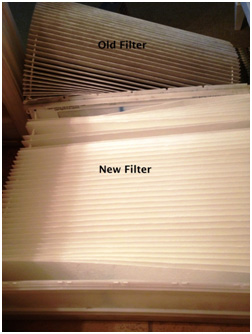
  1. Looks Can Be Deceiving – Upon initial inspection of your filter, you may notice that it appears to be clean. Although the outside may look this way, there could be dust and dirt particles lodged on the inside. Leaving a filter in for too long can decrease efficiency and even harm the system. A quick inspection of the inside, as well as a comparison of your current filter to a new one could help in making the decision whether a replacement is necessary or not.
  1. 20 Minutes or Less – Changing your home air filter is not a daunting task. By following the instructions that came with the system itself, or the ones usually provided with the replacement filter, replacing the filter shouldn’t take any more than 20 minutes. However, if you find that the task becomes too complicated, call your local contractor for assistance.
  1. Great Performance – Keeping blower motors and other components clean is important to ensure that air can move through the heat exchangers. A good, clean air filter can remove much of the dust and dirt from the air-conditioned space, as well as those components, thus maintaining great performance and extended the life of the system.
  1. When to Call a Professional – Even if you are changing the filter regularly, if it comes out appearing extremely dirty, cleaner than expected, or has insects or mold visible, have the system inspected by a contractor. Also, if particles are visibly being released from indoor registers, we would recommend calling a contractor for inspection.

Here’s a quick look at a pleated air filter replacement.

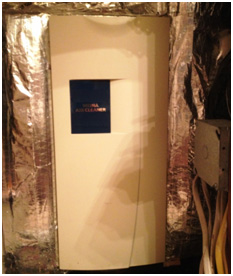
Locate your HVAC air filter.First, turn off the system – make sure it is not running while you are changing the filter. Then, locate your filter (many are at the base of the unit, though, this one was in a utility closet).


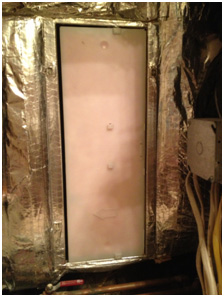
Remove your air filter cover.Once the cover is removed, follow the instruction on the box to replace the filter cassette.


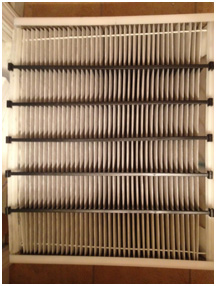
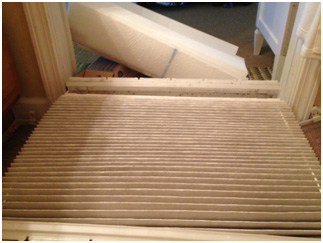
Replacing your home AC air filter.Home air filter removalHere you can see the filter as air would be passing through it.


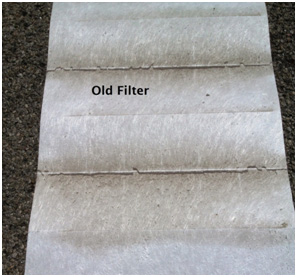
When to replace your HVAC air filter.HVAC air filter comparison.Notice the color difference between the old, dirty filter and the clean, new filter. Place the new filter in the cassette.


For a more detailed look, check out the following step-by-step video on home air filter replacement.

How to Change Your Pleated Air Filter