Three benefits of the smart thermostat

Upgrade to a smart thermostat and ditch the outdated model that is costing you money

Struggling to maintain a comfortable and consistent home temperature? System cycling too fast or too slow? Home thermostat reading doesn’t seem to match the actual room temperature?

An outdated model can not only make you uncomfortable; it can cause HVAC inefficiencies that can cost you money.

3 Perks of the Modern Wi-Fi Thermostat

1. Comfort

Off-brand digital or older mechanical home thermostats are less precise than modern units. These outdated models can cause your HVAC system to cycle too fast or too slow. Not only can this make your home uncomfortable, but it can also strain your system and your utility bill.

2. Features

If you find yourself struggling to read the controls on your old home thermostat, look for a newer smart thermostat model that has more features. A large, easy to read display and keypad lockout are two of many features found in modern smart thermostats.

3. Convenience

Ever wake up to a freezing house and wish you didn’t have to trek down a long hall to turn up the thermostat? Turned the thermostat setting up while on vacation to save money and had to return home after a day of traveling to a sweltering house? Dreamed of being able to control a home appliance with only your voice? The correct smart thermostat can help with all of these things.

Most smart thermostats have free mobile apps that serve as an intuitive remote control, allowing you to set, change and schedule your home thermostat temperature from your bed, your couch, across the room or the country.

When you do replace your home thermostat, remember to dispose of your previous unit properly, especially if is a mercury thermostat. Each state has specific laws and collection programs. You can find more information at thermostat-recycle.org.

Find the best smart thermostat for your home here.

Four Signs of a Refrigerant Leak

Learn the red flags to let you know whether you have a refrigerant leak

We get it ‒ your AC unit isn’t something you think about every day. But it’s still important to regularly check its performance. By catching red flags early, you can maintain a cool temperature within your home and avoid shelling out thousands on repairs. A refrigerant leak is a common problem for air conditioners during the summer months. The following signs may indicate there’s a leak in your AC unit.

Is your electric bill higher than usual?

A refrigerant leak can cause your AC unit to work harder than normal. If your utility bill has unexpectedly skyrocketed, your air conditioner may be leaking.

Is your air conditioner inefficient?

When AC units experience a refrigerant leak, they lose the ability to reach the set temperature on your thermostat. A faulty unit may also run longer than usual.

Are you experiencing increased humidity inside your home?

It should only take a functional air conditioning system about 15 minutes to properly dehumidify your home.

Are ice crystals forming on your evaporator coil?

Ice crystals are a tell-tale sign of a refrigerant leak. It’s important to check your evaporator coil (indoor coil) periodically for new formations.

If you answered yes to any of the questions above, it might be time to give your local HVAC contractor a call.

Most AC leaks are easy to repair if caught early on. And with record-breaking temperatures this summer, there’s no better time to check that your air conditioner is in tip-top shape.

Find the Best Smart Thermostat for Your Home

Use this smart thermostat checklist to find your perfect match

You’ve read all the news stories about smart home products. And you’ve heard many of your friends brag about their connected gadgets. You know the benefits of home automation. So you’ve finally decided to take the plunge and update your traditional thermostat to a smart thermostat.

One of the easiest smart home entry-level devices is a smart thermostat. But how do you know which one is right for you? Use this simple thermostat checklist to help narrow down the smart thermostat selection to find your perfect match.

Budget

One of the first things people look at is the price. Some smart thermostats can run as high as $250, and that’s just for the device. Others charge monthly monitoring fees and not all have a free mobile app. Before you purchase, you can also check online to see if you qualify for a rebate from your utility provider.

Quality

After you’ve narrowed down the field with price, you’ll want assurance that you are purchasing a quality device. Look for thermostats that are Energy Aware Qualified®.

System Compatibility

Next, you’ll want to make sure that the thermostat you purchase is compatible with your thermostat wiring and the type of heating and cooling equipment in your home. One of the most important factors in determining compatibility is whether or not your system has or will require the common, or c-wire.

If you aren’t an engineer, or familiar with HVAC systems and how they work, wiring can be intimidating. Before making your selection, read more about the c-wire here to help you better understand what it is and how it works with your thermostat.

Ease of Install

Most homeowners prefer to install the thermostats themselves. Why waste an hour thumbing through a user manual when you can install and connect by using your phone?

You’ll also want to consider the thermostat design. Look for a thermostat that is designed to cover the existing thermostat footprint, which means no messy wall patches, repairs or painting.

Features and Functions

A 2010 study by Lawrence Berkeley National Laboratory revealed that most people who have programmable thermostats don’t actually program them and use the manual settings instead. Why aren’t people programming their thermostats? Simple. Because they can’t figure it out.

Look for a thermostat with easy to understand navigation. Using the mobile app, you should be able to create custom temperature schedules for each day of the week.

Remote Access

It’s not a connected device if you can’t stay connected. Most smart thermostats have mobile apps, so you can change your settings and adjust your thermostat schedule from across the room or the country. It’s the perfect tool for the moms and dads too busy herding the family for the annual vacation to think about the thermostat settings. Or for the harried business traveler who is more worried about the big client presentation than home energy efficiency. There’s nothing worse than realizing that you forgot to adjust your thermostat when you arrive at the airport or have already driven halfway across the state.

As you can see, there are a lot of things to consider before you purchase your first smart thermostat. By following this thermostat checklist, you’re well on your way to choosing the perfect match.

Three Common Misconceptions About Smart Thermostats

Learn about the benefits of smart thermostats and home temperature control.

Smart thermostats and smart devices are in more homes than ever as consumers become more familiar with home automation technology. Despite the increase in adoption, there are still some common misconceptions about smart thermostats. Are you missing out on the convenience and cost-savings connected home products offer? Let’s take a moment to quell these myths about Wi-Fi thermostats.

I’ll never use it.

When was the last time you changed the TV channel without a remote? You’ll feel the same way after using smart thermostats. Once you start using home automation technology, you’ll never know how you lived without your thermostat remote control. Set, change and schedule your home temperature from across the room or across the country.

It will be too hard to install.

So you’re a little apprehensive about thermostat installation? We understand that some options on the market can be a tad intimidating. For most Wi-Fi thermostats, you don’t need to be a handyman to install. Just download the mobile app. The clearly illustrated in-app instructions will easily guide you through each step of the thermostat installation and connection process with confidence.

They’re too expensive.

If you’ve already started researching smart thermostats, you probably know that many popular smart devices can cost as much as $250. Some even charge monthly fees. Installing and programming an energy-efficient thermostat can help you to reduce wasteful heating and cooling without sacrificing your home comfort. Being connected makes it easy to reduce your energy costs by simply turning the dial down a few degrees when you aren’t home or when you’re sleeping.

And you’re not the only one interested in thermostat savings. Your utility company is too. Since your home energy efficiency generates energy reduction results for them, many utilities offer consumer thermostat rebates and incentives for your purchase.

Before you buy one of the new internet thermostats –

  • Make sure you have a good Wi-Fi connection.
  • Know your HVAC system and check for compatibility.
  • Make sure your new device works with your existing smart home automation hub.

Smart Home Upgrades That Help Sell Your Home

Smart home upgrades aren’t always top-of-mind for many sellers in today’s real estate market. Many look to invest in home improvement projects that pay off in the short-term with the best bang for their buck. A fresh coat of paint. New plants for curb appeal. Modern appliances. But the best home improvements to invest in might not be these typical choices. If you’re looking to sell your house, you might want to consider adding smart home products.

Smart Home Upgrades

As smart home technology has become more mainstream, buyers expect these types of gadgets. Eighty-one percent of people would be more likely to buy a home if smart technology was already installed.* And new smart home upgrades aren’t just appealing to younger buyers. Interest in home automation gadgets crosses generations and income levels.

One of the easiest smart home upgrades is to add a smart thermostat. Easy to install and managed through mobile apps, Wi-Fi thermostats are also compatible with Apple HomeKit, Amazon Alexa, and Wink home platforms.

Another easy project is to add smart lighting, which can be as simple as screwing in a new Wi-Fi-enabled bulb.  Advanced lock technology can give the buyer the impression of heightened safety and security. All of these products can also help you to monitor a vacant home and give your real estate agent more selling points.

In a recent study, nearly one-third of 2015 homebuyer respondents plan on adding home automation gadgets to their new homes. But only 1 in 5 of those planning on selling in 2016 intend to add any smart home upgrades.** Don’t miss out on an opportunity to differentiate your home in this competitive real estate market.

*Coldwell Banker and CNET Smart Home Survey (August 2015)

**2016 Houzz & Home Study

Should it Stay or Should it Go? When to Replace Your AC

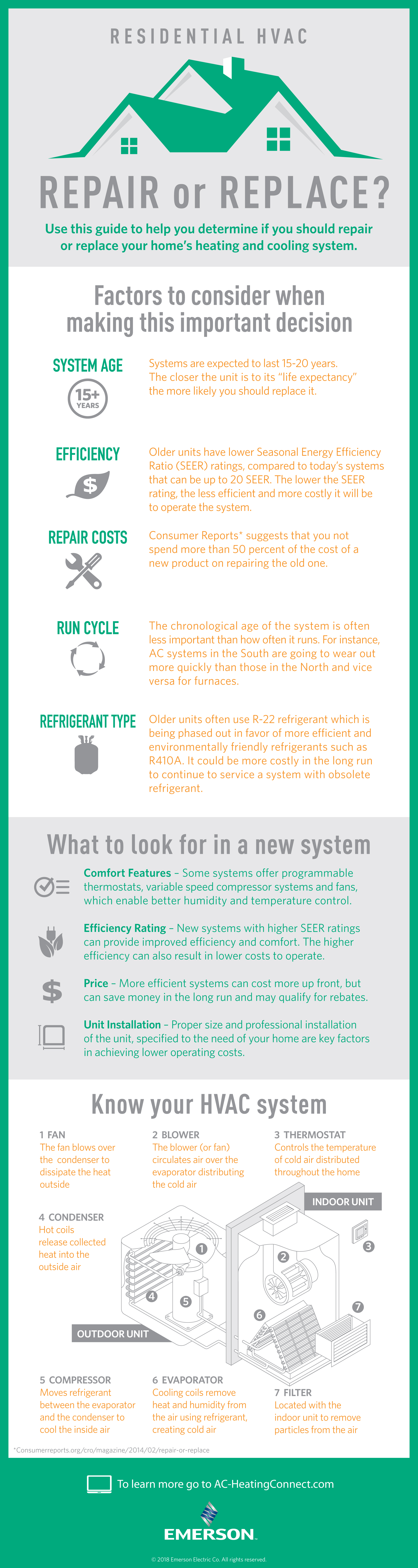
It’s not easy to know whether you should repair or replace your HVAC system, especially if you have an emergency situation. How do you know when you should consider a newer, more efficient system? While there are no hard and fast rules, we’ve created an infographic that will walk you through the factors to consider before making this important decision as well as what to look for when comparing new systems.

025079-repair-or-replace-residential_v6

To download the infographic in pdf, please click here.

Understanding SEER | You don’t need a seersucker suit to stay cool

seer Wearing a seersucker suit isn’t the most fashionable way to keep cool, but men wore the all-cotton fabric for decades as an alternative for wool suits.

Seersucker suits used to be an excellent way to stay cool when air conditioning was nonexistent or more uncommon than it is today. But, you can leave your seersucker suit in the closet this summer. Learn how to choose the most efficient air conditioner for your home.

Seasonal Energy Efficiency Ratio (SEER)

Seasonal Energy Efficiency Ratio, commonly referred to as SEER, measures the cooling efficiency of your air conditioner. It’s often compared to gas mileage. A car with a higher gas mileage runs more efficiently. Similarly, an air conditioner with a SEER rating is more efficient. However, a SEER rating is a maximum rating.

Understanding key terms will help you work with your HVAC contractor to choose the most efficient air conditioner for your home. Proper sizing of your air conditioner should only be done by a trained and certified contractor. Now keep your seersucker suit in the closet!

Are Your Energy Costs Through the Roof? How to Identify Leaking Ductwork

Many consumers install high-efficiency HVAC equipment in their homes with high expectations. They want increased comfort, better indoor air quality, and most importantly, reduced energy bills. However, too often, homeowners are disappointed with the results, especially the high bills. Leaking ductwork might be contributing to your high energy bills below. Learn more below.

My HVAC system is supposed to be efficient. Why are my bills so high?

There is more that contributes to the efficiency of an HVAC system than just the equipment. We’re talking about ductwork. Installed in attics, crawlspaces and inside wall cavities, ductwork is used to carry conditioned air to the various rooms of your home. When the ductwork is not sealed, air leakage often leads to a loss of efficiency, reduced comfort, and higher utility bills.

How bad do ductwork systems leak?

According to Energy Star, HVAC systems lose 20 to 30 percent of the air that moves through the duct system due to leaks, holes or poorly constructed ducts. Leaks lead to reduced airflow, which causes temperature inconsistencies throughout the home. One room might be comfortable while the back of the house is not. Leaking ductwork also pulls in dust, fumes and other contaminants that affect indoor air quality.

How do I fix leaking ductwork?

The first step is to make sure that your ductwork is leaking, and it’s not a different problem. Other concerns include:

  • Undersized ducts;
  • Collapsed ducts;
  • And disconnected seams.

A professional HVAC contractor can help identify the issue and provide guidance on how best to repair.

What is the best method for sealing the leaks?

There are several ways to seal ductwork including mastic sealants, tape, and aerosols.

  1. Brush mastic, a sealant compound, on the leaking area. Once it dries, it will seal the leak.
  2. Apply tape to leaking ductwork. Metal tapes last longer than the typical fabric backed duct tape.
  3. Use aerosols in cases where the leak is not easily accessible.

The three types mentioned above are all good options and will do an excellent job sealing the ductwork.

After fixing the ductwork, homeowners can expect to have better airflow, increased comfort, and reduced utility bills. The extent of changes will depend on the original condition of the ductwork system.

Geothermal Tax Credits

Congress recently reinstated geothermal tax credits for residential and commercial geothermal heating and cooling systems. They provide a 30 percent tax savings for residential installations and a 10 percent commercial tax credit. And homeowners who installed a geothermal system in 2017 can still claim the 30 percent credit.

Similar to ordinary heat pumps, geothermal heat pumps use the ground (instead of outside air) to provide heating, air conditioning, and hot water. Because it uses the earth’s natural heat, this technology is one of the most efficient heating and cooling options available.

Federal Geothermal Tax Credits

The Bipartisan Budget Act of 2018 reinstated tax credits for fuel cells, small wind and geothermal heat pumps. Taxpayers can claim a credit of 30 percent of qualified expenditures for a system located in the United States.

These expenditures include labor costs for on-site preparation, assembly or original system installation, and the piping or wiring to interconnect a system to the home. If the federal tax credit exceeds tax liability, the excess amount may be carried forward to the succeeding taxable year.

Here is the maximum allowable credit, equipment requirements and other details for geothermal heat pumps:

  • 30% for systems placed in service by 12/31/2019
  • 26% for systems placed in service after 12/31/2019 and before 01/01/2021
  • 22% for systems placed in service after 12/31/2020 and before 01/01/2022
  • There is no maximum credit for systems placed in service after 2008.
  • Systems must be placed in service on or after January 1, 2008, and on or before December 31, 2021.
  • The geothermal heat pump must meet federal Energy Star criteria.
  • The home served by the system does not have to be the taxpayer’s principal residence.

State Geothermal Tax Credits

In addition to the federal tax credit, many states offer additional tax credits for installing geothermal systems. Local utilities offer rebates for many energy-saving technologies. Ask your contractor about available incentives and rebates.

For example, a $26,000 system in New York would qualify for a $6,000 state rebate. Plus, the federal tax credit would drop the cost enough to make it competitive with traditional heating and cooling.

Increased Efficiency

Because a portion of the energy used in buildings and homes is related to the thermal loads of heating, cooling, and water heating, one of the drawbacks of standard air conditioning is that the system meets limitations as the outdoor temperature reaches extremes. This is most common with a standard heat pump system in winter. As the outdoor temperature drops below 25°F, it reduces the heat pump’s ability to return air to the system at the proper temperature.

A geothermal unit avoids this scenario by using the natural heat in the ground, which is much better at retaining a consistent temperature. In fact, the EPA ENERGY STAR program has identified geothermal as one of the most energy-efficient technologies available.

Prepare Your Home’s Air Conditioning Unit for the Summer Months

Steps You Can Take to Prepare your AC for Summer

Winter can be tough on outdoor equipment. When the weather warms up, there are a few steps you can take to prepare your air conditioner for the summer. With a little effort, you can set up your home for a trouble-free cooling season.

First, start with the outdoor unit:

  1. Remove any condenser covers, coil blankets or lids from the outdoor unit.
  2. Inspect outdoor unit panels.
  3. Remove debris from the outdoor coil.
  4. Repair or replace any damaged pipe insulation.

Then, inspect the indoor unit:

  1. Change the air filters.
  2. Check the indoor condensate drain lines.
  3. Clean the supply vents and return grills.
  4. Make sure your system is working properly on startup and throughout the first day (and turn it off immediately if it is not working!)

Here are some more tips to help you start up your air conditioner successfully:

Turn on the circuit breaker…carefully

Many homeowners turn off the circuit breaker for the outdoor unit during the winter. In the spring, it’s a good idea to carefully turn the circuit breaker back on at least 24 hours before powering up the air conditioning unit.

To turn on the indoor circuit breaker, first, find the breaker panel in your home. It may be in the basement or the garage. Carefully open the panel and find the breaker switch labeled outdoor AC. Flip the breaker switch to the on position. Don’t use any tools, and never stand in water when turning breakers on and off.

Many outdoor units also have a second electrical disconnect mounted outside in a rainproof box near the unit. This service disconnect is installed so that service personnel can easily remove the fuses from the outdoor unit during service. Homeowners generally don’t have to access this electrical box.

Adjust your humidifier, turning it all the way down.

Many homes with central air conditioning have a furnace-mounted humidifier for the entire home. These units maintain power humidity levels in your home during the cold winter months. Before starting up your air conditioner in the spring, it’s a good idea to turn the humidistat all the way down or off. This dial is usually mounted on or near the furnace. Be sure to turn off the water supply line if a water valve is available, and slide the air bypass door to the ‘summer’ position.

If the humidifier has a pad or screen to hold the water during evaporation, check for mineral deposits. This is the best time to clean or replace this function, if necessary. If dust or dry deposits have collected inside the humidifier, these should be vacuumed out as well. Check the furnace room periodically throughout the summer to ensure that no water is collecting on the floor.

Wait until it gets warm to start up your air conditioner.

Wait for a warm day to start up your air conditioner. If possible, stand by the unit while someone else turns the thermostat to cooling. Listen to the operation of the compressor and outdoor fan. After initial start-up sounds, the unit should be humming after about 30 seconds. Make sure the outdoor fan running quickly. The unit should not start and stop erratically. Hot air should be blowing out of the top of the outdoor condensing unit, and cold air should be blowing inside the house.

Make sure the system is set to run for at least 15 minutes the first time you turn it on.

Inspect the refrigerant lines.

There are two refrigerant lines running from the outdoor unit to the indoor air handler. The suction line is the large copper pipe on the outdoor unit. This line brings the cool refrigerant back to the compressor in the outdoor unit. The suction line should be insulated. Touch the suction line (or suction fitting) after about a minute to make sure it’s cold.

If you face any issues, turn the unit off immediately.

If the air doesn’t feel cool, or there’s no air at all, something is wrong. You should immediately turn off the system at the thermostat. We would recommend going through the checklist one more time. If the problem persists, turn the system off, and call a trusted HVAC contractor to diagnose the problem. Leaving the system turned on when it’s not running properly can do a lot of damage. Finding an HVAC professional to help figure out why your system isn’t working is always the best idea.

A brief inspection of your air conditioner now could help keep your system running smoothly during the summer months. When performing this inspection, take note of the overall system health in order to assess the likelihood of a problem. If your system is old and has endured an unusually harsh season, it might be time to call for help.

A qualified technician can help you do a more thorough spring technical inspection to avoid a system failure in the hottest months of the year. The technician can also help address any concerns you have, so let the contractor know what you found during your own inspection. Summer is just around the corner and no one knows your house better than you.