How much space am I trying to cool?

And has it changed since the old AC was installed?

Getting the most from today's cooling and heating solutions banner
If you have to replace a system the first thing most people think is, “give me the same thing I had.”  In most cases whatever size you had before will work for the replacement system, but there are circumstances where it will not.  For example, if you added windows or doors, added new rooms, zoned off unused rooms, or added insulation you may have affected the amount of cooling that is required.  Some people want to install a larger system “just to be safe,” but in reality this can cause problems down the road.  If your system is too big for your space your electric bill will be higher and you could negatively affect the system’s ability to control humidity, which can lead to several other problems. When it comes to replacing a system, if you’ve made any of the changes above it’s worth having a contractor perform a load analysis of your home to properly size the unit for your needs. If you don’t feel comfortable with the way your contractor is analyzing your space, call another and get a second opinion.  They should walk through the home and ask you about comfort and usage, not just ask about square footage.

Related Articles
Save Money with These Five Home Energy Efficiency Tips
Comparing Options for Cooling Your Home


Do I really need to replace my entire AC system or can it be repaired?

Find out what you need to know about replacing your air conditioner

Stay Smart Banner With HVAC Technician Working on HVAC System

Ultimately this question is best answered by a qualified contractor, but there are some general rules that can help guide your conversation.  Depending on the age, how often your system runs and where you live you could be better off replacing rather than repairing it.  If the problem is something simple and inexpensive like a failed part you are much better off repairing it.  However, if a contractor tells you there is a refrigerant leak or the compressor needs to be replaced you should weigh the cost-benefit options of replacing the whole system versus paying for costly repairs.  You will also need to consider what type of refrigerant your old system has (likely R-22) since it is being phased out in favor of a more efficient and environmentally friendly refrigerant, R410A.  It could be more costly in the long term to continue servicing a system with out-of-date refrigerant.

Related Articles
Repair vs Replace: How to Talk to Homeowners

Should I Consider a Programmable Thermostat?

One of the easiest ways to save money on your energy bill is to stop cooling or heating your home when no one is there.  The easiest way to do that is by using a programmable thermostat.  Rather than waking up to a chilly house, or walking in after work to a home that feels like an oven, a programmable thermostat allows you to control when your home needs to be cooled or heated, and when it doesn’t.  But as much as they are cost-saving and efficient solutions, they aren’t necessarily right for everyone.  To see if you could save money and enjoy a more comfortable home using a programmable thermostat, consider the following factors.

  1. Your family schedule – Do you work away from the house? Does your home sit empty for 6-8 hours per day? If no one is home for large portions of the day, using a programmable thermostat can help save you money by only cooling or heating the home in the mornings and evenings when you’re there.  The average homeowner spends more than $800 per year just on heating and cooling. Using a programmable thermostat can save you 5-12 percent of this cost. However, if some family members are home during the day then a programmable thermostat will offer more limited benefits.
  2. System compatibility – While programmable thermostats work on the vast majority of heating and cooling systems, there are a few exceptions.  Solutions such as radiant floor heating, for example, may not interact well with the adjustments.  In addition, some heat pumps require a special kind of thermostat. It’s always best to check with your contractor before making any system upgrade investment.
  3. Technical ability – A standard thermostat is a simple device requiring you only to adjust the setting to your desired temperature.  A programmable thermostat will require you to enter your desired temperature by time and day and some have several other convenient settings.  While these are increasingly easier to use, it will require following some instructions.  If you can operate a TV and cable box you’ll have no trouble programming a thermostat. If you ever do get stuck, a contractor will happily walk you through the process.

Programmable thermostats come in several levels of sophistication and costs. If you have a fairly standard schedule then investing in the top-of-the-line thermostat is probably unnecessary; however, if you have a very fluid schedule, a newer heating and cooling system with additional functionality, or you prefer more system control, then a more high-end solution might be right for you.

One final tip: check your existing thermostat! Many people realize they have a programmable thermostat already and have failed to program it.  Don’t throw money away!

Do you take advantage of programmable thermostats?  What are some reasons holding you back?

Related Articles
What Is Indoor Air Quality, and Can My AC System Help?

Is Your Fireplace Burning Through your Energy Bill?

Fireplace Efficiency Tips and Tricks for your Home

Few things are as enjoyable on a cold winter night as sitting next to a warm fire. But the reality is that you might be sending your energy bill up in smoke.  More than 100 million homes in North America are built with wood or gas burning fireplaces and nearly all of them can contribute to energy loss.

Putting a Damper on Your Energy Bills

The primary culprit in energy loss is the fireplace’s damper.  An open or unsealed damper in a well-insulated house can raise overall energy consumption by up to 30 percent, or nearly $200 per year. According to the Department of Energy, an average home spends approximately $600 per year for heating.

What’s more, between 80 and 90 percent of the heat produced by wood burned in an open fireplace is lost up the chimney. This means that for every $100 you spend on firewood, you get only $10 to $20 worth of heat. The rest goes up the chimney.

According to the U.S. Department of Energy, conventional fireplaces (wood or gas) are one of the most inefficient heat sources. All that warm air lost up the chimney must be replaced by cold air brought from outside and then reheated by the furnace.

Looking at the Big Picture

To put in perspective how much heat is lost, think about a basketball, which is approximately the size of one cubic foot of air.  A conventional fireplace exhausts as much as 24,000 cubic feet of air per hour.  So, it’s essentially like shooting 400 basketballs out your chimney every minute.  Basketballs aren’t cheap, and neither is wasted heat energy.

Take it From Us

Certainly fireplaces are a mainstay in many homes in the U.S. and while we don’t suggest deconstructing them, we do not recommend they be used as a primary heat source. The dampers should always be closed tightly when not in use, and it’s worth examining the damper seal annually to make sure it hasn’t worn down or bent, which could cause a leak. It’s also worth examining the seals around your doors and windows, which if not properly sealed, can be another site for heat to escape your home.

Is this going to make you more or less likely to have a fire this winter?

Related Articles
Don’t Let Humidity Cost You Money In The Heating Season

Save Money with These Five Home Energy Efficiency Tips

Saving money by saving energy doesn’t have to be difficult.  Over the course of time, these savings can really add up.  Consider the following five tips to help save you money and keep you comfortable.

  1. Use a programmable thermostat – One of the easiest ways to waste money is heating or cooling your home when no one is there.  By setting a programmable thermostat to only heat or cool your home when you’re there to take advantage of it, you can save 25-30 percent on your energy bill.
  2. Check your water heater temperature – The higher you keep your water heater temperature, the more energy you burn.  For optimum savings, set the water heater temperature to between 115 and 120 degrees Fahrenheit.
  3. Change the furnace filter – Follow the equipment manufacturer’s suggested replacement schedule for optimum performance.  If you don’t know it, a good general rule is to change the filter every three months or at the beginning of every heating and cooling season.  A dirty filter means restricted air flow, and your system has to use more energy keeping you comfortable. Restricted air flow could also damage your system.
  4. No more leaks! – Leaks come in all shapes and sizes, but the one thing they have in common is increasing your energy bill.  Check for air leaks around doors and windows as well as leaks throughout your ductwork.  Both cold air infiltrating the home and air escaping through leaky ducts lead to energy dollars down the drain.
  5. Install a whole-house humidifier – Proper humidification means less heating or cooling is necessary to maintain home comfort.  For more on humidity, click here.

What are some of the best money-saving tips you’ve heard?

Related Articles
What Are The Benefits of Higher Efficiency Systems

HVAC Glossary Resource for Facility Managers

A Helpful List of HVAC Industry Terms

Air Conditioner

A system or an assembly comprised of certain system components which are designed for the control of air temperature, relative humidity and air flow in a living or working space.

Air Cooled System

A type of air conditioning system that uses air as a condensing medium and R-22 or R-410A as a refrigerant.  In most air cooled systems, the condenser is located outside and the refrigerant is piped to it from the indoor unit. In air conditioning, the heat from the indoor space is transferred to the outside air.  In a heat pump, the heat is drawn from the outdoor air and is used to heat the indoor air.

Air Handling Unit (or Air Handler)

The portion of the central air conditioning system that moves heated or cooled air throughout a home’s ducts, though it does not include the ductwork. Typically it is located inside and includes a blower, dampers and other equipment in direct contact with air flow.

Blower

A piece of equipment designed to move air through a system. Usually refers to the air handling unit or air handler.

Charge

The amount of refrigerant in a system.

Coil (Indoor Coil)

Equipment that enables heat transfer to and from the refrigerant and the air when installed inside an air handling unit.  The indoor coil often features two rectangular coil surfaces connected at the top and open at the bottom.  From the side, this configuration looks like the letter “A.”

Compressor

The ‘pump’ that circulates vapor refrigerant throughout the system from the indoor evaporator to the outdoor condenser and back.

Condenser Coil

A series of tubes filled with gas (vapor) refrigerant that carries heat from the home and removes it outdoors allowing the refrigerant to condense or liquefy and start the process again.

Condensing Unit

A device that condenses a substance from a gaseous to a liquid state, typically by cooling it. In the process the latent heat is given up by the substance and will transfer to the condenser coolant.

Duct

Any pipe or closed chamber, usually made of sheet metal or fiberglass, that is used for housing and conducting air flow from an air handling unit to the conditioned space.

Ductless Mini-Split

A type of air conditioning system that does not use ducts to transfer cool air and instead the outdoor condenser unit is connected directly to an interior air handler. Because of this direct connection, generally only one room or space can be cooled at a time making ductless mini-splits a viable option for room additions or add-ons, but potentially troublesome for whole-home solutions.

Dual Fuel System

A heating solution that combines a furnace and a heat pump to provide an economical way to heat a home.  A heat pump is activated for moderate heating needs and a furnace is switched on when higher levels of heat are needed. This system helps maximize the energy efficiency of each unit.

EER (Energy Efficiency Ratio)

A ratio to determine the energy efficiency of an air conditioner. The higher the EER rating, the more efficient the unit.  EER ratings are generally lower than SEER ratings because SEER ratings are seasonally adjusted while EER ratings are calculated against a fixed ambient temperature.

Efficiency

A measure of how much energy is used to accomplish a cycle, measured by Seasonal Energy Efficiency Ratio (SEER) or Energy Efficiency Ratio (EER).  The higher the rating, the more efficient a system is and the lower your energy consumption will be.

Evaporator Coil

A series of tubes filled with liquid refrigerant that absorb heat from the air as the liquid refrigerant is ‘evaporated’ into vapor.

Fresh Air Intake

An opening through which outdoor air is drawn into a system.

Furnace

The component in an HVAC system that adds heat to air by burning fuel in a heat exchanger.

Heat Pump

An air conditioner that has a reversing valve allowing it to alternate between heating in the winter and cooling in the summer.

HSPF

An industry term that stands for Heating Seasonal Performance Factor.  It is a measure of efficiency for air source heat pumps. A higher number represents higher efficiency.

HVAC

A term that stands for Heating, Ventilation, and Air Conditioning.

Humidity

A measure of the amount of moisture in the air.

Load Calculation

A measure to determine heat gain and loss within a structure so that properly sized HVAC equipment can be installed.

Payback Analysis

A measure of the value of your system that determines the number of months required before monthly energy cost savings offset the purchase price.

R-22

An HCFC (hydro chlorofluorocarbon) refrigerant, often referred to by a brand name such as Freon®, used primarily in residential air conditioning systems. It is being phased out for its higher global warming potential (GWP) and ozone depleting properties.

R-410A

A non-ozone depleting refrigerant that has replaced R-22 as the preferred refrigerant of choice in the U.S., Japan and Europe.  R-410A performs at a higher pressure than R-22 and requires the use of different equipment than with R-22.

Refrigerant

A chemical, usually a vapor, which can be used in a mechanical system to produce a cooling heat transfer effect while changing the pressure of the refrigerant.  Many air conditioning and refrigeration systems use refrigerants which change from vapor (gas) to liquid and back to a vapor during the heating and cooling process.

Register

A grille and damper assembly that covers the opening or end of an air duct.

Relative Humidity

The ratio of the amount of moisture in the air compared to the amount of moisture the air could hold at the current temperature, expressed as a percentage.

Return Air

The air drawn into the heating unit after having been circulated through a room.

Room Air Conditioner (Window Unit)

Standalone air conditioning unit that cools only where needed, usually installed in a window space. Generally less efficient than central air conditioning, but less expensive to operate.

SEER

A rating that expresses the efficiency of air conditioning equipment throughout an entire average cooling season, including both the hottest and coolest days. It stands for Seasonal Energy Efficiency Ratio.  The higher the SEER rating, the more efficient the system.

Split System

The most common type of residential system, it consists of two main components – a compressor and condensing unit installed outdoors, and an air-handler installed indoors.

System

A general term that refers to the set of components that perform an HVAC function.

Tonnage

A unit of measure used to describe the cooling capacity of an air conditioning system.  One ton of cooling is the amount of heat needed to melt a one ton block of ice in a 24 hour period.

Zoning

A method of providing independent heating or cooling to different areas or rooms within a building or home, typically controlled by separate controls or by opening or closing the vents and ducts in each zone.

Related Podcast:
Common HVAC Terms

Window Air Conditioners – What to Watch Out For

Window air conditioners (sometimes called ‘room air conditioners’ or ‘window units’) are small AC units that are installed through the windows of the room you are trying to cool.  Because they can be purchased at many retail locations, they are relatively inexpensive and fairly easy to install without a contractor. They can appear to be a good option for the budget-conscious consumer.

However, room air conditioners have some drawbacks and before installing several of these in windows throughout your house you should probably be aware of the following factors:

1.  Lower efficiency – Window air conditioners are 30 to 40 percent less efficient than even the most basic, minimum efficiency central air conditioning systems.  Why is this?  The government regulates efficiency standards for central air conditioning systems in the US, but has not done so with window air conditioners.  Because they are less efficient you could potentially see an increase in your energy bill only cooling a few rooms.  Many people mistakenly think window units are more environmentally friendly since they are smaller; but because they are so inefficient, they actually put an additional, unnecessary load on the local power grid during peak cooling times.

2.  Less natural light – Window units take up substantial window space which cuts down on the available natural light in your living space. Because many bedrooms are designed with only one window this can virtually eliminate much of the natural light coming into the room, forcing the use of more electric light and effectively negating any attempted energy savings.  With the window units installed, it also makes it difficult to open the window for fresh air and can cause air circulation issues.

3.  Noise – Window air conditioners tend to be louder than central AC systems since the entire mechanism is right there in the room with you instead of outside your house or in the basement. This can cause problems for people attempting to concentrate while working or studying, trying to sleep or watching television.

4.  Poor air quality – A room air conditioner unit has only a small filter that is capable of filtering only the air within the room you’re cooling.  This will not effectively remove the odors, allergens and dust particles from your living space.  For proper air quality, you would be much better off with a central air conditioning system that has a high quality air filtration system.

Does it ever make sense to install a window air conditioner?

If you need a quick, low investment, temporary solution for a small space, then a room air conditioner should work fine.  However, if you are trying to cool more than a few rooms for more than a month or two, you would be better off with a central air conditioning system.

If you’ve had a window unit in the past, what did you like or dislike about it?

Related Articles
What Is SEER And Why Is It Important?

When Should You Install a Ductless Air Conditioner

What’s the difference?

Air conditioners provide cool air through two forms of delivery: ducted or ductless systems. The majority of homes in the U.S. are built with air ducts made from sheet metal that run from the main air conditioning unit to each room in the house. The ducts are hidden in walls and air is delivered to each room through vents.  In ductless systems, the refrigerant from the outdoor condensing unit is sent directly to an air handler located on the wall or ceiling of a particular room.

While a ductless system can have several benefits, many homeowners with existing ductwork will be better off from a financial and comfort perspective by using a ducted system.  The benefits and concerns of a ductless system are:

Benefits of Ductless

  • Easy for a contractor to install (no ductwork)
  • Some flexibility in location of air handler
  • Ability to cool the home by specific zones
  • Quiet when operating

Concerns with Ductless

  • Reduced overall indoor air circulation and increased humidity can lead to comfort and air quality problems
  • Appearance of the air handler on a wall or ceiling in each room
  • Higher cost of ownership for a whole-home solution if your home already has central AC
  • Serviceability and ease of repairs

While we don’t recommend a ductless system for most homes, there are several situations where a ductless system should be considered over a traditional ducted one.  These include:

  • Room additions or adding cooling to a garage or work space
  • Cooling smaller, older homes without existing ductwork
  • When space is at a premium and ducts won’t fit

The bottom line

Consider more than just up front pricing when making a decision.  Your comfort, humidity and long-term reliability should all be factors in making a smart decision. As with any important HVAC question, it makes sense to talk with a professional. Contact a reputable licensed contractor who can explain the many options and variables when it comes to selecting the best solutions for your needs.

If you’re considering a ductless system, what are some of the reasons it appeals to you?

Your Guide to Understanding Air Conditioning and Heating Energy Labels

What’s with the yellow tags? 

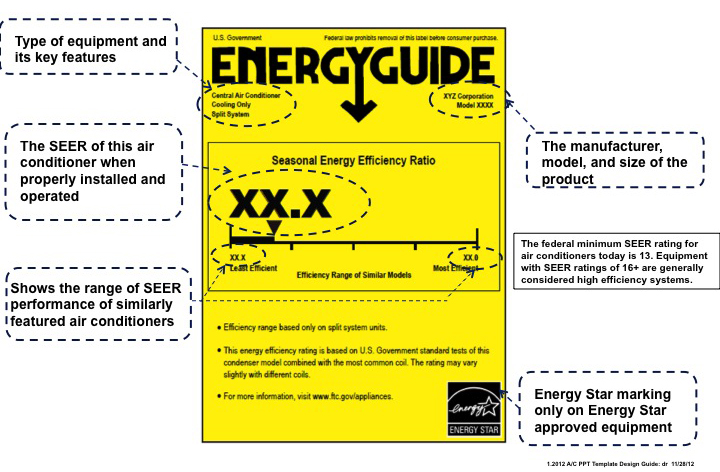
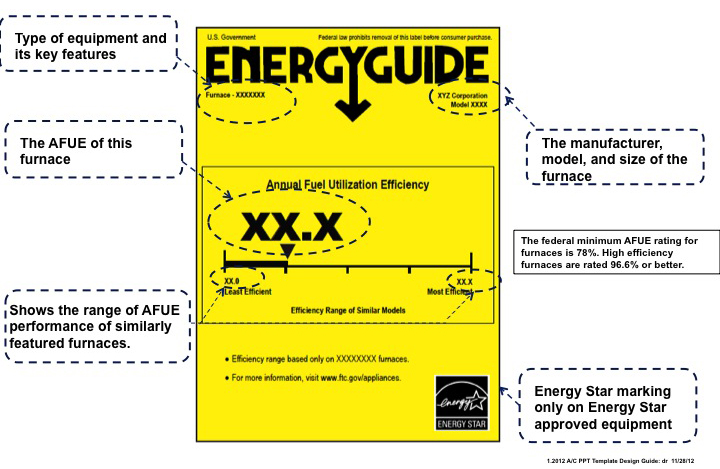
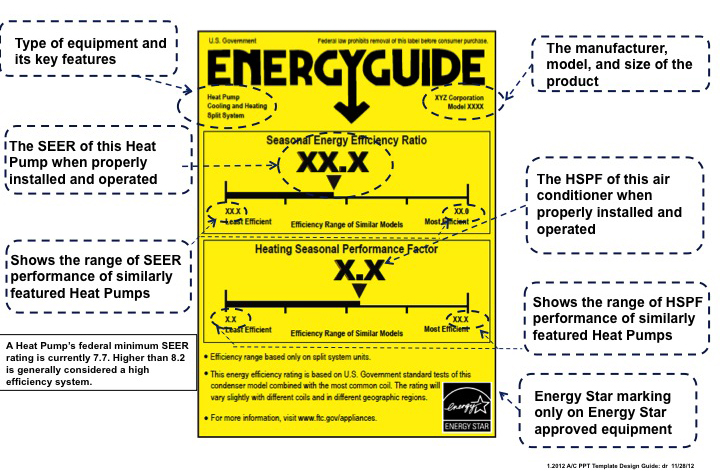
As you begin considering different types of air conditioning equipment, you might notice some yellow tags or labels on your existing equipment or the new equipment being recommended by your contractor.  These energy guides are regulated by the U.S. Department of Energy to ensure that home owners are informed about the relative energy efficiency of the equipment.

Why should you care?

  • These labels can be helpful when you are trying to compare equipment from one manufacturer to the other.
  • Because of these national regulations, you can be confident that the ratings are accurate and enforced through periodic testing.
  • In addition, you can see from the labels below that a helpful measure is shown so you can see how a system’s efficiency rating compares with the lowest allowed efficiency and the highest available.

Some example labels are shown below with explanations of some of the information contained on them.

Air Conditioner Energy Guide Label

Air Conditioner Energy Guide Label

Furnace Energy Guide Label

Furnace Energy Guide Label

Heat Pump Energy Guide Label

Heat Pump Energy Guide Label

Related Articles
HVAC Glossary of Terms

What Is Indoor Air Quality, and Can My AC System Help?

Your air conditioning unit does much more than just push out cool air. Air conditioning systems today, especially high-efficiency systems, help control what’s known as IAQ or “Indoor Air Quality.”  IAQ is a combination of cleanliness of the air (no dust or pollen), humidity, temperature control and odor.

Why is this important?

Indoor air quality can affect your health, comfort and wallet. The following tips can help keep your air clean, fresh and healthy.

1. Change your air filters every three months or at the beginning of every heating and cooling season.

  • Filters keep out dust, pollen, spores and other airborne problems that can lead to health issues.
  • Changing the filter is important because a dirty filter causes less airflow, which makes your system work harder and costs you more money in energy bills.
  •  A dirty filter can also cause your system to overheat or lead to other permanent damage.
  • Check with the original equipment manufacturer’s recommendation for exact timing.

2. Get a High SEER (more efficient) system.

  • To maintain good air quality you need to have longer periods of air circulation allowing the air to constantly pass through the filter.
  • The higher efficiency systems can run at low power for longer periods and keep the air moving in your home. This is simultaneously better for your air quality and is more energy efficient.
  • High efficiency systems (>16 SEER) feature stepped or variable speed modes that change the amount of cooling and air flow that is delivered.

3. Avoid using room air conditioners and ductless systems that don’t have proper air filtration.

  • These systems are ideal for small spaces that require cooling, but if you try to use them for more than just an “add-on” zone to your main system you will likely not be pleased with the overall air circulation and filtration that will result.
  • The key to keeping your air healthy and dust free is to keep it moving through your ducted central air conditioning system

4. Keep humidity low.

  • Humidity causes the air to feel hotter than it really is which usually prompts people to crank up their AC system.
  • Without humidity you would actually be more comfortable at higher temperatures and save money on your energy bill.
  • Similar to an air filter, your central air conditioning system can act like a big sponge to remove the moist, humid air from your home, making it important to run efficiently for longer periods.
  • In addition to comfort issues, high humidity can cause mold to grow which can lead to health problems.

The Bottom Line:

Your central air conditioning system can provide good indoor air quality for many years if you and your contractor select the right equipment, have it installed properly and keep up with filter changes and other basic maintenance.

Did you know your central air conditioner could play such a big role in your health and comfort?

Related Articles
What Are The Benefits of Higher Efficiency Systems
What Is SEER And Why Is It Important