HVAC in the News: Should I really set my thermostat to 78 degrees?

Recently, a number of news articles have highlighted a 2009 recommendation from ENERGY STAR on using programmable thermostat settings to save energy.

While 78 degrees was used as an example on the ENERGY STAR website, a recent statement by ENERGY STAR says, “In order to save energy, the ENERGY STAR website recommends owners of programmable thermostats increase the air conditioning temperature setting by 7 degrees F when homes are unoccupied and by 4 degrees F when occupants are asleep.”

Whether you start at 78 degrees or another temperature that suits your family, bringing the temperature setting up while your home is empty, or while you are sleeping, can save on your energy bills.

Here are a few ways to improve the function of your air conditioning system, which will allow you to set the temperature higher and still be comfortable:

  • Program your thermostat to meet your family’s schedule. Using a Wi-Fi smart thermostat gives you the ability to make adjustments from your phone quickly, from anywhere.
  • Clean any dirt or debris from your outdoor unit
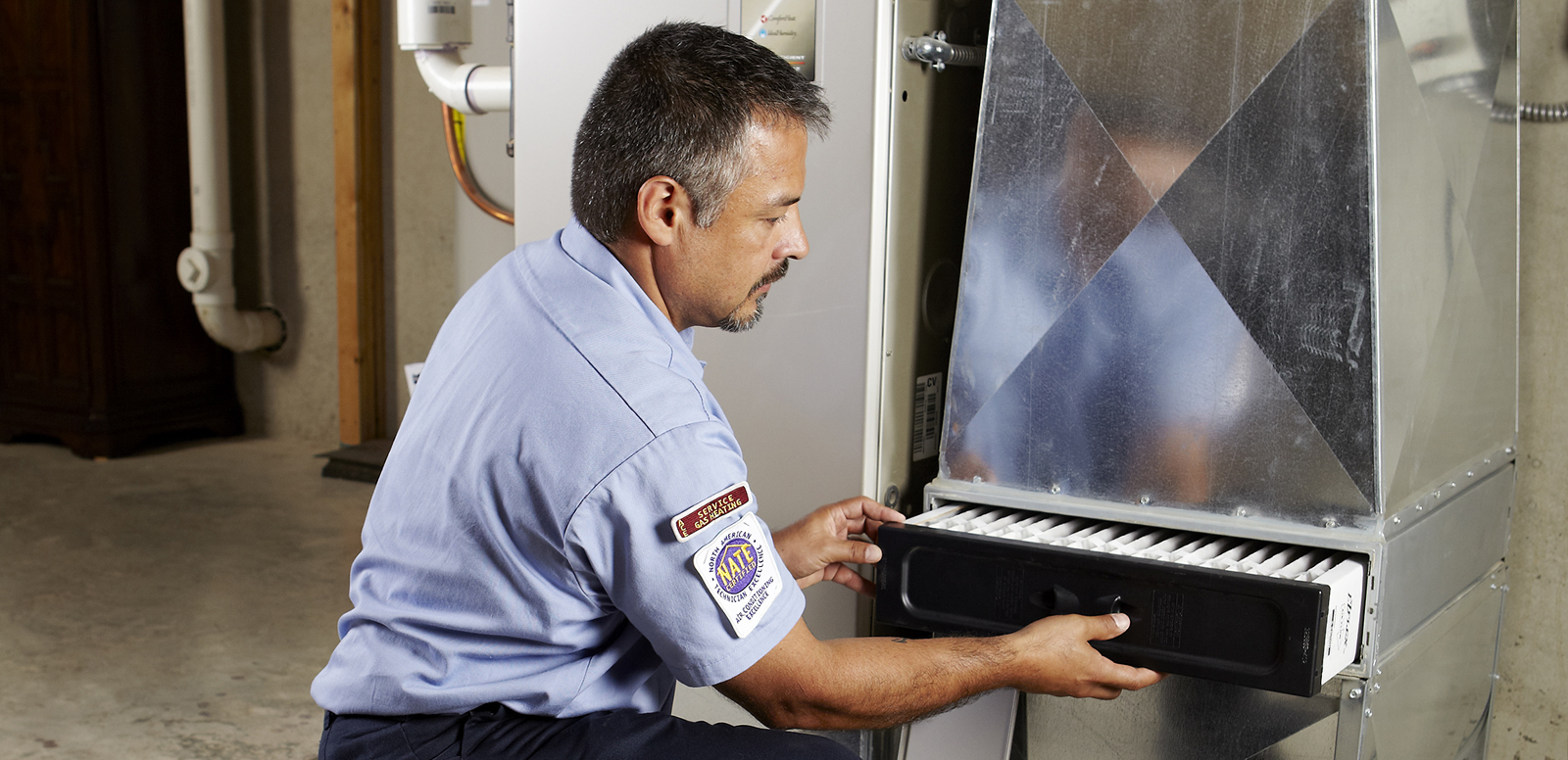
  • Change your air filter. Clean filters can lower energy consumption 5-15%
  • Clean air vents and grilles to ensure they are open and free of dust

See more HVAC Maintenance Tips

If you are in the market for a new air conditioning system, consider the following:

  • Look for a system that offers an important feature called “capacity modulation.” This provides lower energy consumption, improved humidity control, better air quality, and a more comfortable living environment.
  • Ask about the Seasonal Energy Efficiency Ratio (SEER), a ratio of the amount of cooling produced (BTU) divided by the amount of electricity (watts) used. The higher the SEER, the greater the air conditioner’s efficiency.
  • Ask your contractor about maintenance agreements that can keep your system running in top shape and ensure the system is installed correctly to maximize efficiency. New smart maintenance solutions use sensors to let you know how your system is running.

Learn more about Reducing Your Energy Costs with These Energy-Saving Tips

Finally, just to ensure that Americans are clear about the government’s stand on home cooling temperatures, the U.S. Department of Energy issued a statement saying, “It is the position of DOE that Americans should set their thermostats to whatever temperature they choose.”

Sources:

ENERGY STAR programmable thermostats:
https://www.energystar.gov/products/heating_cooling/programmable_thermostats

DOE Statement on Energy Star Thermostat Report:
https://www.energy.gov/articles/doe-statement-energy-star-thermostat-report

ENERGY STAR statement on thermostat settings:
https://fox43.com/2019/08/20/set-your-air-conditioning-to-78-degrees-during-the-day-82-degrees-at-night-federal-agencies-recommend/

CNN: A federal program says you should keep your home above 78 degrees:
https://www.cnn.com/2019/08/20/health/thermostat-recommendations-energy-star-trnd/index.html

Comfort Conversation Checklist

When it comes to enhancing indoor environments, what detail is more important than the quality and comfort of the air in which we live and work?

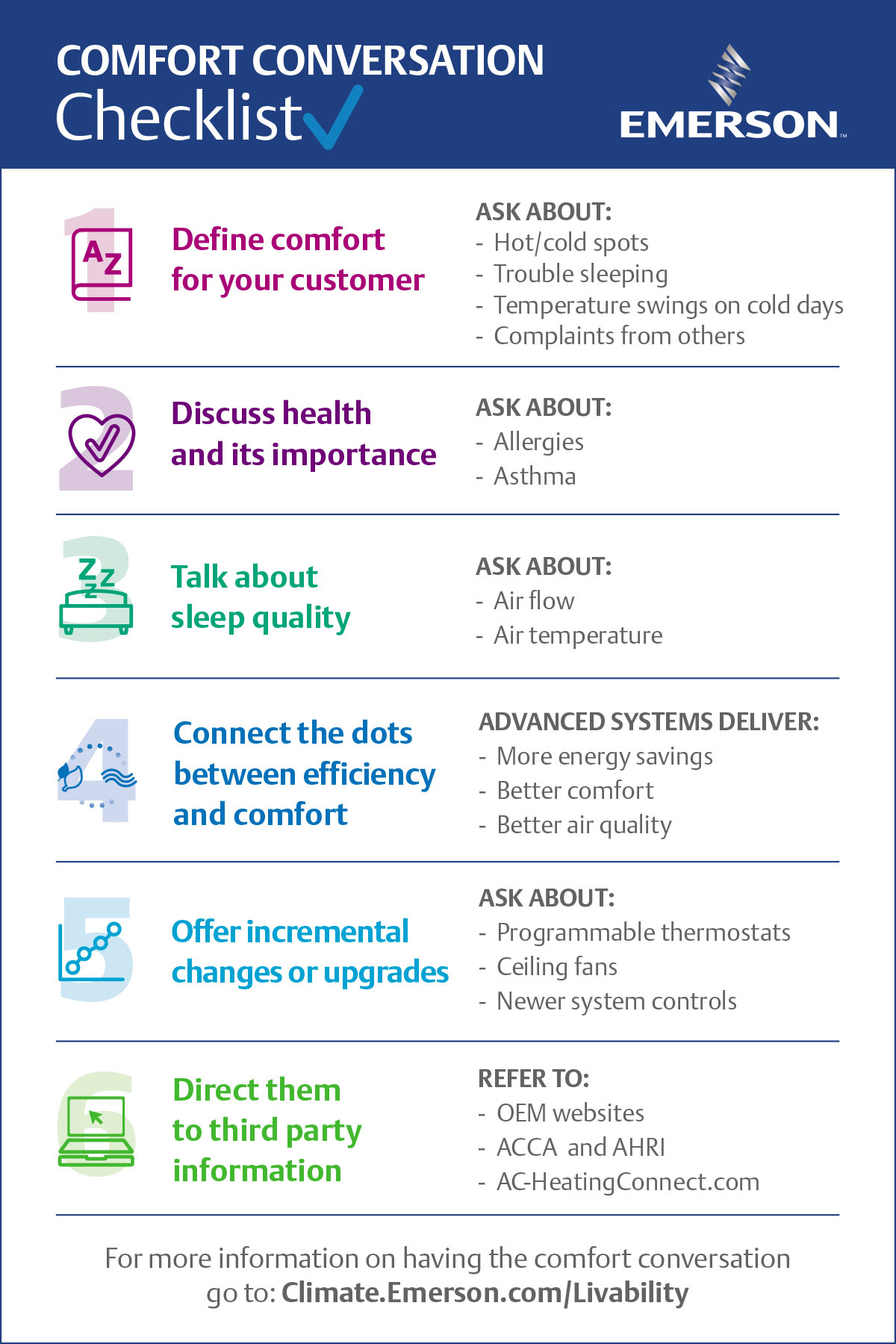
We’ve developed a checklist for contractors to use with customers to guide them toward maximizing comfort, through discussions of health, sleep quality, incremental upgrades, among others. Having the comfort conversation on your next service call, will not only improve your relationship with your customers but will help them view you as a valued consultant.

comfort conversation checklist

To download the checklist, click here.

Back to School: The Contractor’s Guide to Continuing HVAC Education

Do you remember the old-time technicians who would grab the suction to charge while watching for “sweatback”? How about the techs who would laugh at flowing nitrogen while brazing as a crazy idea that they teach in school but that nobody does in real life?

Times are changing, and as refrigerants and technology all continue to evolve, they require us technicians to be on our toes, constantly learning new skills and embracing new ideas.

The idea that you can go through a year or two of trade school and then coast the rest of career without continuing to learn has never been true in the HVAC trade, but it has never been less true than it is today.

I had an ongoing conversation with a top educator and influencer a few months ago on impacts of relative humidity on evaporator coil temperature and some of the nuances in newer high-efficiency equipment. We had a friendly disagreement and went back and forth on the phone and via text until we agreed upon a test we could do to help prove the result.

We built the test rig and performed the test and we learned that both of us were right on some points and wrong on others. It resulted in a lot more clarity on both of our parts moving forward as we work and educate.

Not only had both of us have been through school, but we both also spend countless hours thinking about, testing and training on air conditioning. In this instance, we still needed to pause and learn on something that is probably quite obvious to someone else.

So, if we all accept that continuing education is a huge part of successful outcomes in HVAC what can we do to continue to learn and grow?

Options for Continuing Education

Manufacturer Training

Some of the best opportunities for education involves attending classes from manufacturers where they teach the specifics of their equipment as well as the underlying concepts. I recently attended a Copeland compressors course where the instructor went over common causes of compressor failure and we tore down some semi-hermetic compressors to see the result.

These sorts of classes are often available through your local wholesaler, but you can also attend classes directly from equipment and components manufacturers that will be worth the time even if it requires travel.

Trade Organizations

Both ACCA and RSES offer training classes in person and online. RSES also has regular training webinars or excellent topics and even online classes that qualify for NATE continuing education credits.

There are also many excellent conferences put on by these organizations that have classes and presentations that will really open your eyes to aspects of the trade you may have never considered.

Trade Schools

More and more fully accredited HVAC/R courses are showing up around the country, and many of them have online learning options where you can receive occupational certificates and even Associates degrees. I was speaking to a good friend of mine, Dick Wirz who is an instructor and author and he outlined how achievable and affordable an Associates of Applied Science in A/C & Refrigeration is at his local school, Northern Virginia Community College. While this is a significant time investment it may be worthwhile for some technicians to consider.

Free Online Resources

Over the last five years, we have seen an increase in quality online training content from manufacturers and independent content creators. I created HVACRschool.com and the HVAC School podcast for the very purpose of making quality HVAC/R learning materials more easy to find and consume for technicians. There are many more excellent sources, from “AC Service Tech” on YouTube to the HVAC On Air podcast, and many more. You can find many great resources now that can help keep you up to speed, without needing to look too far. I will caution you to be careful to cross-check things you learn from independent creators, it isn’t all high quality and some of it can even be dangerous.

Books and Bulletins

I will admit I am a sucker for books old and new. Some of the best information I’ve learned came from books that are 20, 50 even 80 years old on the basic concepts and science of our trade. I keep my eyes peeled on eBay for these old books and snatch them up whenever I can.

There are some excellent modern books like the RACT (Refrigeration and Air Conditioning Technology) manual, Fundamentals of HVACR, Refrigeration for Air Conditioning Technicians and many books published by ESCO. These books tend to be in-depth, deep dives into the trade and if you have never worked through one, I would highly suggest it.

Some of my favorite light reading comes from manufacturer technical bulletins and one of the very best apps on the market for technical bulletins is the AE Bulletins app (available on Google Play and Apple) from Emerson. Just to try it out, go ahead and download the AE Bulletins app and read AE17-1260 on compressor heating. I guarantee you will learn something new and relevant.

Habits of Continued Learning

I will confess there was a time a few years back where I got a bit bored and burned out. Too many long hours and too much of the same issues over and over…or so I thought.

As I started doing more training, I began paying more attention to little details, reading manufacturer data and bulletins and attending more classes I realized that there was a lot I missing and taking for granted. I’ve learned that the best way to stay engaged is to share what I’m learning with other techs and apprentices. My first A/C instructor used to say that teaching was the best way to learn and I’m finding that to be true over and over again.

If you want to be able to explain how everything you work on works to an apprentice, you will inevitably find that there are gaps in your understanding that need to be filled. This is the perfect opportunity to pause and take the time to learn something new.

More than anything you will need to stay in touch with your enjoyment and curiosity around the work. If you enjoy learning, then learning will never be a burden and often all it takes is a little focused attention to rekindle that flame of curiosity.

What is Your HVAC System’s Blood Pressure?

HVAC Static Pressure

We all know that blood pressure is a common indicator of a person’s health. If their blood pressure is within an acceptable range, they are healthy.  If their blood pressure is too high, there is often an issue restricting proper blood flow.  Your HVAC system has a similar reading that can ensure proper airflow, this reading is referred to as static pressure.

Static pressure in an HVAC system is a measure of the resistance of airflow through the ductwork, filter, coil, and furnace.  Much like your body, when the resistance to flow increases, your system must work harder to keep up.  Working the system harder leads to premature failure. The good news? This can be avoided with proper knowledge and maintenance.

What factors lead to improper static pressure:

  1. Ductwork: Improperly sized or improperly installed ductwork can lead to an increase in static pressure. Ductwork can be undersized–increasing pressure–or oversized–having too little pressure. Improperly installed or designed ductwork that has too many bends, lack of support, or ductwork that is collapsing results in additional resistance to airflow.  Return duct sizing should not be overlooked, as it can also affect static pressure.
  2. Filters: The size and type of filter used in an HVAC system affect the static pressure. A typical 1” pleated filter adds more static pressure than a 4” pleated filter.  A 4” pleated filter has a larger surface area giving the air more ways to pass through without restriction.
  3. Evaporator coil: If the evaporator coil is dirty and plugged with debris, a restriction to airflow will occur resulting in an increased static pressure.

What are the results of improper static pressure?

  1. Temperature variance throughout your home. You may notice that some parts/rooms in your house feel cold or warmer than other areas depending on the season.
  2. The HVAC system can experience component failures. Typically, blower motors and components associated with the blower motor circuit are the first things to fail.

How do I test for Static Pressure?

As a homeowner, we need to leave this test to the contractors.

What will a contractor do to complete this test?

With the fan operating on the furnace, the contractor will drill a small hole in the return duct before the filter, and another hole in the supply ductwork after the evaporator coil.  A manometer is used to measure the difference in pressure.  This measurement is then compared to the rating on the blower motor.  If the system is found to be operating out of the suggested range, your contractor should discuss options to correct the issue.

Measuring static pressure will allow your contractor to identify a problem before a larger failure occurs.  When you have your HVAC system serviced before the start of a new cooling or heating season, have your service contractor verify your HVAC system blood pressure, static pressure, is within an acceptable range.

Learn even more about HVAC Static Pressure from PV Heating & Air.