Advice from the Field: Contractor Q&A

We asked two licensed contractors to share some advice and best practices on things homeowners can do to prepare for a contractor visit, maintain their system, and have an overall positive experience with their air conditioning and heating system.

The contractors contributing to this article are Ray Isaac, of Isaac Heating and Air Conditioning in Rochester, NY, and Dave Hutchins of Bay Area Air Conditioning in Crystal River, FL.

Q: How can a homeowner find a good contractor?

A: (Dave) There are obviously referrals from neighbors, and people trust who they know, but just make sure who they are recommending is capable of providing the service you need. Installing ducts is a lot different than replacing a compressor. Also, be sure to go with a licensed and certified contractor.

(Ray) I tell people that referrals are good, but also look to see which contractor is active in their local community.  A company sponsoring a little league team or a cancer walk is going to be more committed to good service than a general name in the yellow pages. Above all else though, you want someone who has the latest certifications from NATE (North American Technician Excellence) or similar organizations.

Q: What should a homeowner not attempt to fix themselves?

A: (Dave) Other than basic maintenance, please don’t fix anything.  Today’s equipment is very sophisticated with electronics and damaging it can cause an even more expensive problem.

(Ray) Basic maintenance items like changing the air filter, or trimming brush away from the condenser unit is fine, but anything else you should let a professional handle.

Q: What other general advice can you give?

A: (Ray) If you’re looking online for a contractor it’s a pretty good sign you aren’t maintaining your system enough.  The best time to find a contractor is before you need one.  Call and ask for a system checkup and find a contractor you can trust. You know where you get your car’s oil changed and you should also know who to call for your AC maintenance.

(Dave) If you’re shopping for a contractor and don’t have an immediate need, call them on a Sunday afternoon and see what kind of response you get.  Many advertise weekend and 24-hour service, and it’s best to test that out before you’re in a crisis.

Have a contractor you think we should talk to?  Let us know!

Related Videos
What’s a good contractor worth?
Right questions to ask your HVAC Contractor
How to Prepare For New Regional Efficiency Standards

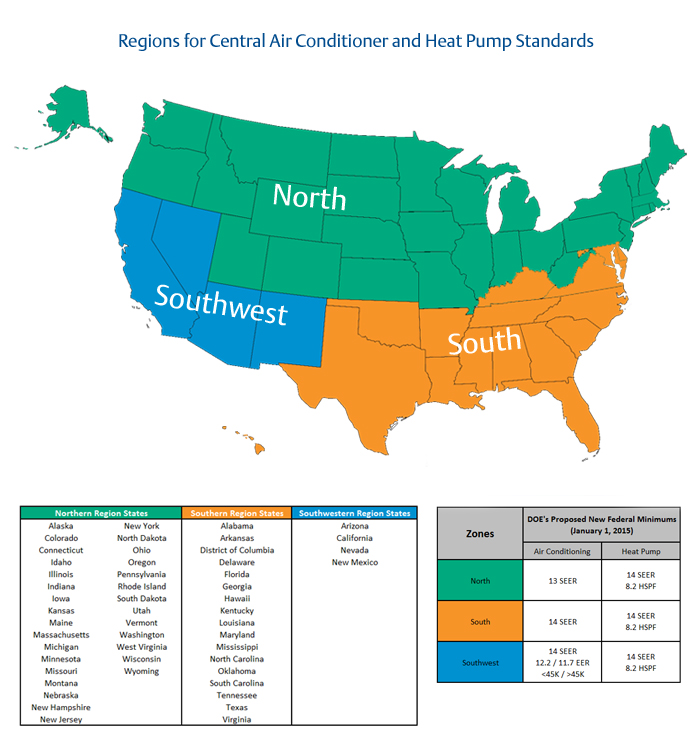
The Energy Independence and Security Act of 2007 provided for the next round of government regulated standard efficiencies allowed for air conditioners sold in the Unites States.  These new standards will go into effect on January 1, 2015.  What is unique about these new efficiency standards is that they have allowed for different standards for various parts of the country rather than having just one national standard.  Similar to the standard efficiency increases experienced in 2006 when the minimum went from 10 SEER to 13 SEER, this regulation will apply to all equipment, whether it is being installed in an existing structure as a system replacement or in a new structure.

Here is a summary of what you need to know about the new regulations (also, see the map and table below):

Northern States – Minimum 13 SEER air conditioning remains the standard, but heat pumps go to 14 SEER and 8.2 HSPF.

Southern (Southeastern) States – Minimum efficiency goes to 14 SEER for both air conditioning and heat pumps and 8.2 HSPF for heat pumps.  The 8.2 HSPF/14 SEER heat pump rating will become a national standard.

Southwestern States – Minimum efficiency also goes to 14 SEER for air conditioning, but there is a new standard for EER that will call for 12.2 EER for systems less than 45,000 BTUH and 11.7 EER for systems over 45,000 BTUH. Heat pumps require national standard of 14 SEER and 8.2 HSPF

What can you do?

Here are few things you can do to prepare for these new standards:

  • Stay in touch with us via this site or our other contractor support sites as we get closer to the implementation date
  • Watch for OEM’s to change their product offerings to be ready for these new standards.  Emerson is working directly with all the major OEM’s to help them be ready, but each one may have a slightly different approach to meet the needs of three different regions.
  • Train your employees on the latest in new equipment which will feature electronic controls, variable speed blower motors and more.  You will need to stay current through Emerson training or through your OEM’s training.

What questions do you have about the regulation changes?

Related Articles
How to Speak with Customers About Refrigerants

What Does a Contractor Evaluate When Recommending a Solution?

Good contractors will do a lot more than ask you how much you want to spend on a new system.  When selecting the best air conditioning and heating system for your needs, contractors consider:

1. Where you live and what the climate is like.  The contractor will determine how long the cooling and heating seasons are and if there are any other “regional” issues to deal with like excess humidity and air quality due to pollen or other airborne contaminants.

2. How important is comfort?  The easiest thing a contractor can do is sell cool air in the summer and hot air in the winter. What they will try to find out is how comfortable you want to be.  Comfort, as we will define it, is largely achieved when you don’t notice when your heating or cooling system is working.  If you feel too hot at night, have cold or hot spots in the house, or wake up to a freezing home, you’re not comfortable. Higher efficiency systems are able to do things like moderate temperatures very precisely and remove indoor humidity which all contributes to a more comfortable house.  If you aren’t asked about comfort, be sure to bring it up!

3. What are your electricity and gas costs?  There are ways to heat or cool that involves either burning fossil fuels or using electricity. A contractor can explain which solution will be most efficient and be the best match for your desired level of comfort. This will save you money over the life of the system.

4. Are you more concerned with initial costs or total cost of ownership?   High efficiency systems tend to have higher upfront purchase costs, but will usually save you significant money over the life of the system.  Even though you may find rebates and incentives on websites like www.dsireusa.org, upfront costs might be too high for your budget.  Your contractor will work with you to match the most efficient system to your budget.

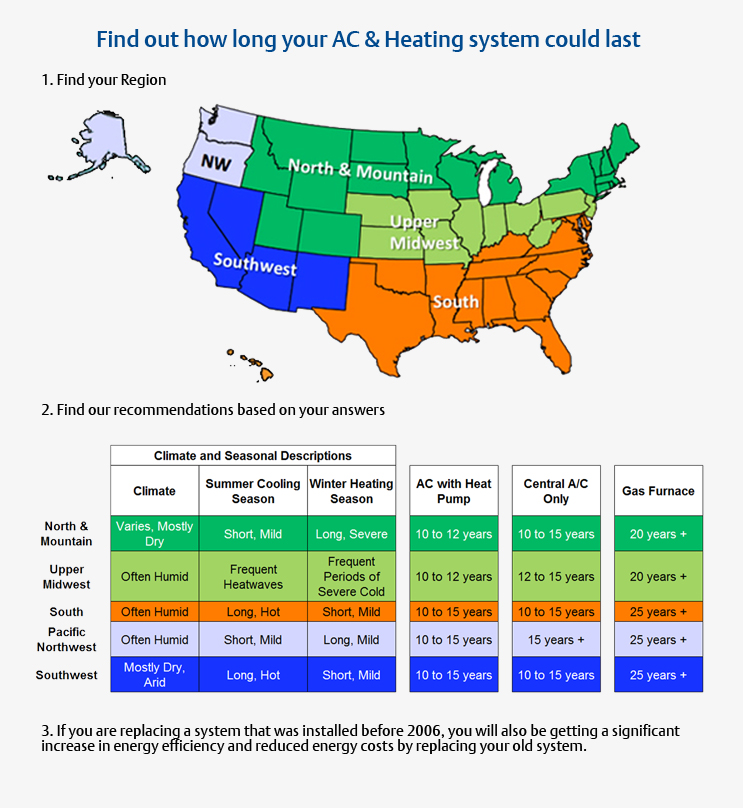
The following chart helps illustrate how you and your contractor can decide which system is right for you. Tell us: before coming to this site did you think of air conditioning as just cold air, or did you consider comfort aspects like humidity and temperature variability?

Find the Best Air Conditioning and Heating System For Your Region

Related Articles
Comparing Apples to Apples: Understanding Government Ratings
Comparing Options for Cooling Your Home

Repair or Replace? What Should I Do with My Old Air Conditioner?

It is a myth that age alone can make a system fail, so be wary of anyone that tells you otherwise. If you are considering repairing or replacing your old unit, you need to look at how often you run your system.

Run-time for your system is based on:

  • Where you live
  • What type of system you have
  • How often you choose to run it

Some modern systems have run-time monitors that keep track of this information for you kind of like an odometer on your car. Until those become widely adopted, check out these approximate ranges for what you might expect:

Warm States – If you live in an area of the country that experiences long summer cooling seasons (8-9 months or more) then you likely have logged a lot of hours on your system.  As a general rule, you can expect to have a system that runs effectively for about 10 to 15 years based on normal usage.  If your system is a few years younger than this you should favor repairing it instead of replacing.

Moderate States – If you live in the Midwest or Northeast where the cooling season runs from about May to September, you might be able to get a few more years out of your air conditioning system – approximately 15-18 years based on normal usage.

Cold States – If you live in the North, such as Minnesota, Maine, North Dakota, etc., you could have a central air conditioner that has seen very little run time and could be worth repairing even if it is more than 20 years old.  Run-time is the main factor, not age, and your contractor can help you make this determination.

Heat Pumps – If you have a heat pump that means your system is used for both heating and cooling and has had almost twice the run time of an air conditioning only system.  You can almost divide the above times in half to determine how long an older heat pump system might last under normal usage.

Bottom Line: Air conditioning and heat pump systems do not simply go bad because they are old.

  • These are sealed systems and if you maintain them properly, change the air filters and have periodic maintenance and cleaning done by a contractor, they should easily run well throughout their useful life.
  • If the system is not maintained or has experienced a lot of run hours in extreme conditions it might not last as long as you would expect.
  • You should always check your warranty before you decide whether to repair or replace your system.
  • Over the past few years, OEM system warranties have been extended to cover a lot of repairs – even out to ten years or more.
  • Talk to your contractor about your options and make the best decision for you.

Have you been told your system needed to be replaced simply because it was old?

Related Articles
Repair vs Replace: How to Talk to Homeowners

Repair vs Replace: How to Talk to Homeowners

Eliminating Doubt

The decision of whether to repair or replace an entire HVAC system is a dilemma contractors are often asked about by customers.  On average, people will likely purchase four new cars before they are faced with a major repair or the need for a new system.  Because of this, customers can often be skeptical of your judgments about how long a system should last – and the question is complicated and hard to explain.  One thing customers need to hear is that it usually depends on how frequently the system has been used – not just how old it is.  If your customer has a heat pump in the Southeast or upper Midwest then they have one of the shortest-lived systems available.  This is not because it was designed poorly or installed incorrectly.  It is simply a factor of running through its usable life.

How We’ve Helped

To help you with these types of conversations, we’ve gathered information regarding the “useful life” of various HVAC systems in various environments.  We developed this table based on our experience with average HVAC run times and the anticipated use each system will experience in its lifetime.  The assumption is that each system was installed and maintained properly.

Tip: You’ll also note we added a few comments about the benefits consumers will experience from upgrading to a newer system with the increases in standard minimum efficiency ratings we have experienced since 2006.  If the system is much older than that the efficiency improvements are greater and probably should be replaced on this basis alone.

We hope this helps you explain the average life expectancies of various systems to your customers.  If so, we’d love to hear their reactions to seeing the data!

repair-replace-region-chart

To download the chart in PDF, please click here.

Related Articles
Repair or Replace? What Should I Do with My Old Air Conditioner?
Be Cool and Avoid Disaster: Six Pitfalls to Avoid When Buying a New AC or Furnace


How to Select the Right HVAC Contractor

The choice of a contractor is an important decision and shouldn’t be made quickly or without due diligence. Finding a contractor who can become a real partner in the maintenance of your home’s HVAC equipment can be invaluable for years to come.

Where to find HVAC Contractors?

It’s always a good idea to ask your friends and neighbors if they have recommendations for contractors they like and trust. Many contractors rely on positive word of mouth to help grow their business, so if someone you trust is willing to back them, chances are they will do good work. There are also several online research tools, such as Angie’s List and association sites such as www.acca.org that provide listings of licensed and reputable contractors.

What to Look For?

Once you’ve identified a contractor, here are five helpful things to look for during your first meeting to make your choice a little easier. We recommend talking to at least three contractors to find the best fit for your situation.

  1. Do they know your system? The contractor needs to have the proper permits, and have experience with the kind of system you are using or want to install. Also make sure to get bids in writing and get guarantees on bids and work to be performed.
  2. Is the contractor fully licensed? Licensed HVAC contractors are tested on a wide variety of areas, from basic refrigeration components to piping. Using a licensed contractor will not only protect your investment, it will protect you against liability issues. Reputable contractors won’t hesitate to show you their credentials if you ask.
  3. Do they understand the big picture? A good contractor will be familiar with advances in technology, in order to better recommend choices to customers. You’ll want to consider environmental issues, safety, and money-saving options. In addition to quality equipment, you’ll need help with installation decisions.
  4. Do they recommend efficiency improvements? Did you know good contractors can also inspect your ductwork, change air filters and clean off your condenser unit? Many times simple maintenance issues can lead to significant cost savings. Go with a contractor that wants to help you understand maintenance and the right way to improve your cooling system
  5. Do they listen to you? A good contractor will take the time to fully answer your questions and make sure you understand their recommendation. You don’t want someone who is trying to rush off to the next job leaving you confused.

What things do you look for when hiring a contractor?

Related Articles
Advice From the Field: Q&A with Contractor

Related Videos
What’s a good contractor worth?
Right questions to ask your HVAC Contractor

Why Refrigerants Matter?

Refrigerant Overview

The substance that makes your heat pump and air conditioner work so well is its refrigerant. It is a gas that when compressed enables the transfer of hotter or cooler temperatures. In recent years, the most common type of refrigerant has been a hydrochlorofluorocarbon (HCFC) known as R-22. In 1987, an environmental agreement between developed nations known as the Montreal Protocol was established. It called for the phase-out of HCFC’s and chlorofluorocarbons (CFC’s) which are known to damage the ozone layer and contribute to global warming. As a result, the manufacturing of R-22 systems was stopped on Dec. 31, 2009.

Homeowner Impact

If you have a system that uses R-22, it can still be serviced and recharged with R-22 until 2020. The most popular alternative to R-22 is a refrigerant known as R-410A. It is currently sold under a variety of brand names such as GENETRON®, SUVA 410A®, Forane 410A®, and Puron®.

Because of the R-22 phase-out and the introduction of newer R-410A systems, the availability of R-22 is decreasing and the price is increasing. In fact, depending on the age and condition of your system, it could actually be more economical, over the life of the system, to replace it with an R410-A unit. The reason for the R-22 to R-410A shift was largely an environmental one. However, R410-A systems are more energy efficient than older models, resulting in monthly energy cost savings of 10%-40%.

Important Dates:

  • January 1, 2010: The Montreal Protocol does not allow manufacturers to produce new HVAC systems containing R-22.
  • January 1, 2015: The U.S. must reduce its consumption of R-22 by 90%.
  • January 1, 2020: Chemical companies will no longer be allowed to manufacture R-22 to service existing systems.

If you have to purchase a new system you need to get one that uses a refrigerant other than R-22. Tell us if you’ve learned something else about why refrigerants matter!

Related Articles
What’s the Difference Between R-22 and R-410A?
HVAC Glossary of Terms

Simple Ways to Extend the Life of Your AC and Heating System

For the most part, residential air conditioners and furnaces don’t require constant upkeep to maintain good working order. However, there are certain things you can do to keep your system running optimally throughout the year.

  1. Change air filters – it’s always best to follow the manufacturer’s recommended timetable for changing filters. If you can’t find their recommendation, a general rule is to change your filter every three months or at the beginning of every heating and cooling season. In addition, ensure the filter is sized correctly. It should fit snuggly, but you shouldn’t have to force it into place.
  2. Keep the outdoor unit clean – Most residential systems have an outdoor condensing unit, which looks like a cube with metal coils around the outside. The coils need to be free of debris, which can easily accumulate through grass clippings, falling leaves or dust. To clean, simply hose off with light pressure.
  3. Let the air flow – To maintain a reliable static pressure and reduce moisture buildup which can lead to mold, keep all vents open regardless of whether or not you spend time in a particular room. Similarly, do no close doors to rooms you don’t frequent as the home needs to have open air flow.
  4. Clean duct grills – Once a year it is important to clean the vents and grills at the opening of each duct in every room. Simply lift the grill out of the floor and wipe with a rag or use a vacuum to remove dust and debris.
  5. Keep discharge pipes open – the discharge pipe, usually a PVC pipe, running outdoors from your HVAC system needs to be kept clean and free of debris. During the winter months it can easily become frozen over with ice or buried in snow drifts. A stopped up discharge pipe can lead to expensive repairs. Your AC unit also has a drip tube that runs to a drain in the floor. This needs to remain open and clear to prevent backup within the system.

A little preventative maintenance will go a long way in saving you money down the road. If you feel that you’re not capable or qualified to perform the tips listed above, it’s always best to call a certified contractor.

How often do you perform preventative maintenance?

Related Articles
Save Money with These Five Home Energy Efficiency Tips

Don’t Let Hidden Humidity Cost You Money in The Heating Season

Humidity Overview

Relative humidity refers to the percentage of water vapor present in the air at a given temperature. For example, when the relative humidity is 50 percent, the air is holding half the moisture it’s capable of holding. The air’s ability to hold water decreases as the temperature goes down and increases as the temperature goes up.

Humidity in Action

On a cold winter day the outside temperature might be 10° F with 70 percent humidity. When the cold outside air creeps into your home, and your furnace heats it to 72° F, the air expands. While the moisture in the air remains the same, the relative humidity is significantly reduced. This means that the outside cold air with 70 percent humidity has an indoor relative humidity of only 6 percent. That’s more than four times drier than the Sahara Desert!

The dry interior air will steal moisture from wherever it can find it, including your body. As moisture evaporates off your skin, you feel cooler. When you feel cooler, you tend to turn up your thermostat and the cycle continues, which becomes an expensive habit given the high cost of heating.

How to Protect Yourself

To combat this problem it becomes essential to maintain indoor relative humidity at a comfortable 35 to 45 percent range. This minimizes the air’s need to replenish moisture and little or no evaporation from your body takes place. As a result, you can actually turn down your thermostat about three degrees and still maintain your former level of comfort and warmth, all while saving on energy costs.

There are many ways to humidify the air in your home. You can use a single room humidifier or you can install a whole home humidifier connected directly to your HVAC system. These humidifiers work automatically to ensure the air in your home is at peak humidity levels to keep you comfortable. Typically, these whole home systems cost between $300 and $600, but the energy savings year over year make it a smart investment. It is also recommended to use a more accurate digital thermostat with humidity control to automate the process and keep your system at peak efficiency.

In addition, consider upgrading to a system with a variable speed or modulated compressor. These compressors are able to adapt to the cooling demand of your home by running on more or less power as the situation demands. They use less energy and because they run for longer periods of time, albeit at a lower speed, they are able to do a better job of controlling relative humidity within the home.

Ask your contractor about humidity in your region and the best way to protect yourself.

Do you feel extra thirsty during the winter months? What other ways do you notice humidity affecting your comfort at home?

Related Articles
Is Your Fireplace Burning Through your Energy Bill?

What is SEER and Why is it Important?

When it comes to cars, we evaluate efficiency based on miles per gallon. With residential air conditioning, efficiency is measured by SEER, or Seasonal Energy Efficiency Ratio. In effect, the higher the SEER rating, the more efficient the system will be. The U.S. recently adopted minimum SEER requirements, currently 13, and any system over 16 SEER is generally considered high efficiency. A SEER rating over 20 is in the highest efficiency group.

If you’re confused about why efficiency matters, one good reason is cost. A system with a SEER rating of 13 will have to use more energy than a system with a SEER rating of 18. Those energy costs can really add up over the life of your system – up to several hundred dollars per year in savings. A higher efficiency system, because it uses less energy, is also a more environmentally friendly option.

There are a few things you can do to maximize the SEER rating of your air conditioner. These include:

  1. Change the air filter
    A dirty filter will restrict air flow, making your system work much harder, using more energy and costing you more money. Check the filter regularly and follow the manufacturer’s recommended schedule for replacement. A good general rule is a change every three months or at the beginning of every heating and cooling season.
  2. Seal the ducts
    Air that escapes through leaks in a duct increases the amount of time your air conditioner must run to reach your desired level of comfort. Sealing the ducts can improve your efficiency by as much as 20 percent or more. You can seal a duct using duct sealant such as mastic or a metal-backed foil tape.
  3. Use a programmable thermostat
    setting your thermostat to only heat or cool your home during the hours when you’re there can save several hundred dollars per year in energy costs.
  4. Keep the outside unit clean
    any debris built up on the outside coils of your condenser unit will make the system work harder to deliver air flow. Wash off the outdoor unit with a hose on light pressure.

When making any of these decisions it’s always best to consult with a reputable contractor who can explain the various options and walk you through what makes sense for your home. To help locate a reputable contractor visit an industry association site such as www.acca.org.

Related Articles
Comparing Apples to Apples: Understanding Government Ratings